“Is any among you sick? Let him call for the elders of the church, and let them pray over him, anointing him with oil in the Name of the Lord … Therefore confess your sins to one another, and pray for one another, that you may be healed.”
 In this passage from the Epistle of Saint James, we have scriptural warrant for two of the seven Sacraments, namely Holy Unction, also known as the Anointing of the Sick, and the Reconciliation of a Penitent, also known as Confession.
 In my Confirmation Classes for young people, I pass out a sheet containing a table listing all seven sacraments down the left side, and a series of columns with boxes to fill in the distinguishing markers or characteristics of each sacrament: its outward and visible sign, its inward and spiritual grace, who can administer it, who can receive it, whether it’s repeatable or unrepeatable. More generally, we distinguish between the Sacraments of Initiation – namely Baptism and Confirmation – the Sacraments of Lifelong Vocation – namely Holy Orders and Holy Matrimony – and, of course, the Sacrament of our spiritual food and drink, the Holy Eucharist.
The remaining two Sacraments, the Anointing of the Sick and Confession, are what we might call occasional Sacraments, even though some people receive them more regularly and frequently than others. Nonetheless, Holy Mother Church makes them available to her children on an as-needed basis, when we’re sick or ill, or when some sin or wrongdoing is weighing on our conscience.
The Sacrament of Unction used to be known as “Extreme Unction” because for centuries people normally received it only in extremis, when death was imminent. It was and still is an integral component of the Church’s Last Rites. But one of the fruits of the Liturgical Renewal of the last fifty years or so has been the recovery of Anointing as a repeatable Sacrament of which all Christians may avail themselves, in times of sickness or injury, for purposes of healing. Here at S. Stephen’s we offer the Anointing of the Sick weekly as part of our Wednesday evening Mass.
It’s important to be clear what Unction is and what it is not. Some Christians do have a gift for what is known as prayer for healing. Typically, someone with this gift will lay hands on a sick person and pray – and sometimes with dramatic results that can only be called miraculous. And I don’t want in any way to dismiss or denigrate that type of spiritual gift or that type of prayer. But it’s not the same thing as Holy Unction, which can only be administered by a priest, using oil that has normally been blessed by a bishop. The efficacy of this Sacrament does not depend upon the personal spiritual gifts of the priest administering it, for it is the Church’s Sacrament and does not belong to any individual person; and it is Christ himself who acts through it to bring healing to its recipient.
Now, a basic principle of sacramental theology is that the Sacraments always effect what they signify. And in some sense, when you receive Anointing for healing, then you really are healed even if there’s no immediate physical cure of your illness or injury. The reason is that when we get sick, we need not only physical healing but also spiritual healing. Above all we need restoration of our relationships with God and with one another. How often, when we’re not feeling well, let alone undergoing pain and suffering, do we become miserable and grumpy, tempted to feel sorry for ourselves and to indulge in self-pity? (I speak as the chief of sinners here, by the way.) Illness has the capacity to bring out the worst in us because deep down, often at a subconscious level, it reminds us of our frailty, vulnerability, and mortality. We need spiritual healing so that illness and injury will become not an occasion of sin, but rather of repentance, humility, forgiveness, reconciliation, and hope in God’s promises.
For this reason, James writes, “the prayer of faith will save the sick man, and the Lord will raise him up; and if he has committed sins, he will be forgiven.” None of this need involve a physical cure. Sometimes it does, sometimes it does not. The salvation, the raising up, and the forgiveness of which James speaks may be in this life or in the next. The Sacrament of Anointing brings healing in that it brings us into the presence of God, who even in the midst of present pain and suffering takes away all fear, resentment, and self-pity, and fills us with quiet confidence and even joy.
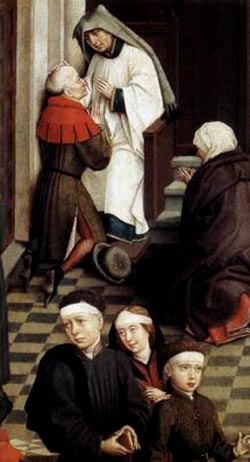 The Sacrament of Anointing is closely related to the Sacrament of Reconciliation, or Confession. As some of us may have heard at some point, the Anglican approach to confession is summed up in the threefold tag: “None must, some should, all may.” None must: in the Episcopal Church we don’t normally require anyone to make their confession as a condition of membership in good standing. Some should: nonetheless, to paraphrase the old Prayer Book Exhortation, if anyone cannot quieten his own conscience, let him come to a discreet and learned minister of God’s word, and there open his grief, that he may receive the spiritual benefit of ghostly counsel and absolution. And all may: It’s an incomparable privilege of membership in the Church Catholic that at any time you want you can ask a priest to hear your confession; and many people do, not only to quiet their consciences when they’ve committed serious sins, but also as a spiritual exercise and an aid to spiritual growth, providing a periodic occasion for what the Twelve-Step programs call a “searching moral inventory.”
This week, the Bishop-Elect came to see me here at S. Stephen’s, and of course I took the opportunity to give him the tour of the church. He was delighted to see the confessionals at the back of the Lady Chapel and nave, and he remarked that he often told people that, yes, there are Episcopal churches that do have confessionals and now he can look forward to having such a church in his diocese. He seemed a little disappointed when he asked whether we have regular weekly times for confession and I said no, but he was pleased when I told him that we do schedule confessions and get a good number of customers at certain times of year, such as our Advent and Lent Quiet Days and Good Friday.
So, reflecting on the words of Saint James in today’s Epistle, I commend both the Anointing of the Sick and Confession as sacramental means of grace that Christ makes available to us in his Church for the purposes of healing and forgiveness. It is Christ himself who comes to us in and through these Sacraments as our healer and reconciler. And it rejoices his Sacred Heart when we turn to him in repentance and faith, availing ourselves of these wonderful gifts in which he so freely and generously gives us Himself.

