 |
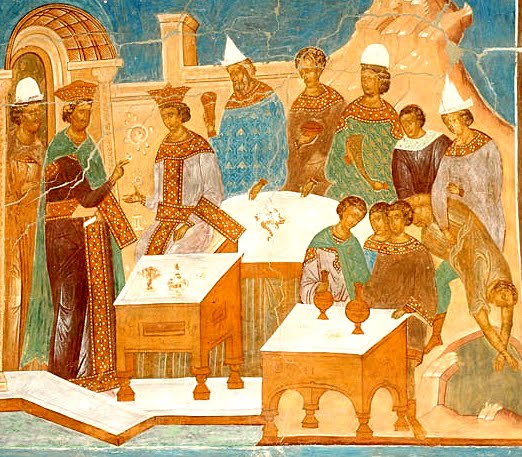
| Parable of the Wedding Feast, Russian, 14th Century |
Matthew 22:1-14
Most of us are familiar with the parables of grace. By means of various images and figures they depict God as infinitely loving, forgiving, and willing to go to any length necessary to rescue and redeem the lost: for example, the father in the Parable of the Prodigal Son; the Shepherd who goes in search of the one lost sheep in the wilderness; the woman who sweeps her house up and down looking for a lost coin. These images of a loving and gracious God resonate well with us.
But then, in a number of other parables, the happy ending is tempered by images of judgment, condemnation, and punishment. The goats are separated from the sheep; the tares are winnowed from the wheat; and, in today’s Gospel, not only are those who refused to come to the marriage feast put to the sword and their city put to the torch, but even one of the guests gathered in at the last minute is found lacking the required wedding garment and cast into outer darkness.
One strategy that many people adopt in reading the Scriptures today is simply to pay attention to the passages that they like and ignore the ones they don’t like. But that won’t do. If the Bible really is God’s Word as we claim it to be, then we need to wrestle with all of it, not just the bits that appeal to us. We need to take seriously not only the parables of grace but also the parables of judgment.
An ancient technique of interpreting biblical stories is to distinguish the different layers of meaning in the text. The first and most obvious layer is the literal meaning. But at the level of literal interpretation, the parable in today’s Gospel presents us with some details that are puzzling, to say the least.
When the king sends his servants the second time to extend the invitation to his son’s wedding feast, those invited seize the servants, abuse them, and kill them: an extreme way to refuse a dinner invitation. Then it gets totally bizarre. While dinner is getting cold, the king sends his troops to destroy the murderers and burn their city. Declaring that those originally invited were not worthy, the king sends his servants out into the streets to gather in everyone they find. And so we have the surreal picture, almost a dreamscape, of a banquet hall filling with guests, against the backdrop of a night sky lit up by the flames of the burning city in the distance.
For me, the strangest detail of all has always been the man with no wedding garment. After all, these guests have just been gathered from the streets into the wedding hall with no warning. How can anyone expect them to be properly dressed for a wedding?
Some recent commentators suggest, however, that according to the customs of the ancient world, the details of the parable are not as strange or absurd as they first seem. Great banquets and feasts usually didn’t happen at a precise date and time, announced in advance. Guests normally declined the first invitation, because it merely served as a warning that the preparations were under way. So it was customary to send a second invitation when the feast was finally ready.
Those invited to the marriage feast of the king’s son were almost certainly the nobles and aristocracy of the kingdom. For them, to turn down the second invitation to such a great state occasion was an act of defiance bordering on treason. Their killing of the king’s servants suggests that this is precisely what they were about: rebelling against the authority of both the king and his son. In this light, sending troops to burn their city was a completely plausible response to a political challenge. In the ancient world, this sort of thing happened all the time.
For the original audience, only two features of the story would have come as a surprise. The first was the king’s sending his servants into the streets to invite the common people to the banquet. That would have been unheard of.
The second would have been the guest without a wedding garment. For in marriage feasts in the ancient world, at least according to some commentators, these items of clothing were given to the guests as they arrived. So, the man without a wedding garment has probably refused the garment offered to him at the door. His attitude is perhaps one of stubborn defiance: “if you want me to come in, fine, but you’ll have to take me as I am.” Confronted with a show of such blatant disrespect, the King has no choice but to have him tossed out.
The literal interpretation does not, however, exhaust the parable’s meaning. By his introduction, Our Lord makes it clear that the parable points beyond itself to something greater: “The kingdom of heaven may be compared to a king who gave a marriage feast for his son.” The point of the parable is not what it tells us about biblical marriage customs, or the politics of the ancient world, but what it tells us about the kingdom of God.
Read at this level, the parable’s message is that God’s grace abounds in the invitation extended to all people everywhere to come and partake of the feast of the kingdom of heaven. In the end, the king tells his servants to gather everyone in, both bad and good. While everyone without exception is invited, those who end up excluded are precisely those who refuse the invitation. In the parable, those invited make light of the invitation and go off, one to his farm and another to his business. In their minds, they have more important matters to attend to than the wedding feast of the King’s Son. And, if my interpretation is accurate, even the guest cast out at the end could have chosen to accept the wedding garment offered to him as he entered the hall.
So, in the end we have a parable of both grace and judgment. God extends his grace to all of us in the invitation to the wedding feast of his Son. In the Church we understand our weekly and daily celebration of the Holy Eucharist as an anticipatory foretaste of that very same feast: the marriage supper of the lamb. God invites us all to come to Mass and join in the Church’s life of worship, prayer, study, service, celebration, and thanksgiving.
When we reject that invitation, it is not so much God who judges us as we who invoke judgment upon ourselves. We’re all invited to the wedding feast; every Sunday affords us the opportunity once again to accept the invitation, or to decide that we’ve got more important things to be about. By developing the habit of responding faithfully to God’s invitations in this life, however, we prepare and dispose ourselves to be found worthy in the next.
