Sunday, December 28, 2014

Saint Stephen, Deacon and Protomartyr (Transferred)

Rembrandt, Stoning of Saint Stephen, 1625

Have you ever heard of “The Witness Days?” The term was unfamiliar to me until a few days ago. It refers to the multiple commemorations of martyrs surrounding the seasons of Advent and Christmas: Saint Andrew on November 30, Saint Thomas on December 21, Saint Stephen on December 26, the Holy Innocents on December 28, and Saint Thomas Becket on December 29.

The Greek word martyr means “witness,” and in the Church’s tradition it has come to signify those holy men and women who bore witness to Christ unto death. This church is dedicated to the Protomartyr, or first martyr, Stephen. Although Saint Stephen’s Day is the day after Christmas, the Prayer Book permits us to celebrate it on the Sunday following because it is our patronal feast.

Every year, many commentators remark on the seeming incongruity between the celebration of the Lord’s Nativity and the commemoration of Stephen’s grisly martyrdom, execution by stoning, the very next day. So much of the devotional imagery and language surrounding Christmas focuses on the angelic hymn extolling peace on earth. Yet the stoning of Stephen on December 26 and, even more, the slaughter of the Holy Innocents on December 28, seem to belie that promise.

So, this morning, it seems appropriate to reflect on this apparent discontinuity. The juxtaposition of Christmas Day, and Saint Stephen’s Day stands to teach us much about the nature of the Christian faith.

The first point to note is that the coming of the Christ child into the world provokes deadly opposition. He comes as the Prince of Peace, the bearer of God’s Kingdom. But that prospect presents itself as a threat to the ruling powers of this world. The birth narratives in both Matthew and Luke’s Gospels both emphasize this point in very different ways.

In Matthew, on learning from the wise men of the recent birth of one born to be King of the Jews, King Herod the Great immediately orders the slaughter of all the male children aged three years and under in the vicinity of Bethlehem. Jesus, Mary, and Joseph escape in the nick of time and take refuge in Egypt.

In Luke, by contrast, the note of opposition is sounded in the form of a warning by the old man Simeon, when Joseph and Mary take Jesus up to the Temple in Jerusalem to present him to the Lord forty days after his birth. After hailing the child as the long-awaited Messiah, “a light for revelation to the Gentiles, and for glory to thy people Israel,” Simeon foretells, “Behold, this child is set for the falling and rising of many in Israel, and for a sign that is spoken against … that thoughts out of many hearts may be revealed.”

Simeon is saying that the coming of Christ into the world precipitates a crisis in the classical sense of the word. The word “crisis” comes from the Greek verb “to judge” or “to decide” and it signifies a time when a difficult or important decision must be made, often for or against something or someone. Related to the words “critic” and “critical,” it suggests a time requiring the exercise of critical judgment. The coming of Christ into the world confronts people with the existential question of how they will respond to him – by accepting or rejecting him – and in so exercising their human judgment they invoke divine judgment upon themselves in the process.

Those who decide for Christ in this moment of crisis must expect to suffer opposition and persecution just as Christ himself suffered opposition and persecution. Our Lord says as much on multiple occasions. For example, in Matthew 10:34 he declares: “Do not think that I have come to bring peace on earth; I have not come to bring peace, but a sword.”

These words remain as true today as in the early centuries of Church history. Throughout the world, more Christians are suffering persecution and martyrdom than ever before. In the twentieth century more Christians suffered martyrdom than in all the previous centuries combined; and the twenty-first century is shaping up to be as bad or worse.

Commentators often remark on the similarities between the trial and stoning of Stephen in the Acts of the Apostles and the trial and crucifixion of Our Lord in the Gospel passion narratives. Stephen is tried before the Sanhedrin, just as Jesus was. False witnesses testify against him, just as they testified against Jesus. At the critical moment in the trial, Stephen looks into heaven and declares, “Behold, I see the heavens opened and the Son of Man standing at the right hand of God,” just as, at his trial, Jesus had declared, “from now on the Son of man shall be seated at the right hand of the power of God.” Stephen is cast out of the city to be stoned, just as Jesus was taken outside the city walls to be crucified. Finally, Stephen’s dying prayers, “Lord Jesus, receive my spirit,” and “Lord, do not hold this sin against them,” directly echo our Lord’s words from the cross: “Father, forgive them, for they know not what they do,” and “Father, into your hands I commit my spirit!”

So, just as Christ came into the world ultimately to suffer death on the cross, so those of us who call ourselves Christians may well find ourselves called to suffer opposition and persecution for our witness to Christ. Insofar as we bear such adversities patiently and with love, we become more and more conformed to Christ, more and more united with him in his sufferings, just as Stephen was, and hence all the more effective in our witness.

Notice how boldly Stephen testifies before the Sanhedrin. He doesn’t mince words. It’s disappointing how contemporary church members often seem embarrassed to be Christians and feel compelled to make excuses for their faith. “Yes, I’m a Christian, but not like those dreadful fundamentalists …“ “Yes, the Church has committed its share of crimes with its inquisitions and crusades, but my church isn’t like that …” Enough already! That kind of talk just buys into and internalizes the hateful propaganda the world has always used to persecute and oppress us, from the days of King Herod until now. Better to take a leaf from Saint Stephen’s notebook and bear witness to Christ without excuse, and without apology.

And it is precisely Christ’s Incarnation – his birth at Bethlehem and his subsequent life, death, and resurrection – that enables us to bear such witness to him faithfully. Here is the deepest linkage of all between Christmas Day and St. Stephen’s Day. In today’s Old Testament reading, Jeremiah prophesies bravely against the inhabitants of Jerusalem at great risk to himself. But in our reading from the Acts of the Apostles, Stephen has gained something that Jeremiah lacked: namely the knowledge that Jesus will be with him in bearing whatever suffering he may have to endure. Thus dying with Jesus, Stephen gains the assurance of rising with Jesus in glory.

Thursday, December 25, 2014

CHRISTMAS 2014 -- At the Midnight Mass

John Duns Scotus, 1266-1308
Christmas is the feast that we Anglicans celebrate best. The glories of the Anglican musical and liturgical tradition come into their own with the choir of King’s College, Cambridge, singing the festival of nine lessons and carols, showcasing choral gems from David Willcock’s arrangement of Cecil Frances Alexander’s “Once in Royal David’s City” to Harold Darke’s setting of Christina Rossetti’s “In the Bleak Midwinter.”

Attempting to explain why it is that Anglicans celebrate Christmas so splendidly, some commentators point to the central place of the Incarnation in Anglican theology and spirituality. I find this explanation entirely persuasive. The Word became flesh and dwelt among us. At Christmas we take particular delight in recounting the story of his taking flesh in all its vivid and earthy detail: the inn, the stable, the manger, the shepherds, the angels, and the animals.

And yet – from time to time I hear church members make slightly supercilious and denigrating remarks about the celebration of Christmas. It’s all well and good to commemorate the birth of Jesus, they say, but the theological significance of Christmas pales in comparison with that of Holy Week and Easter. Our Lord’s death on the cross and resurrection are what really matter to Christian faith.

To evaluate such claims, we need to look a bit more closely at the classical Christian doctrine of the Incarnation. At Bethlehem, God the Son, the eternal Second Person of the Holy Trinity, came down from heaven to be born at a particular place in a particular time, to share in our human nature, and to participate in our human condition. But why?

The standard and indeed correct answer is that he came to save us from sin and death. In the biblical account, Adam and Eve disobeyed God and the whole human race inherited the guilt of their sin. We need not read the story of Adam and Eve literally to understand it as a definitive interpretation of the human condition. We are fallen creatures, held captive by sin, unable by our own efforts to redeem ourselves or to live as God intended when he created us. So in the Incarnation Christ came among us to redeem us by dying on the cross.

One possible implication of this account, however, is that Christ’s conception and birth of the Virgin Mary have significance only as preliminaries to his atonement. To suffer and die for us, he had first to be born as a human being. A further implication is that if Adam and Eve had not sinned, the Incarnation would not have taken place.

In the medieval West, this line of thinking even led some to regard the fall of Adam and Eve as a good thing for having occasioned the great blessing of Christ’s coming into the world. In the hymn known as the Exsultet, sung by the deacon at the blessing of the Paschal Candle during the Easter Vigil, we encounter the famous lines: “O happy fault, O necessary sin of Adam, which gained for us so great a Redeemer!”

The fifteenth-century English carol “Adam lay ybounden,” expresses the same basic idea. If Adam had not sinned by taking the apple in the Garden of Eden, then our Lady (the blessed Virgin Mary) would never have become Queen of Heaven. So the carol concludes: “Blessed be the time / That apple taken was / Therefore we moun singen / Deo gratias!

This view became widespread in the Christian Church, at least in the West. But from the beginning a number of theologians of impeccable orthodoxy took the opposite view: that even if Adam and Eve had never fallen, the Incarnation would likely have taken place anyway. Saint Irenaeus made this suggestion in the second century, and Saint Maximus the Confessor developed it in the seventh. Both theologians proposed that, even before the Fall, God created the world with the precise intention of becoming incarnate in it as a human being.

Medieval scholastic theologians debated the question with enthusiasm, as they were wont to do. In the thirteenth century, Saint Thomas Aquinas took the negative position, pointing out that Scripture consistently describes the Incarnation as a remedy for human sin – as, for example, in I Timothy 1:15, “Christ Jesus came into the world to save sinners.” Yet after concluding that the Incarnation would probably not have taken place if humanity had not sinned, Thomas immediately adds that God’s power is not limited, so that God could have become incarnate under any circumstances he chose.

Taking the opposite position, the thirteenth-century Franciscan theologian John Duns Scotus argued vigorously that it was unfitting for God’s greatest deed ever of becoming incarnate to have been contingent upon Adam’s sin, such that if Adam had not sinned, the Incarnation would have remained undone. (In subsequent years, as in so many other theological controversies, the Dominicans tended to follow Aquinas, while the Franciscans tended to follow Scotus.)

But why would God have become incarnate as a human being apart from the purpose of redeeming fallen humanity? All the writers I’ve mentioned propose in different ways that by becoming incarnate and participating in our human nature, God communicates his infinite life, wisdom, and love to us finite human beings. He shares in our human life so that we may share in his divine life, and so fulfill the purpose for which he created us: to live in union with him for eternity.

We should exercise due caution about making any sweeping claims on this question. The suggestion that God would have become incarnate even in the absence of human sin is a contrary-to-fact hypothetical speculation. We can never know the answer for sure because, as it happened, humanity did fall, and Christ did come into came into the world to save us from our sins. What we can say, perhaps, is that if we had not sinned, then Christ would not have had to suffer and die on the cross. The Incarnation of the Son of God may well have taken place anyway but would likely have taken a very different course.

So, we’re left with a speculation, but an edifying speculation all the same. At Christmas, we give thanks to God for sending his Son into the world to save us from sin and death. At the same time, the possibility that he would have come anyway, even apart from the Fall, confirms our characteristically Anglican intuition that Christmas cannot be reduced to a mere prerequisite to Holy Week and Easter. This festival celebrates a mystery that to some extent stands independently and in its own right.

To put it bluntly, even apart from Holy Week and Good Friday, there might well still be Christmas. Even if he had not had to suffer and die on the cross, the Son of God might still have been born as one of us, to teach us, enlighten us, and bring us to the fullness of eternal life and joy in God’s presence. This evening’s celebration proclaims that promise and that hope, in which we do well to rejoice with all the enthusiasm we can muster.

Sunday, November 30, 2014

Sermon for Advent 1, Year B

Michelangelo, The Last Judgment
Sistine Chapel, 1536-1541

One December several years ago, I attended a luncheon with a group belonging to a local community organization. And I was having a pleasant chat with the lady sitting next to me, who, seeing my clerical collar, identified herself as a member of [a local] Congregational Church.

Towards the end of lunch, she turned to me and said in a confidential tone that in the past week or so the scripture readings in her church had been all about the Apocalypse, the Second Coming of Christ, and the Last Judgment. She was clearly puzzled and even a bit disturbed. Did I have any idea why this might be? Then she remarked, “I thought we UCCs didn’t DO the Apocalypse!” (UCC referring, of course, to the United Church of Christ, to which the Congregational Church belongs.)

I explained that it was Advent, and that her church was obviously using the Revised Common Lectionary – which appoints these very readings during the season. I pointed out that one of the great achievements of the ecumenical movement to date is the existence of such a common lectionary used by many different denominations so that, despite our continuing separation and disagreements, we’re at least hearing the same readings on Sunday mornings. At the same time, I wondered to myself: how many Episcopalians would instinctively share her sentiments?

What are we to make of the apocalyptic imagery in so much of both the Old and New Testaments? One option is literalism. In today’s Gospel, our Lord describes the sun being darkened, the stars falling from heaven, and the Son of Man coming in clouds with great power and glory. He emphasizes the need to read the signs of the times, so that when we see these things taking place, we know that the end is near. But then he immediately qualifies this assertion by warning that no-one knows the exact day or hour, so we need to stay awake and watch at all times.

Down through history, groups of Christians have developed elaborate timetables for the Second Coming, identifying contemporary world politics and leaders with the apocalyptic events and figures described in these Scripture passages. Various sects have worked out comprehensive theologies of the tribulation, rapture, and millennium. About fifteen years ago, the best-selling Left Behind series gave a detailed fictional description of what it would be like to live through the end times.

It’s tempting for Episcopalians and mainline Protestants to be superciliously dismissive of such biblical literalism. At the opposite end of the spectrum, I suppose, would be a liberalism that simply discounts the apocalyptic material in Scripture as reflecting an outdated and anachronistic worldview with no relevance for how we should believe, think, and live in today’s world. My UCC conversation partner at that luncheon was clearly of this mind.

In today’s Episcopal Church, moreover, depictions of divine judgment and wrath are very much out of fashion. All the emphasis is instead on God’s unconditional love for each one of us. The mindset is very much that summed up by H. Richard Niebuhr as the credo of late-nineteenth century liberal Protestantism: “A God without wrath brought men without sin into a kingdom without judgment through the ministrations of a Christ without a cross.” Not much room for apocalyptic Sturm und Drang in that picture! 

In perhaps typically Anglican fashion, I want to propose a third way, a middle way, of approaching these parts of the Bible. One of the blessings of a lectionary based on the liturgical calendar is that it forces us periodically to wrestle with passages of Scripture we might otherwise overlook or ignore. The Revised Common Lectionary is far from perfect; it doesn’t cover the whole Bible by any means. But it cycles through Scripture in a fairly systematic way, emphasizing those passages that the Church has discerned to be foundational to a complete and balanced grasp of Christian doctrine.

So, every Advent we read and wrestle with these apocalyptic passages, even while acknowledging that we don’t fully understand them. They’re inherently mysterious; I doubt that we shall fully understand their meaning until we experience for ourselves the events they describe. This biblical imagery of Christ returning to judge the living and the dead may refer to future events in this world; or it may refer to what happens after we die, in the next world. We don’t need to have all the cosmological logistics worked out, however, to get the basic message of these readings.

That message is that the future belongs to God. Sooner or later, whether in this world or the next, we shall face Christ as our Judge. And that is good news. A universe without judgment is a universe in which our choices between good and evil, right and wrong, ultimately don’t matter. But the God-given freedom and dignity of the human person are such that our choices do matter; actions have consequences, even eternal consequences.

We hear a lot today about the need for accountability and transparency in political, economic, and organizational life. Well, the Last Judgment will be the ultimate in accountability and transparency. There we shall render account for all the choices we ever made in this life. There, perhaps as never before, we shall see ourselves as we really are.

Both Scripture and Tradition warn us to live our lives in such a way as to be always prepared for that Day of Judgment. Today’s Gospel states this theme clearly: “What I say to you I say to all: Watch!” The further good news, however, is that our Judge is also our Advocate. In the end, we escape eternal perdition not by proving ourselves worthy of heaven, which is impossible, but by casting ourselves on God’s mercy. God manifests his love for us not by pretending that our sins don’t matter or that they never happened, but by forgiving us. Indeed, our sins matter so much that Christ paid the price of them upon the cross. To be prepared for the Last Judgment, then, we need to repent, and place our whole trust in Christ as the agent of God’s forgiveness and mercy.

Faith and repentance, then, are the keys to being prepared. But they depend in turn upon constant recollection of the Judgment that awaits us. Otherwise we get distracted and caught up in the concerns of the present moment. So again, our Lord warns us: “Watch therefore – for you do not know when the master of the house will come, in the evening, or at midnight, or at cockcrow, or in the morning, lest he come suddenly and find you asleep.”

During Advent, the Church asks us to attend to those passages of Scripture that warn us of our need to stay awake and alert, so that we may live in such a way as to be prepared to meet him and face his judgment at any time – whether in an hour from now or a hundred million years from now. In the coming Sundays and weekdays of the season, we shall have the opportunity to explore further what it means to be a people prepared for the Advent of the Lord.

Sunday, November 16, 2014

Sermon for Proper 28, Year A

Matthew 25:14-30

It’s perhaps providential that the appointed Gospel on Stewardship Sunday should be one of the great parables of stewardship. At the risk of pointing out the obvious, the Master who entrusts his property to his servants stands as a figure of Christ who entrusts us with all our material possessions and spiritual blessings in this life. The Master's going away on a long journey represents Christ’s Ascension into heaven at the end of his earthly life. And the Master’s long-delayed return and settling of accounts with his servants points towards Christ’s Second Coming and the Last Judgment, when we shall be raised from the dead to give an accounting of our stewardship of the gifts entrusted into our care.

Beyond that, interpretations of this parable have tended to go in one of two directions. First is the economic interpretation, associated with what Max Weber called the Protestant ethic. By this reading, the parable justifies the accumulation of earthly wealth and the enjoyment of material prosperity as signs of God’s favor. To those who have, more will be given; to those who have not, even what they have will be taken away. That’s good news for the rich: not such good news for the poor.

Second is the moralizing interpretation. Even though the word “talent” in Greek means a huge sum of money, and has absolutely nothing to do with the ability to paint, sing, or do needlepoint, innumerable sermons on this parable exhort us to use our God-given gifts to the best of our ability. That is good advice in itself, but it’s not really the message of today’s Gospel.

We generally fail to realize how shocking and scandalous this parable would have been to our Lord’s original audience. They didn’t understand economics the way we do. We’re apt to admire the first two servants who invest their money and double their return for their good business sense. And we’re apt to scorn the servant who buries his money in the ground just as we scorn people today who stuff their life savings away in their mattresses. After all, money loses value over time with inflation and you’ve got to keep it wisely invested just to stay even.

That’s how we think; but people in the ancient world thought very differently. They didn’t have the same understanding of inflation as we do; and they saw nothing wrong with burying treasure in the ground. In fact, the rabbis taught that when someone entrusted you with a large sum of money, burying it for safekeeping was the most morally responsible action you could take. Indeed, one who buried such money in the ground was released from liability if the money was lost.

Moreover, the operating assumption in the ancient world was that the supply of this world’s goods was finite, limited, and already distributed. So, if you were not born rich, the only way you could get rich was by making someone else poor. People who became wealthy through their business dealings were thus universally suspected of fraud, deceit, or theft. Financial success was not the badge of respectability that it is today: quite the opposite.

So, our Lord’s original audience likely regarded the first two servants, who double their money, as shady and dishonest characters—just like their master who reaps where he has not sown and gathers where he has not winnowed. The great scandal of the parable is that these disreputable servants are the ones who end up being rewarded, while the honest servant, who’s done the right thing by burying his money safely in the ground, is the one who ends up being punished.

Now, what could our Lord possibly mean by telling such a transgressive story? Well, I would propose that the parable challenged its original audience, just as it challenges us, to imagine a different kind of world, governed by different kinds of economic laws, with a different kind of wealth, denominated in a different kind of currency. We live in an economic world governed by finitude and scarcity. In such a world, there are circumstances in which hoarding treasure makes perfect sense. We’d better guard what we have or others might take it from us.

But maybe the talents in the parable represent a different kind of treasure: not commodities to be invested or hoarded, but rather gifts to be shared. Our Lord has entrusted into the care of his Church great spiritual treasures—the Gospel, the Sacraments, and all the gifts of grace. He intends us to share these treasures and spread them abroad liberally. And when we do share them—freely, generously, and abundantly—we find that unlike material wealth and possessions, which diminish the more we give them away, these spiritual gifts keep on multiplying back to us until the day when the Master returns and bids us enter into his joy.

What special insights might this parable offer us today, on Stewardship Sunday? Well, first, consider the key difference between the two servants who enter into the joy of the Master, and the servant cast into outer darkness. The first two servants exhibit bold generosity of spirit and a willingness to risk everything in their Master’s service, while the third is motivated by fear, insecurity, and the desire to protect himself by eliminating all risk. Similarly, when we consider how much we can afford to pledge to the financial support of our Church, we need to cultivate that same spirit of generosity and willingness to take risks in the Lord’s service.

Second, notice the transformation of relationships that takes place at the end of the parable. The Master bids the two servants, “Enter into the joy of your Master.” That invitation implies that henceforth they are no longer servants but partners, fellow heirs with the Master in a joint inheritance. This point is of crucial importance for us. So often, conversations on pledging seem to presuppose a dichotomy between “us” and “them.” That is, we, the representatives of the institutional Church, stand up here and try to persuade you, the members of the congregation, to part with more of your hard earned income than you think you can afford, and you, in turn, occasionally give us pushback and tell us why we shouldn’t be so demanding. That kind of “us versus them” dynamic is a lose-lose proposition for everyone concerned.

The crucial breakthrough takes place when we replace this “us versus them” dynamic by a collective taking of responsibility, which acknowledges, “we’re all in this together.” That is, this is our parish, no-one else is going to support it but us, and we all need to do whatever we can to ensure that it has the financial resources it needs to fulfill its mission, even at the cost of significant risk and sacrifice to ourselves. When we accept collective responsibility for stewardship in such a spirit of love and generosity, then we may be confident that when our Master returns we shall hear the words, “Well done good and faithful servant; you have been faithful over a little; I will set you over much. Enter into the joy of your Master.”

Sunday, November 2, 2014

THE SUNDAY AFTER ALL SAINTS
(Sermon at the 10 am Mass)


Towards the end of his classic work The Shape of the Liturgy, Dom Gregory Dix describes a tomb of one of the saints of God. He writes:

           “There is a little ill-spelled ill-carved rustic epitaph of the fourth century from Asia Minor:— ‘Here sleeps the blessed Chione, who has found Jerusalem for she prayed much’. Not another word [Dix continues] is known of Chione, some peasant woman who lived in that vanished world of Christian Anatolia. But how lovely if all that should survive after sixteen centuries were that one had prayed much, so that the neighbors that saw all one’s life were sure that one must have found Jerusalem!”

Here Dix sums up a large part of the meaning of our annual commemoration of All Saints. Throughout the Christian year, we remember the great heroes and heroines of the faith: apostles, evangelists, missionaries, martyrs, confessors, virgins, visionaries, widows, monks, nuns, kings, queens, and founders of religious orders and houses of charity. Many of them are well known to history, and we can read not only their biographies but also their own words in their own writings.

But then, on All Saints Day, we pause to remember also the countless forgotten holy ones of God, most of whom don’t even have an epitaph. As the collect puts it, today we celebrate all God’s righteous servants, known to us, and unknown.

Sometimes I wonder, though, what Dix’s blessed Chione was really like. Even though she prayed much, I like to imagine Chione having her idiosyncratic quirks and crotchets, her annoying habits, and perhaps even her moral weaknesses. Maybe her family, friends, and neighbors found aspects of her personality irritating. But still, they were sure that she’d found Jerusalem. She’d prayed much, and that was enough.

A common misconception is that a saint is one who has displayed complete moral rectitude and spiritual perfection in this earthly life. After a number of years of cycling through the Church’s calendar of saints at our weekday Masses, one builds up a degree of familiarity with their lives and personalities, and one discovers that many of them were far from perfect.

Consider Saint Nicholas, whose life provides the inspiration for the popular figure of Santa Claus. Nicholas was a bishop in Asia Minor, what is today Turkey, in the fourth century. He was by all accounts a good and kind bishop, who took special care of the poor in his diocese, and was known for giving gifts to their children. He suffered imprisonment and torture in the persecution under the emperor Diocletian, but was released upon the accession of the emperor Constantine.

When Nicholas attended the Council of Nicaea in 325, he became so enraged at the heretical teaching of the presbyter Arius, that he walked across the room and punched Arius in the face – an act for which his fellow bishops suspended him from the exercise of his episcopal ministry for a time, and for which he repented, even though in the end the Council confirmed his view and condemned Arius’s teaching as heresy.

Nicholas was a real saint, but his besetting sin – at least according to this legend – was anger. He was not perfect. The same can be said for many of the saints we commemorate throughout the church year. They were not perfect. They had their share of besetting sins and moral shortcomings.

Why then do we honor them as saints? The designation saint suggests not that they were morally or spiritually perfect, but rather that God’s grace was visibly at work in their lives. After they died, people remembered them as those who had made God’s presence known and manifest to all those around them. I suspect we’ve all encountered at least one or two such people. When we spent time in their presence, we found our own faith strengthened. They made us feel good about being Christians. Their example made us more hopeful about the potentialities of our own life in Christ.

The good news is that sainthood is not some ideal of perfection attainable only by an elite few. We don’t have to be perfect in this life to be saints. When we get to heaven, we shall be made perfect. Otherwise we could not bear the pure brightness of divine glory. But in this life, we’re still in via, on the way, works in progress. Nonetheless, as baptized members of the Body of Christ we’re all called to be saints. That’s why the Mass of All Saints Day is one of the occasions during the Church Year when we renew our baptismal vows.

In his autobiography The Seven Story Mountain, Thomas Merton recounts a conversation with a Catholic friend in the months following his conversion and baptism. As they were walking together, his friend turned and demanded to know:
               
           “What do you want to be, anyway?’
                  I could not say [Merton continues], “I want to be Thomas Merton the well-known writer of all those book reviews … or Thomas Merton the assistant instructor of Freshman English … so I put the thing on the spiritual plane where it belonged, and said: “I don’t know. I guess what I want is to be a good Catholic.”
                  “What do you mean, you want to be a good Catholic?”
                  The explanation I gave was lame enough, and expressed my confusion, and betrayed how little I had really thought about it all. [He] did not accept it.
                  “What you should say”—he told me—“What you should say, is that you want to be a saint.”
                  A saint! The thought struck me as a little weird. I said: “How do you expect me to become a saint?”
                  “By wanting to,” [he said] simply.
                  “I can’t be a saint.” I said. “I can’t be a saint.” And my mind darkened with a confusion of realities and unrealities: the knowledge of my own sins, and the false humility that which makes [us] say that [we] cannot do the things that [we] must do, cannot reach the level that [we] must reach …
                  But he said, “All that is necessary to be a saint is to want to be one. Don’t you believe that God will make you what he created you to be, if you will consent to let him do it? All you have to do is desire it.”

What Merton makes clear in this little dialogue is that the first step to becoming a saint is simply consenting to let God make us into the people he has created us to be. The tragedy is that so many people fail to become saints because, deep down, that’s not what they really want.

 Every year, on All Saints Day, I insist on having the hymn “I sing a song of the saints of God.” Behind the surface appearance of a slightly silly children’s Sunday School ditty the lyrics express precisely the same profound spiritual point that Merton makes in The Seven Story Mountain. For the sake of our eternal salvation we need above all to make these words our own: “the saints of God are just folk like me, and I mean to be one too.”

Sunday, October 12, 2014

Sermon for Proper 23, Year A

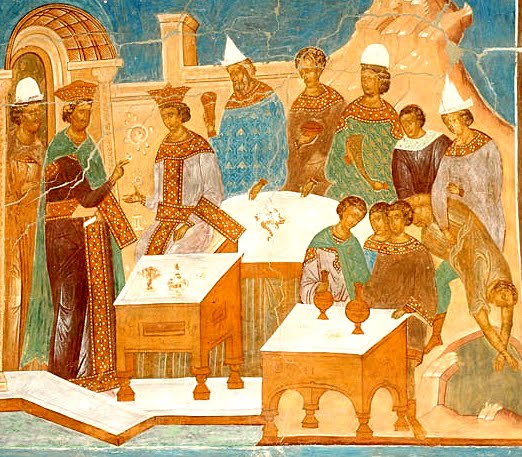
Parable of the Wedding Feast, Russian, 14th Century

Matthew 22:1-14

New Testament commentators sometimes draw a distinction between two types of parables found in the Gospels: parables of grace, and parables of judgment. On the whole, I find it a helpful distinction.

Most of us are familiar with the parables of grace. By means of various images and figures they depict God as infinitely loving, forgiving, and willing to go to any length necessary to rescue and redeem the lost: for example, the father in the Parable of the Prodigal Son; the Shepherd who goes in search of the one lost sheep in the wilderness; the woman who sweeps her house up and down looking for a lost coin. These images of a loving and gracious God resonate well with us. 

But then, in a number of other parables, the happy ending is tempered by images of judgment, condemnation, and punishment. The goats are separated from the sheep; the tares are winnowed from the wheat; and, in today’s Gospel, not only are those who refused to come to the marriage feast put to the sword and their city put to the torch, but even one of the guests gathered in at the last minute is found lacking the required wedding garment and cast into outer darkness.

One strategy that many people adopt in reading the Scriptures today is simply to pay attention to the passages that they like and ignore the ones they don’t like. But that won’t do. If the Bible really is God’s Word as we claim it to be, then we need to wrestle with all of it, not just the bits that appeal to us. We need to take seriously not only the parables of grace but also the parables of judgment.

An ancient technique of interpreting biblical stories is to distinguish the different layers of meaning in the text. The first and most obvious layer is the literal meaning. But at the level of literal interpretation, the parable in today’s Gospel presents us with some details that are puzzling, to say the least.

When the king sends his servants the second time to extend the invitation to his son’s wedding feast, those invited seize the servants, abuse them, and kill them: an extreme way to refuse a dinner invitation. Then it gets totally bizarre. While dinner is getting cold, the king sends his troops to destroy the murderers and burn their city. Declaring that those originally invited were not worthy, the king sends his servants out into the streets to gather in everyone they find. And so we have the surreal picture, almost a dreamscape, of a banquet hall filling with guests, against the backdrop of a night sky lit up by the flames of the burning city in the distance.

For me, the strangest detail of all has always been the man with no wedding garment. After all, these guests have just been gathered from the streets into the wedding hall with no warning. How can anyone expect them to be properly dressed for a wedding?

Some recent commentators suggest, however, that according to the customs of the ancient world, the details of the parable are not as strange or absurd as they first seem. Great banquets and feasts usually didn’t happen at a precise date and time, announced in advance. Guests normally declined the first invitation, because it merely served as a warning that the preparations were under way. So it was customary to send a second invitation when the feast was finally ready. 

Those invited to the marriage feast of the king’s son were almost certainly the nobles and aristocracy of the kingdom. For them, to turn down the second invitation to such a great state occasion was an act of defiance bordering on treason. Their killing of the king’s servants suggests that this is precisely what they were about: rebelling against the authority of both the king and his son. In this light, sending troops to burn their city was a completely plausible response to a political challenge. In the ancient world, this sort of thing happened all the time.

For the original audience, only two features of the story would have come as a surprise. The first was the king’s sending his servants into the streets to invite the common people to the banquet. That would have been unheard of.

The second would have been the guest without a wedding garment. For in marriage feasts in the ancient world, at least according to some commentators, these items of clothing were given to the guests as they arrived. So, the man without a wedding garment has probably refused the garment offered to him at the door. His attitude is perhaps one of stubborn defiance: “if you want me to come in, fine, but you’ll have to take me as I am.” Confronted with a show of such blatant disrespect, the King has no choice but to have him tossed out.

The literal interpretation does not, however, exhaust the parable’s meaning. By his introduction, Our Lord makes it clear that the parable points beyond itself to something greater: “The kingdom of heaven may be compared to a king who gave a marriage feast for his son.” The point of the parable is not what it tells us about biblical marriage customs, or the politics of the ancient world, but what it tells us about the kingdom of God.

Read at this level, the parable’s message is that God’s grace abounds in the invitation extended to all people everywhere to come and partake of the feast of the kingdom of heaven. In the end, the king tells his servants to gather everyone in, both bad and good. While everyone without exception is invited, those who end up excluded are precisely those who refuse the invitation. In the parable, those invited make light of the invitation and go off, one to his farm and another to his business. In their minds, they have more important matters to attend to than the wedding feast of the King’s Son. And, if my interpretation is accurate, even the guest cast out at the end could have chosen to accept the wedding garment offered to him as he entered the hall.

So, in the end we have a parable of both grace and judgment. God extends his grace to all of us in the invitation to the wedding feast of his Son. In the Church we understand our weekly and daily celebration of the Holy Eucharist as an anticipatory foretaste of that very same feast: the marriage supper of the lamb. God invites us all to come to Mass and join in the Church’s life of worship, prayer, study, service, celebration, and thanksgiving. 

When we reject that invitation, it is not so much God who judges us as we who invoke judgment upon ourselves. We’re all invited to the wedding feast; every Sunday affords us the opportunity once again to accept the invitation, or to decide that we’ve got more important things to be about. By developing the habit of responding faithfully to God’s invitations in this life, however, we prepare and dispose ourselves to be found worthy in the next.

Wednesday, September 17, 2014

Requiem Mass for the Departed Brethren of the SSC *

Mosaic of Crucifixion
National Shrine of Our Lady of the Snows
Belleville, Illinois
Given at the Shrine of Our Lady of the Snows, Belleville, Illinois

What a great privilege it is to join in the offering of Requiem Mass for the repose of the souls of our departed brethren in the Society of the Holy Cross! An integral component of our vocation as Catholic priests is the offering of the Holy Sacrifice for both the living and the dead. Likewise, we do well to teach those committed to our spiritual care the duty and joy of praying for the souls of the faithful departed.

This morning, I want to propose that our contemporary culture presents us with an opportune moment for preaching the Catholic doctrines of Purgatory and prayer for the dead. These doctrines contain a message of hope that people today are longing to hear. The time is ripe. But first, a few reflections on the nature and purpose of this Requiem Mass will help illustrate why this is so.

Let’s think for a moment about our relationships with those who have gone before us in this Society. Some of them are priests about whom we’ve read in the history books, like Lowder and Mackonochie. Others are priests we’ve known personally, who perhaps influenced us by their examples and teaching. Still others are priests whom we never knew at all. Regardless, we take this opportunity to offer our prayers that they may rest in peace until the Day of Resurrection.

Now, narrow the focus a bit and think specifically about those priests, now departed, who had the greatest influence on us while they were alive. We need not confine ourselves to priests of our Society. But let’s call to mind whomever it was whose example inspired us to consider a call to the priesthood. Or who mentored us at significant times in our discernment, formation, and training. Or who gave us the special words of support, advice, and encouragement that we particularly needed at some point. Perhaps some of these figures are still here with us in this earthly life, in which case we can certainly thank God for them, pray for them, and perhaps thank them personally. But as we get older, we find that more and more of them have joined the ranks of the faithful departed.

Now, as we think on them, I will venture with near certainty that two features stand out simultaneously in our memories. First is whatever it was that we found influential or inspirational about them: their learning, their wit, their compassion, or their dedication to their flock. In many cases, I daresay, they were men of genuine holiness. But second, and this is crucial, they were not without their faults and flaws! Perhaps they could be cranky or bad-tempered. Perhaps they were prone to excesses of one sort or another: food, drink, or worse. Like all of us, they had their besetting sins. Sometimes, indeed, that is precisely what makes our stories about them so entertaining!

So, at one and the same time, they were good and even holy men; and yet they were sinners. This dual reality sets the agenda for what we’re about this morning. We can almost imagine a covenant between the living and the dead members of our Society. They influenced and inspired us during their earthly lives with the vision of priesthood to which we found ourselves called. And in return for all they gave us, we fittingly offer two things on their behalf: first, our prayers for their souls to speed them on their journey into the fullness of God’s presence; and second, our perseverance in the priestly vocation to which their examples and guidance inspired us. We pray for their souls in the recognition that when they died God wasn’t yet finished with them – just as we hope that those who come after will pray for us. That is what this Requiem Mass is all about. And we do our best, with God’s help, to keep faith with our forebears by persevering in our priestly vocation. That is what this entire Synod, indeed the entire life of our Society, is all about.

Now, to return to my earlier point: today, the Catholic doctrines of Purgatory and Prayer for the Departed offer a message of hope that people in our culture desperately long to hear. An integral component of our perseverance in our priestly vocations will be regularly to offer Masses and prayers for the dead.

In my pastoral experience over the past twenty years or so, I’ve noticed two broad attitudes towards death and life after death among many of the people to whom I’ve ministered as they’ve either faced their own deaths or the deaths of their loved ones.

The first basic attitude might be called a functional atheism. It takes the view that this earthly life is all that there is, and once you’re dead, you’re dead. The light is extinguished; life is annihilated; all is darkness. A hundred years ago or so, people feared death because they feared hell. Today, few people seem to fear hell but plenty of people fear nonexistence.

Over and against functional atheism, the Catholic tradition affirms the reality of life after death. We pray for the faithful departed because we have the assurance that in Christ they are alive. That confident proclamation is good news that people today, especially the bereaved, need to hear, but so often don’t hear from those who have pastoral responsibility for them.

The second basic attitude is the diametric opposite of the first: what might be called a functional universalism. It cheerily affirms not only that our departed loved ones are still alive, but also that they’re already in heaven in the fullness of glory. From this basic attitude arises the enormous cultural pressure in a great many of our churches to turn funerals into those gaudy celebrations that have aptly been described as “premature canonization ceremonies.”

The difficulty with this second posture is that is subtly leads those who are bereaved into denial of the very real shortcomings, flaws, and sins of the departed. Again and again, I hear the bereaved say things like, “He must be in heaven because he was such a good person.” The irony is that when the departed was alive, this was often not what this person was saying about him. On the contrary, he was often a source of enormous irritation and exasperation to those around him.

Against functional universalism, the Catholic tradition affirms not only that hell is a very real possibility for those who knowingly, willing, and decisively reject God’s love and goodness, but also that when we die none of us is ready to see God face to face. With the exception of Our Lady, at the time of our departure we all have some way to go in the way of further purification and sanctification before we’re ready to enter into the fullness of God’s presence.

The good news is that we don’t have to deny the all-too-real shortcomings and flaws of the departed in order to entertain the hope that they’re ultimately destined for heaven. Instead we pray for them, humbly asking God, by the merits of Christ, to bring to perfection the good work that he began in them in this life.

In the 1930s and 40s, the British writer and anti-war activist Vera Brittain offered an interesting insight about comforting those who mourn. In the First World War, her fiancé, her brother, and two of her best friends were killed in the trenches – devastating losses, the emotional wounds of which she carried for the rest of her life.

When we encounter people who’ve experienced such losses, we often don’t know what to say; and we may well be tempted to think that there is nothing we can say. But in her 1942 book Humiliation with Honour, Vera Brittain registers her disagreement with those who say that mere words can never be much help: “The power of words,” she writes, “is greater than anyone can calculate. … The use of the right words at the right time can transform the existence of a man or woman from desolation to glory. But you may have to live a whole lifetime before you learn how to choose those words.”

I don't know about you, but I have certainly have not yet lived that whole lifetime! I have learned, however, that the one thing I can say that’s almost always pastorally helpful is: “Your loved one is in my prayers.” Better still, “I will remember him at Mass.” Or best of all, “I will say Mass for him.” Regardless of their personal beliefs, those recently bereaved are often touched, sometimes even deeply moved, when they hear that we’re praying for the one whom they’ve lost – perhaps because we’re offering them so much more than mere words.

So, today we keep faith with those who’ve gone before us in the Society of the Holy Cross – not only by offering this Requiem Mass for the repose of their souls, but also by rededicating ourselves to the priestly vocation they exemplified to us during their earthly life. And a key component of perseverance in our priestly vocations must always be offering the Holy Sacrifice of the Mass for the living and the dead.


(*  Note: SSC stands for Societas Sanctae Crucis, Society of the Holy Cross.)


Sunday, September 14, 2014

Feast of the Holy Cross (Sermon at the 10 am Mass)


The proper name of today’s Feast is the Exaltation of the Holy Cross. In the year 326, in the newly Christian Roman Empire, the Empress Helena, mother of the Emperor Constantine, had come to Jerusalem on a mission to locate the sites of Golgotha and the Holy Sepulcher. She directed excavations at the place identified by local tradition; and, lo and behold, at the bottom of a cistern three crosses were found. The problem was that no one could tell which one was the Lord’s cross, and which two were the crosses of the thieves crucified with him.

At this point Bishop Macarius of Jerusalem intervened and proposed a solution. Crippled and sick people were brought to touch each of the three crosses. The one that produced miraculous healings was thus identified as the True Cross. Bishop Macarius then raised up the True Cross for all the people to see – and the Latin word verb to lift or raise up is exaltio. Hence the Exaltation of the Holy Cross really means the lifting or raising up of the Holy Cross. The paradox we celebrate today is the transformation of an instrument of shame and death into an effective sign of healing and life.

You may have noticed that following my name in print I often append the initials SSC. Occasionally, some have wondered if they stand for Saint Stephen’s Church – but, no, they’re actually the initials of the Latin name of the society of priests to which I belong, Societas Sanctae Crucis, the Society of the Holy Cross.

During the coming week, I’ll be traveling to St. Louis to attend the annual SSC Synod. This gathering is always held as near as possible to Holy Cross Day, the 14th of September. The Society of the Holy Cross originated in 1855 in the Church of England, when six priests met at a mission house in the Soho District of London to form as association for mutual support and encouragement, continuing priestly formation, practice of the spiritual disciplines, and the cultivation of personal holiness.

These men already knew well what it meant to take up the cross. They had already dedicated their lives and ministries to the Catholic revival in the Church of England. For this reason, they had already encountered hardship, privation, opposition, and costly personal sacrifices.

They found themselves excluded from the Church of England’s more comfortable livings. Instead, they had gone into the industrial slums of the English cities and had founded mission parishes in dangerous and squalid surroundings. Their efforts to reintroduce Catholic ritual and ceremonial into Anglican worship had drawn fierce opposition. Protestors occasionally disrupted their liturgies and sometimes riots even broke out in the streets around their churches. Their bishops often kept them at arm’s length and refused to visit their parishes out of disapproval of their ritual innovations.

The founders of the SSC understood that if they were to persevere in the face of such challenges, they needed to cultivate a systematic approach to the Christian life that would sustain and strengthen them in their work. Within a year of their founding, the SSC organized the first retreats held in the Church of England since the Reformation featuring extended periods of silence punctuated by spiritual addresses. Members of the Society took vows in which they committed themselves to a Rule of Life including daily Mass and daily recitation of the Divine Office.

These priests understood that to bear the cross that had been laid on their shoulders in the form of Catholic witness in the Church of England, they had to intentionally embrace a life of spiritual discipline and self-sacrifice. In this way, they would lift up the cross so that it might become a sign of healing and salvation in the lives of their flocks. So, to remind themselves of this dimension of their priestly vocation, they named their society after the Holy Cross.

The Feast of the Holy Cross reminds us that the same principle holds good for all Christians, not just for clerical members of a particular priestly society. All authentic Christian discipleship entails taking up the cross and following Jesus in one way or another.

This message is not particularly popular these days. Many people seem to want a version of Christianity that will meet their needs on their own terms – whether for spiritual comfort, aesthetic gratification, intellectual stimulation, or simply the fellowship of like minds and kindred spirits. But, as you’ve heard me say many times before, religious consumerism is the opposite of authentic Christian discipleship.

Every once in a while, someone comes into my office and tells me that they’re feeling spiritually dry and not getting anything much out of Sunday Mass anymore. My initial response is almost always to ask what else they’re doing to nurture their relationship with God the rest of the week. Are they setting aside a time for prayer every day? Are they reading any of the daily offices? Are they coming to any of the weekday Masses? Do they ever attend retreats or quiet days? How long has it been since they’ve made their confession?

It often seems to come as a surprise when I explain that the Anglo-Catholic way really comprises a complete package, of which these practices are integral components. While the Sunday Mass is the most important part of the package, it’s not fair to expect it to bear the weight of sustaining one’s spiritual life if one is neglecting all the other parts. The system is a comprehensive whole, and each part works best only when all the other parts are working as well. So, if you want to get more out of Sunday Mass, you need to put in more – and not just on Sundays but throughout the week as well.

At this point, the person sometimes protests. I’m already doing everything I can. My life is too difficult; I’m being pulled in too many different directions; there are too many demands on my time and attention. But that’s precisely the point. Already a cross is laid on your shoulders. The best way to find the strength to bear that cross is by practicing the spiritual disciplines that will help you face all the other demands and challenges of your life.

It’s difficult but not impossible. We can’t always expect the practice of Christianity to be easy, comfortable, or convenient. There are indeed times when it requires hard work and positive self-sacrifice.

The promise of Holy Cross Day, however, is that the way of the cross is the only true path to genuine fulfillment, joy, happiness, and peace. By having suffered and died upon it, Our Blessed Lord has transformed the cross from an instrument of shame and death into a sign of forgiveness, healing, hope, and salvation. But in a sense, it’s not enough just to take up the cross and follow Jesus. Like Bishop Macarius of Jerusalem so many centuries ago, we’re called to lift up the cross and raise it on high, so that people may look upon it and be saved.


Proper 19, Year A (Sermon at the 8 am Mass)

Matthew 18:21-25

For many people, forgiving those who’ve hurt us is one of the most difficult demands of the Christian Gospel.

Some years ago, in the movie “Dead Man Walking,” Susan Sarandon played the nun, Sister Helen PreJean, who became the spiritual advisor to a convicted murderer on death row in the days leading up to his execution. One of the film’s most dramatic moments involved Sister Helen’s encounter with the parents of the two young people murdered by the prisoner. They desperately wanted the execution to go forward; and they deeply resented the idea that this nun should be attempting to bring the condemned man any solace or comfort in his last days. Their lives were consumed by the desire for retribution. And watching the film, one’s reaction might well be, “Who can blame them?” If we were in their position, forgiveness would probably be the last thing on our minds.

Yet, Jesus teaches us to pray, “Forgive us our trespasses, as we forgive those who trespass against us.” And the parable in today’s Gospel embodies our Lord’s teaching of forgiveness.

Today’s Gospel reading picks up where last week’s left off. There, Jesus was teaching the disciples how to deal with fellow Church members who wrong them in some way. What Jesus said was: If your brother sins against you, take the matter up with him privately; if he refuses to listen to you, take two or three witnesses; if he refuses to listen to them, tell the matter to the whole Church; if he refuses to listen to the Church, then cast him out.

So, at the beginning of today’s Gospel reading, Peter replies, “All right, Lord. But suppose he repents and asks to be forgiven? How many times must I forgive him? As many as seven times?” In other words, doesn’t there come a point when someone’s hurt you one time too many, and you just can’t forgive them again no matter how contrite or sorry they are?

Peter probably thinks he’s being enormously generous in offering to forgive as many as seven times. But Jesus says no, not seven times, but seventy times seven. The phrase “seventy times seven” is a biblical euphemism that means an infinitely large number. For the Christian, there must be no limit to our willingness to forgive.

We need to understand, however, what forgiveness is and what it isn’t. When someone has hurt you, forgiveness does not mean waving your hand and saying, “Oh, that’s all right, it doesn’t matter.” It’s not all right, and it does matter. If it really were all right, there’d be nothing to forgive.

To ask forgiveness is to admit that one has done wrong. And to forgive is not to excuse the wrong, or to pretend that it didn’t happen. Rather, forgiveness means overcoming our instinct to strike back. It involves letting go of our desire for vengeance and retribution.

Forgiveness of this sort does not mean that a violent criminal shouldn’t go to jail. It does not mean that a chief financial officer who’s embezzled company funds should get to keep either his job or the money. It does not mean that a woman should continue to live with an abusive husband. It does not mean that the Church should move priests who’ve molested children from parish to parish and cover up their crimes. In each of these situations, decisive steps are necessary to safeguard the community and to protect the innocent.

But even in tough situations like these, forgiveness means refusing to be ruled by the hatred, malice, vindictiveness, and desire for revenge that can consume us and poison all our attitudes and behavior. It means refusing to let our lives and identities be defined by the ways in which we’ve suffered or been victimized. After a would-be assassin shot him in Saint Peter’s Square, Pope John Paul II exemplified Christian forgiveness when he went to the prison a year later and personally forgave his attacker.

The parable in today’s Gospel teaches us how to become forgiving people. A king releases a slave from a debt of ten thousand talents. But then the same slave refuses to forgive a debt of a hundred denarii owed to him by another slave.

The key to the story is the difference between the two debts. A denarius was a silver coin roughly equal to the day’s wage of a laborer. But a talent was equivalent to 6,000 denarii. So, the ten thousand talents that the servant owed the king was an astronomical sum. There was no way that the servant could have paid off the debt. On the other hand, the one hundred denarii that the servant was owed by his fellow servant was an infinitesimal fraction of the ten thousand talents. So, it cost the king infinitely more to forgive the debt owed by the servant than it would have cost the servant to forgive the debt owed by his fellow servant.

Our Lord’s point is that we find the motivation to forgive those who’ve sinned against us only when we realize how much more God has forgiven us. To become truly forgiving people, then, we need to realize our own sinfulness and our own need for forgiveness.

Only then can we begin to appreciate the sheer magnitude of Christ’s love for us. He died on the cross to forgive us our sins and reconcile us to God. It cost him far more to forgive us than it will ever cost us to forgive anyone else. So, to become forgiving people, we need to keep our gaze fixed on the cross. Then, and only then, will we know the freedom and joy that comes from being able to forgive others just as God has forgiven us.

Howard Thurman, the African-American preacher and civil rights leader, tells of visiting an elderly black man in hospital. During the visit, the man declared, “You’re looking at a man who cannot die. Not long before the Civil War I barely escaped from the plantation with my life. I was accused of doing something I had not done. The master had me dragged to the smokehouse. I was stripped to the waist and my hands were tied to one of the crossbeams. I was whipped until I fainted, then revived with buckets of cold water and flogged again.

“The next thing I remember was the darkness of the night and someone was cutting me loose and helping me dress in fresh clothes that hurt my skin. Oh, how it hurt! Whoever this was helped me to escape into the woods. Finally I came to the river and got across the Ohio to freedom. Ever since I have been kept alive by hatred for the man who beat me. I suppose he has long since died. The only thing is, I know I dare not die until I forgive him.”

Thurman visited the man many times over the next few weeks. One day he entered the room, and the old gentleman greeted him in great excitement. He said, “It happened last night. It finally happened.” A few days later, the old man died. He knew that none of us can find true freedom, in life or in death, until we learn to forgive.


Note: Portions of this sermon appeared in the "Sunday's Scriptures" section of The Living Church, Vol. 249, No. 4 (September 7, 2014), 59. The Howard Thurman story originally came from a commentary by Will Willimon in Pulpit Resource.

Tuesday, September 9, 2014

Sermon for Proper 18, Year A

Sunday 7 September 2014

Matthew 18:15-20

The great historian of diplomacy Herbert Butterfield once remarked that to understand the dynamics of conflict among nations and peoples, one need only spend a month in a typical parish choir. In addition to being a distinguished historian, Butterfield was a Christian thinker of some depth, and my guess is that he spoke from experience.

Life in the Church – not just the choir but every part of the parish – does not always exhibit the harmony, peace, and love to which we’re called as Christians. Today’s Gospel explicitly acknowledges this hard reality. Jesus is under no illusions. He knows that short of Heaven itself conflicts and disputes will take place even among members of the same congregation. Moreover, in the earliest days of Christianity, as for much of the Church’s history, the people with whom one worshiped on Sunday were also one’s neighbors: the people with whom one lived and worked, and bought and sold, throughout the rest of the week. So conflict within the parish was potentially divisive and disruptive to the social fabric of the entire community.

To avoid such division, our Lord gives some straightforward, practical directions on what to do when another member of the Church hurts, offends, or wrongs us in some way. These instructions consist of three steps.

First, “If your brother sins against you, go and tell him his fault, between you and him alone. If he listens to you, you have gained your brother.”

In other words, the person with the grievance must take the initiative to rectify the problem. Yet, how often this is not what happens! We suffer some insult or injury and, instead of taking the matter up with the perpetrator, we start sulking, feeling sorry for ourselves, and nursing a grudge. Or, worse still, we complain to everyone but the person who’s offended us. Nothing stirs up division and dissension more than people grumbling and complaining behind one another’s backs. On certain occasions, I’ve unwittingly said or done something to upset someone, only to discover weeks, months, or even years later that that person told everyone else about it but me! But here our Lord instructs us: If someone has offended you in some way, first of all take it up with that person: directly, and privately. That way, you might be able to reach some sort of mutual understanding and achieve reconciliation without stirring up trouble and making the situation worse.

Sometimes this direct approach works; sometimes it doesn’t. So, then, the second step: “If he does not listen, take one or two others along with you, that every word may be confirmed by the evidence of one or two witnesses.”

The biblical background here is that the Old Testament repeatedly requires that no one should ever be condemned on a charge of wrongdoing except on the evidence of two or three witnesses. One witness alone is not enough without corroboration. The New Testament carries this principle over into the life of the Church, as for example when Saint Paul writes “Any charge must be sustained by the evidence of two or three witnesses” (2 Cor. 13:1).

As an aside, every so often a parishioner will come to me and make some accusation against another parishioner: so-and-so is saying this and doing that! And almost always, my instinctive response is to tell them that I really can’t do anything about it unless and until I’ve heard the accusation from more than one person. Otherwise, it’s just uncorroborated hearsay. With one or two exceptions, the biblical principle still holds good today: admit no charge except on the evidence of two or three witnesses.

So, our Lord is saying that if we can’t work out our differences one to one, then we need to bring one or two others into the picture. There’s always the possibility that these third parties might be able to help us see some merit in the other person’s position that we can’t see by ourselves, and help mediate between the two points of view.

But if this process of mediation fails, and our mediators agree that we’ve been wronged, then we’ve gained the necessary two or three witnesses when we go to step three: “tell it to the church; and if he refuses to listen even to the church, let him be to you as a Gentile and a tax collector.”

The early Christians took this command, “tell it to the church,” quite literally. When members of the congregation had personal complaints against one another, they would stand up in church on Sunday morning and air their grievances. Then the whole congregation would listen and try to arbitrate, or render a judgment. The Eucharist could not proceed until both parties were reconciled, or else until the guilty party, if unrepentant, had been expelled from the assembly.

Of course, this procedure caused more problems that it solved, and was gradually abandoned. It survives in symbolic form in our liturgy, however, as the Passing of the Peace, which is really a symbolic gesture of the forgiveness and reconciliation with all of our brothers and sisters in Christ that’s required of us before we approach the Lord’s Table together.

But what can it mean in today’s world to “tell it to the church”? The understanding that eventually gained acceptance was that telling it to the church could be equally well accomplished by telling it to one of the church’s authorized representatives, namely the clergy.

In other words, if another member of the parish hurts or wrongs you in some way, first, take the matter up with that person directly. If that doesn’t work, try getting one or two friends to mediate. And if that doesn’t work, then bring the matter to one of the parish clergy. I say this not because we clergy relish the thought of meddling in our parishioners’ disputes—we don’t. Yet discord among the members wounds the whole Body. So, the Church has a legitimate interest in promoting reconciliation and forgiveness among all its members. And one of the responsibilities to which the clergy have been ordained is known as the ministry of reconciliation. Frankly, when people in the parish are at odds with one another, it is the clergy’s business.

Even within the Body of Christ, conflicts and disputes are inevitable. We’re still sinners, after all, and we’ve all got a long way to go before God is finished with us. What makes Christianity distinctive, however, is not the absence of conflict, but rather the ability to achieve forgiveness and reconciliation when conflicts arise, as they inevitably will.

In today’s Gospel Jesus gives some practical directions on how to work towards forgiveness and reconciliation. The point of the three steps is that we must do everything we possibly can to be reconciled and at peace with one another. The goal is not to cast anyone out, but rather to keep everyone within the fold. Christ has shown his love for us by forgiving us and reconciling us to God. And it’s precisely in mutual forgiveness and reconciliation that we begin to show Christ’s love to the world.


Note: Portions of this sermon also appeared in the "Sunday's Scriptures" section of The Living Church, Vol. 249, No. 4 (September 7, 2014), 58.

Sunday, August 24, 2014

Feast of Saint Bartholomew (Sermon at the 10 am Mass)

Hereford Mappa Mundi, c. 1300

Hereford Cathedral in England houses a treasure of medieval cartography: the Mappa Mundi, or Map of the World, dating from approximately the year 1300. Part of the map’s fascination is the glimpse it gives into what might be called the literal world-view of pre-modern European Christians.

The map is circular, in the shape of a disc, and is oriented differently from modern maps. The vertical axis has East at the top and West at the bottom, while the horizontal axis has North to the left and South to the right.

Significantly, the city of Jerusalem occupies the spot at the very center of the map, marked by a cross. The half-disc of the map above Jerusalem represents Asia, with India and the Ganges at the very top. The two bottom quadrants represent Europe to the left and Africa to the right, divided by the Mediterranean Sea, extending vertically from just below Jerusalem to the bottom, terminating at the Pillars of Hercules. Even though the map was made in England, the British Isles are squeezed in at the very perimeter, to the lower left, at the far edges of Europe.

The Mappa Mundi expresses the early Christian worldview in which Jerusalem stands at the center of a divided into three great continents: Africa, Asia, and Europe. Into these three continents, after Christ’s death and resurrection, the Twelve Apostles went forth from in all directions, preaching the Gospel and planting the Church.

For easily understandable reasons, however, the New Testament and subsequent Christian history focused on the missionary journeys of Paul and the other few apostles who brought the Gospel west, into Europe, through what is today Turkey into Greece and ultimately to Rome itself, the center of the Empire. Saints Peter and Paul both died as martyrs in Rome. Three centuries later, the Roman Empire itself adopted Christianity as its official religion. For these reasons, it’s easy to fall into the trap of misidentifying ancient Christianity as a primarily European phenomenon.

Nothing could be further from the truth. From the first century on, beginning with the Twelve Apostles themselves, Christian missionaries went forth from Jerusalem not just west into Europe, but in all directions, sometimes well beyond the frontiers of the Roman Empire: south into Egypt, Ethiopia, and Libya; southeast into Arabia and even as far as the coast of India; east into Persia and Syria; northeast into what is today Georgia and Ukraine; and north into Armenia and the Caucasus. But their missionary journeys, sermons, and miracles were not recorded in the New Testament. We know about most of them only from oral traditions and legends that were written down many years later.

The Apostle whom we commemorate today, Saint Bartholomew, is a case in point. His name appears in the lists of the Twelve that appear in the Gospels of Matthew, Mark, and Luke. He is very likely the same person who appears in the first chapter of John’s Gospel under the name Nathanael – the one who asks, “Can anything good come out of Nazareth?” and of whom Jesus says, “Behold, indeed, an Israelite in whom is no guile.” If that is the case, then Nathanael would have been his first name, and Bartholomew – meaning “Son of Tolmai” – would have been his last name.

That he was one of the Twelve Apostles does tell us something about the shape of his life. The Twelve were the hand picked inner circle of disciples. They traveled about from town to town and village to village with Jesus as he preached, taught, and healed the sick. They were with him at the Last Supper on the night before he died. After his Resurrection, he appeared to them and commissioned them to preach the Gospel to all nations.

Beyond that, however, the New Testament is silent about Bartholomew. Tradition has it that he traveled to such far away places as India and Ukraine, and finally suffered martyrdom in Armenia by being flayed alive. In art he’s depicted holding a tanner’s knife, the instrument of his death. For this reason also, we wear red today, as on all Feasts of Martyrs.

This morning, I want to make two points about how Bartholomew speaks to us across the centuries in the midst of the world we live in today. First, as the horrific events of this summer have reminded us, ancient Christian communities continue to this day in places like Lebanon, Syria, Iraq, Egypt and Ethiopia. These communities are not the product of European expansion and colonization beginning in the so-called Age of Discovery, but have been there since the earliest centuries of the preaching of the Gospel.

Second, according to the tradition, all but one of the Twelve Apostles ultimately died as martyrs for their faith. The one exception was John, the Son of Zebedee, who lived to a ripe old age and died in Ephesus in what is today Turkey. Being an apostle meant being willing to give up everything to follow Jesus, including ultimately life itself. The word martyr means “witness” and the Apostles, including Bartholomew, were among those who bore witness to Christ even unto death.

Today, the Christian descendants of the communities founded by the Apostles in the Middle East are similarly being subjected to the persecution that makes martyrs: especially in areas where radical Islamic jihadism is on the rise. The point not to be missed about the recent murders of Christians in Iraq is that in each case -- at least in the case of the adults -- the Christians appear to have been given the option of converting to Islam. Only when they refused to betray Christ were they beheaded.

Thus, they have borne witness to their faith in Christ as more precious than life itself. In this sense, their deaths do not represent defeat; they have conquered their enemies and won the martyr’s palm of victory. And I am convinced that long after the so-called Islamic State has been consigned to the dustbin of history, the Universal Church will have in its calendar of saints a day of solemn commemoration of the Martyrs of Iraq.

In the meantime, we may be confident that Saint Bartholomew and the rest of the apostolic martyr band are welcoming their children home. This month we have been praying every day for persecuted Christians and religious minorities throughout the world, and especially in Iraq and Syria. Today we invoke Saint Bartholomew’s prayers for them as well. In the early centuries of Christianity, the blood of the martyrs was the seed of the Church; and we may rest assured that it will be so again in the twenty-first century.

Proper 16, Year A (Sermon at the 8 am Mass)

Ruins of the Temple of Pan, Caesarea Philippi
Matthew 16:13-20

A reciprocal identification takes place in today’s Gospel. Peter identifies Jesus as the Christ, the Son of the Living God; and Jesus in turn identifies Peter as the Rock on which he will build his Church.

Our Lord and his disciples have just arrived in the region of Caesarea Philippi. This town was located in the very north of Galilee, near the foot of Mount Hermon, in the area known today as the Golan Heights. Its older name was Paneas, because its predominant landmark was a shrine to the god Pan, about which I shall say more presently.

Here Our Lord asks his disciples, “Who do men say that the Son of Man is?” (Jesus typically referred to himself as the Son of Man, a phrase that seems simply to have meant “human being.”) The initial answers are intriguing. “Some say John the Baptist; others say Elijah; and others Jeremiah or one of the prophets.”

By this time, John the Baptist is already dead. Yet Matthew’s Gospel reports that when King Herod heard about the fame of Jesus, he said to his servants, “This is John the Baptist, who has been raised from the dead; this is why these powers are at work in him.” So the rumor that Jesus was John the Baptist returned from the dead was already circulating in high places.

As for Elijah, many Jews believed that Elijah would return as the messenger sent to prepare the way for the Messiah. This belief was based on a verse in the Book of Malachi, “Behold I will send you Elijah the Prophet before the great and terrible day of the Lord comes.”

And as for Jeremiah or one of the prophets, many Jews were expecting a figure called “the Prophet.” This expectation was based on the parting words of Moses to the Hebrews: “The Lord your God will raise up for you a prophet like me from among you—him shall you heed.”

John the Baptist, Elijah, Jeremiah or one of the prophets: all interesting speculations as to Jesus’ identity, but all falling short of the truth. So, he asks the disciples: “But who do you say that I am?” Speaking up on behalf of the rest, Simon Peter replies, “You are the Christ, the Son of the Living God.”

The title “Christ” in English comes from the Greek word Christos, which in turn translates the Hebrew Messiah, which means simply “Anointed One.” Contrary to what many of us grew up thinking, “Christ” is not our Lord’s surname, but rather his title. To call him “Jesus Christ” amounts to calling him “Jesus the Messiah,” or “Jesus the Anointed One.”

The Jews of New Testament times were expecting God to send a Messiah or Anointed One as the agent of God’s kingdom on earth. When the Messiah came, he would defeat God’s enemies and inaugurate a universal reign of justice and peace.

As Christians, we believe that Jesus was the Messiah, though his exercise of the messianic office was very different from what the Jews of his time was expecting. So he congratulates Peter for his answer. “Blessed are you, Simon Bar-Jonah, for flesh and blood has not revealed this to you, but my Father who is in heaven.”

Then he continues: “And I tell you, you are Peter, and on this rock I will build my Church, and the powers of hell shall not prevail against it.” Here Jesus is indulging in a bit of wordplay. In Greek – the language in which the New Testament is written – the name Peter, Petros, is similar to the word for rock, petra. And remarkably, the same is true in Aramaic, the language that Jesus was speaking, where both the name Peter and the word for “rock” are the same, kepha.

Also, the literal translation of “the powers of hell” is “the gates of Hades.” Here we come back to the point I made earlier about Caesarea Philippi being the site of a temple of the Greek god Pan. An especially lecherous deity, Pan had the head, torso, and arms of a man but the legs, hindquarters, and horns of a goat. His worshippers engaged in orgiastic rituals involving lewd practices best left unmentioned.

At the present-day site of Caesarea Philippi, the ruins of the temple of Pan can be seen on an outcropping of rock overlooking the town. Directly behind the temple rises a 100-foot cliff, in which opens out a great gaping entrance to a cave. Pagan worshipers believed that such caves were gates to the underworld, Hades. (For them, Hades was not so much what Christianity later came to depict as Hell, as simply the abode of the dead: a dreary world in which the departed spirits took the form of pathetic shadows of their former selves.)

With a little imagination, then, we can picture Jesus and the disciples arriving in the environs of Caesarea Philippi, and seeing the rocky hillside with its temple, and its cave believed to be one of the gates of the underworld. Over and against such temples built on physical rocks, Jesus declares that Peter and, by extension, the other apostles are the rock on which he will build his Church – in Greek, his ecclesia, or assembly – against which the gates of Hell itself would not prevail.

So far as I’m aware, this is the one and only time the Gospels depict the presence of Jesus and his disciples – if only by implication – in the vicinity of pagan shrines and temples. Such centers of idolatrous worship and debauched religious practices would have been deeply offensive to their monotheistic Jewish sensibilities.

Yet perhaps it’s especially appropriate that here, of all places, Peter should confess Jesus to be the Messiah, the Christ, the Son of the Living God; and that Jesus in turn should name Peter the Rock upon whom he will build the Church against which even the gates of Hell shall not prevail. Already they are the advance guard of a movement of the Spirit that will sweep away all such false worship by the power of God’s truth.

The Roman historian Plutarch relates an incident that took place during the reign of Tiberias – who was Emperor from 14 to 37 AD, a period largely overlapping with the life of Jesus. A sailor, Thamus, was sailing from Greece to Italy, when he heard a divine voice calling over the waters, “The Great God Pan is dead.”

Christian apologists from Eusebius of Caesarea to John Milton to G.K. Chesterton have symbolically interpreted this proclamation of the death of Pan as coinciding with the birth of Christ. But I like to imagine that it coincided instead with this exchange between Jesus and Peter within sight of Pan’s shrine at Caesarea Philippi: “You are the Christ, the Son of the Living God;” and “You are Peter, and on this rock I will build my Church, and the gates of hell shall not prevail against it.”