Recently I’ve discovered the series of books called by the title of “Very Short Introductions.” Published by Oxford University Press, these compact little books offer brief, accessible, and yet substantial inroads into a wide variety of topics, academic disciplines, and fields of study. And they manage to do so without dumbing down the material.
It just happens that in the past month or so, I’ve had occasion to look at two of these Very Short Introductions: one on angels and the other on dinosaurs. The Very Short Introduction to Angels gives a fascinating account of beliefs about angels not only in the Bible but also in the Jewish, Christian, and Muslim traditions, as well as the depictions of angels in the history of Western art, literature, and popular culture. And the Very Short Introduction to Dinosaurs has caught me up on developments in paleobiology, and theories about the evolution and extinction of the dinosaurs over the past forty-five years or so, since I last took an active interest in the subject at the age of about seven or eight.
So, in anticipation of today’s celebration, this juxtaposition of Very Short Introductions got me wondering: What, if anything, do angels and dinosaurs have in common? With a little reflection, more similarities come to mind than one might think at first.
Many dinosaurs are scary; and so are angels. Throughout Scripture, when an angelic messenger appears to a human being, the first thing he typically says is, “Do not be afraid” or “Fear not.” That indicates that most people's initial reaction to the manifestation of an angelic presence is sheer terror.
Both dinosaurs and angels are subject to elaborate systems of classification. The evolutionary charts of different classes of dinosaurs are complex, with many categories and subcategories with such names as saurischians, ornithischians, therapods, and sauropods. Likewise, mutatis mutandis, ancient thinkers classified the angels into complex ranks and hierarchies: seraphim, cherubim, thrones, dominions, virtues, powers, principalities, archangels, and angels.
But the most important similarity of all is that dinosaurs and angels are God’s creatures, just as we are; and more than that, they tend to relativize humanity’s place in God’s creation. Human beings emerged on earth as a recognizably distinct species approximately half a million years ago; and human culture began to have an identifiable material impact on the world about 10,000 years ago. By contrast, the dinosaurs first appeared 225 million years ago and then disappeared 65 million years ago – flourishing for a period of 160 million years in between.
To put those numbers into perspective, if we count the time that has elapsed since the dinosaurs first emerged as one year, then we human beings evolved about twenty hours ago – less than one day. And organic life on earth is much older still than the dinosaurs, having emerged according to most estimates 3.8 billion years ago.
We human beings are virtually new arrivals in the long timeline of the earth’s natural history. So, it’s a bit absurd to claim, as many traditional philosophies and religions have claimed, that God created the world just for us. God was delighting in his creation and the various life forms he created in it for billions of years before he brought us human beings on the scene.
The existence of angels brings home the same point in a different way. We human beings like to think of ourselves as the summit of creation in terms of self-awareness, intelligence, and the ability to shape our destinies by the exercise of free will. Yet the Church’s traditional teaching is that creation comprises not just the material world that we can see, but also a spiritual world that most of the time we cannot see. We profess this belief every Sunday in the first article of the Nicene Creed, which affirms that God is the creator of heaven and earth, of all things visible and invisible. And, as purely spiritual creatures endowed with intelligence and free will, the angels constitute the invisible dimension of God’s creation.
Recent Christian theological reflection on the ecological crisis pinpoints one of the chief causes of environmental degradation as anthropocentrism – the belief that we human beings are the be-all and end-all of creation, and that the earth and all its creatures exist to serve us and our human needs. Those reflecting on these issues have proposed that, as a first step towards a solution, we need to replace this human-centered perspective with a creation-centered perspective. That is, we need to learn to see ourselves as placed not over but within the natural world, set in a web of relationships of mutual interdependence and reciprocity with all other creatures.
And the real upshot of my comparison of dinosaurs and angels is that they both effectively challenge our anthropocentrism by reminding us that there is so much more to God’s creation than impinges on our conscious awareness most of the time. The earth and the natural world have been around so much longer than we human beings have, and will likely continue long after we’re gone. And intelligent and creative as the human race undoubtedly is, the invisible world contains intelligences of far greater power and subtlety.
One of the peculiarities of our Western liturgical calendar in the Church is that all our great feasts and festivals focus on the mysteries of Redemption: Christmas, Easter, Ascension, Pentecost, and all the saints’ days – combine to tell the story of what God has done to save us after our fall from grace and incurring of the guilt of Original Sin. By contrast, in modern times the Eastern Orthodox Church has started keeping September 1st as the “Day of Creation,” that is, as a day commemorating God’s work of creating heaven and earth in the first place, a creation that he pronounced “very good.”
Maybe in the Western Church we will eventually adopt this Festival of Creation as well. In the meantime, the closest thing we have is the Feast of Saint Michael and All Angels, which is, in effect, a celebration of creation in its invisible and spiritual dimension. Today, then, we contemplate the vastness, beauty, complexity, and interdependence of all that God has made. We pray that just as God’s holy angels worship and serve God in heaven, so they may protect and defend us on earth. And we look forward in joyful hope to that glorious day when all of God’s creation – angels, dinosaurs, and all – will be gathered into that Kingdom of which there shall be no end.
Sunday, September 29, 2013
Sunday, August 25, 2013
Proper 16, Year C -- Sunday Sermon
Isaiah 58:9-14
Luke 10:13-17
In Episcopal Church circles, certain preachers, writers, and church leaders periodically assert that worship, what we do here on Sunday morning, is not the central focus of the Christian life. They argue instead that the essence of being a Christian involves what happens on the remaining six days of the week, where we’re called to do God’s work in the world by serving the poor, feeding the hungry, and healing the sick. This, they say, is what God really cares about.
Those making this argument then proceed to describe Sunday morning worship as an opportunity to regroup and recharge our batteries, so that we may receive in turn the spiritual motivation and energy to get back out there and do the work that God has given us to do.Luke 10:13-17
In Episcopal Church circles, certain preachers, writers, and church leaders periodically assert that worship, what we do here on Sunday morning, is not the central focus of the Christian life. They argue instead that the essence of being a Christian involves what happens on the remaining six days of the week, where we’re called to do God’s work in the world by serving the poor, feeding the hungry, and healing the sick. This, they say, is what God really cares about.
In my academic work in Christian ethics, I often come across a distinction between instrumental value and intrinsic value. Something with instrumental value is a means-to-an-end, while something with intrinsic value is an end-in-itself. And much of the moral disorder in our contemporary world results from confusing these two types of value. Money, for example, has instrumental value: it is a means to other ends, and we get into trouble when we start treating it as an end-in-itself. People, on the other hand, have intrinsic value; and we get into trouble when we start treating them instrumentally, as means to other ends [such as money].
So, the argument that I’ve described basically approaches the Church's liturgy and sacraments instrumentally, as means to the end of living the Christian life defined in terms of good works in the world. But I want to suggest that this view is fundamentally short-sighted and incomplete. Worship is an activity of intrinsic value. Much as it may help us in other spheres of our life – and valuable as good works in the world undoubtedly are – worship is nonetheless worthwhile and necessary in its own right. It needs no other justification.
Our Old Testament reading from the Prophet Isaiah exemplifies this mindset. The Sabbath is a delight: a day not to go our own way or seek our own pleasure, but to delight in the Lord through worship and prayer.
But then we have the controversy in the Gospel reading between our Lord and the Ruler of the Synagogue. The Ruler of the Synagogue objects to Jesus healing a woman bent over from disease on the Sabbath; and Jesus rebukes him. At first glance, it might seem that our Lord is siding with those who argue that works of mercy are more important than worship.
What’s going on? The Ruler of the Synagogue is clearly not objecting to our Lord’s ministry of healing per se but to his healing on the Sabbath: the period that begins at sundown on Friday and ends at sundown on Saturday.
The Ruler is concerned above all with the community’s faithful observance of Torah, the Jewish Law. The Law is sacred: God’s gift to his people to enable them to become holy, a people set apart for himself. And a key litmus test of how well you keep the Law is how well you keep the Sabbath: a day set aside for worship, recreation, and rest, and emphatically not for work.
By our Lord’s time, the rabbis have begun to debate the question: Which activities constitute violations of the Sabbath and which do not? With respect to the treatment of injuries and healing of diseases, a particular distinction has gained widespread acceptance between what today we would call medical emergencies and chronic illnesses.
Providing treatment in response to a true emergency, such as a broken bone or an immediately life-threatening condition, does not violate the Sabbath. But chronic complaints are another matter. If someone has suffered from a debilitating disease for years, and is likely to continue suffering for years to come, then there’s no reason why intervention aimed at healing can’t wait another twenty four hours until the Sabbath is over. On this principle, the Ruler of the Synagogue declares: “There are six days on which work ought to be done. Come on those days and be healed, and not on the Sabbath day.”
It’s a well-thought-out and not unreasonable position. Yet Jesus forcibly takes issue with it, denouncing those who’ve criticized him as hypocrites. To understand why, we need to take a deeper look at the origins of the Sabbath itself.
The key text is Deuteronomy 5:15. In giving the commandment to keep holy the Sabbath day and do no work, God instructs Moses: “You shall remember that you were a slave in the land of Egypt, and the LORD your God brought you out thence with a mighty hand and an outstretched arm; therefore the LORD your God commanded you to keep the sabbath day.”
In other words, the Sabbath originated as a celebration of the liberation of the Israelites from servitude under Pharaoh. Because the people have been freed from bondage, they must not enslave themselves to other gods – particularly the gods of wealth, power, and status, whose demands can become all-consuming. Setting aside a day on which no work is to be done is a sign of this liberation from false gods to enjoy the freedom to worship the one true God.
When Jesus is challenged for healing the bent-over woman of her infirmity, he replies: "And ought not this woman, a daughter of Abraham whom Satan bound for eighteen years, be loosed from this bond on the sabbath day?" In other words, by liberating the woman from her disease, he has not violated the Sabbath but rather fulfilled its true and proper meaning: liberation from bondage. The Sabbath sets us free to join in the worship of God – and that is precisely what this woman does: "he laid his hands upon her, and immediately she was made straight, and she praised God."
In other words, to return to the language of instrumental value and intrinsic value: our Lord’s healing of the woman is not an end-in-itself but a means-to-an-end. The healing is an instrumental good which makes possible the intrinsic good of the woman’s re-integration into the community’s praises of God. Jesus does not come to the synagogue so that he can heal people on the Sabbath; rather, he heals people on the Sabbath so that they may resume their rightful place in the synagogue and its worship!
By extension, the argument that liturgy and worship are means to the end of enabling us more effectively to perform good works in the world gets the means-ends relationship precisely the wrong way round. The true end, goal, and glory for which we’ve been created is eternal life in God’s presence. What we do here in Church on Sunday morning is a foretaste of what we shall be doing in heaven for eternity: joining with all the angels and saints in adoration and praise of the Almighty. Everything else we do in this life is ordered towards that end. We feed the hungry, shelter the homeless, and heal the sick in the hope that in doing so we all may be set free to join ever more fully in the worship of God, both in this world and in the world to come.
Sunday, August 4, 2013
Finding of the Relics of Saint Stephen -- Sermon at the 10 am Sunday Mass
As Christians, we have a definite orientation to time. We look forward to the future in hope for the coming of God’s Kingdom. And we look back to what God has done in the past as the grounds for this hope. This Christian looking back, this remembering, is not merely nostalgia for some bygone golden age, but rather how we prepare ourselves to meet God in the present and receive his promises for the future.
We remember the Christian past by reading the Bible. Every Sunday we gather to listen to the Scriptures. In the liturgy, we retell the ancient stories of patriarchs, prophets, apostles, and martyrs. We hear again the letters of the apostles to the Churches. We recount the words and deeds of our Lord and Savior Jesus Christ. This public reading of the Scriptures shapes our corporate memory and identity as God’s people.
We remember the Christian past by sharing in the Sacraments. In English, the Holy Eucharist is called the memorial of Christ’s death and resurrection. But the Greek word for memorial, anamnesis, means something more like “making present” or “calling into our midst.”
Christian Eucharistic devotion rightly focuses on the change of the bread and wine into the Body and Blood of Christ. But no less miraculous is the Eucharistic transformation of time. Both present and future are telescoped into one present moment, and we are there—at the Last Supper, at Calvary, at the empty tomb, in the upper room, and again at the great banquet that awaits us in God’s kingdom.
So, the two primary means of remembering the Christian past are God’s Word and God’s Sacraments. There are other means, secondary to be sure, but nonetheless of vital importance to Christian faith and devotion.
One such means is Christian art. When we walk into a church we often see paintings, statues, and stain glass windows depicting our Lord, the Blessed Virgin Mary, and the saints. In the Eastern Christian tradition, icons are understood to be windows into heaven, portals through which their heavenly prototypes are made visually present in our midst.
Another means of Christian remembering is sacred music. Ancient Church music such as plainchant or polyphony offers us a sense of connectedness with all the generations of previous Christians who have worshipped and prayed with this same music. The same goes for church architecture. While it’s true that we can worship anywhere – including contemporary church buildings that look like conference centers – gothic and Romanesque church buildings particularly evoke a sense of the Christian past.
From very early times in church history—the fourth century if not before—Christians have remembered their past by visiting holy places such as Jerusalem where our Lord and his apostles lived and died. Everyone I’ve ever known who has visited the Holy Land says that you return able to visualize the stories in the Bible as never before, because you’ve been in the physical environment where they took place.
And we remember the Christian past by means of relics. We’re all familiar with relics whether we realize it or not. In the purely secular sense, a relic is simply any artifact associated with a particular person or event in history. The Smithsonian is full of relics of our national history, from the original Star-Spangled Banner that flew over Fort McHenry to the gowns worn by First Ladies at Presidential Inaugural balls. In the National Archives, visitors line up to view an original copy of the Declaration of Independence, set in a display case that resembles nothing so much as a sacred shrine. We treasure such secular relics because they visibly and tangibly connect us to our past as a people.
And then there are relics in the sense of human remains—chiefly bones. From the very earliest days, Christians have preserved the relics of the saints. The Bible attests that the Hebrews took great care to preserve the tombs of the patriarchs Abraham, Isaac, and Jacob. In the Exodus, the Hebrews brought the bones of the Patriarch Joseph up out of Egypt, so that they could be buried in the Promised Land.
Evidence for the early Christian veneration of relics is found in the second century account of the martyrdom of Polycarp, the Bishop of Smyrna in Asia Minor. Convicted of the crime of being a Christian, Polycarp was burned at the stake. The eyewitness author writes: “we afterwards took up his bones which are more valuable than precious stones and finer than refined gold, and laid them in a suitable place; where the Lord will permit us to gather ourselves together, as we are able, in gladness and joy, and to celebrate the anniversary of his martyrdom …”
As early as the second century, then, Christians were gathering at the burial places of the martyrs to celebrate the Eucharist on the anniversaries of their deaths and possibly at other times as well.
After the legalization of Christianity in the early fourth century, great churches such as Saint Peter’s basilica in Rome were built over the sites of the tombs of the apostles. Relics of the saints were brought out of the catacombs and placed under the altars of newly constructed churches in other places. Indeed, it is sometimes said that many of the cathedrals of Europe are best thought of not so much as great churches that happen to contain shrines of saints, as shrines of saints over which great churches have been built.
The departed saints, of course, are in heaven with God. Yet the physical presence of their mortal remains serves as a tangible sign of our continuing spiritual fellowship with them. St. Augustine of Hippo wrote in The City of God that when we pray in the presence of a saint’s relics on earth, that same saint prays for us before God’s throne in heaven. Even if in some cases their authenticity is questionable, they nonetheless remind us that Christianity is not a religion of timeless myths and archetypes, but rather the history of God’s dealings with real live flesh-and-blood human beings, who’ve left us their mortal remains to prove it. The veneration of relics testifies above all to the Incarnational principle at the heart of the Catholic faith.
So, with great joy we celebrate our summer patronal festival of the finding of the relics of Saint Stephen in the year 415 by the priest Lucian in the small town Caphar-Gamala outside Jerusalem. Our joy is multiplied by the presence of a relic of Saint Stephen in this church. After today’s liturgy, those who wish to do so will have the opportunity to venerate the relic in the Lady Chapel following the closing organ voluntary.
As Christians we have a definite orientation to time. We look back to the past and forward to the future. Our relic of St. Stephen links us back in time to the earthly life of the first martyr, our patron saint, for whom our church is named. And it speaks the promise that just as Stephen now prays for us in heaven, so also in the future we shall be dwell together in heaven with him, with each other, and with all the saints of God.
We remember the Christian past by reading the Bible. Every Sunday we gather to listen to the Scriptures. In the liturgy, we retell the ancient stories of patriarchs, prophets, apostles, and martyrs. We hear again the letters of the apostles to the Churches. We recount the words and deeds of our Lord and Savior Jesus Christ. This public reading of the Scriptures shapes our corporate memory and identity as God’s people.
We remember the Christian past by sharing in the Sacraments. In English, the Holy Eucharist is called the memorial of Christ’s death and resurrection. But the Greek word for memorial, anamnesis, means something more like “making present” or “calling into our midst.”
Christian Eucharistic devotion rightly focuses on the change of the bread and wine into the Body and Blood of Christ. But no less miraculous is the Eucharistic transformation of time. Both present and future are telescoped into one present moment, and we are there—at the Last Supper, at Calvary, at the empty tomb, in the upper room, and again at the great banquet that awaits us in God’s kingdom.
So, the two primary means of remembering the Christian past are God’s Word and God’s Sacraments. There are other means, secondary to be sure, but nonetheless of vital importance to Christian faith and devotion.
One such means is Christian art. When we walk into a church we often see paintings, statues, and stain glass windows depicting our Lord, the Blessed Virgin Mary, and the saints. In the Eastern Christian tradition, icons are understood to be windows into heaven, portals through which their heavenly prototypes are made visually present in our midst.
Another means of Christian remembering is sacred music. Ancient Church music such as plainchant or polyphony offers us a sense of connectedness with all the generations of previous Christians who have worshipped and prayed with this same music. The same goes for church architecture. While it’s true that we can worship anywhere – including contemporary church buildings that look like conference centers – gothic and Romanesque church buildings particularly evoke a sense of the Christian past.
From very early times in church history—the fourth century if not before—Christians have remembered their past by visiting holy places such as Jerusalem where our Lord and his apostles lived and died. Everyone I’ve ever known who has visited the Holy Land says that you return able to visualize the stories in the Bible as never before, because you’ve been in the physical environment where they took place.
And we remember the Christian past by means of relics. We’re all familiar with relics whether we realize it or not. In the purely secular sense, a relic is simply any artifact associated with a particular person or event in history. The Smithsonian is full of relics of our national history, from the original Star-Spangled Banner that flew over Fort McHenry to the gowns worn by First Ladies at Presidential Inaugural balls. In the National Archives, visitors line up to view an original copy of the Declaration of Independence, set in a display case that resembles nothing so much as a sacred shrine. We treasure such secular relics because they visibly and tangibly connect us to our past as a people.
And then there are relics in the sense of human remains—chiefly bones. From the very earliest days, Christians have preserved the relics of the saints. The Bible attests that the Hebrews took great care to preserve the tombs of the patriarchs Abraham, Isaac, and Jacob. In the Exodus, the Hebrews brought the bones of the Patriarch Joseph up out of Egypt, so that they could be buried in the Promised Land.
Evidence for the early Christian veneration of relics is found in the second century account of the martyrdom of Polycarp, the Bishop of Smyrna in Asia Minor. Convicted of the crime of being a Christian, Polycarp was burned at the stake. The eyewitness author writes: “we afterwards took up his bones which are more valuable than precious stones and finer than refined gold, and laid them in a suitable place; where the Lord will permit us to gather ourselves together, as we are able, in gladness and joy, and to celebrate the anniversary of his martyrdom …”
As early as the second century, then, Christians were gathering at the burial places of the martyrs to celebrate the Eucharist on the anniversaries of their deaths and possibly at other times as well.
After the legalization of Christianity in the early fourth century, great churches such as Saint Peter’s basilica in Rome were built over the sites of the tombs of the apostles. Relics of the saints were brought out of the catacombs and placed under the altars of newly constructed churches in other places. Indeed, it is sometimes said that many of the cathedrals of Europe are best thought of not so much as great churches that happen to contain shrines of saints, as shrines of saints over which great churches have been built.
The departed saints, of course, are in heaven with God. Yet the physical presence of their mortal remains serves as a tangible sign of our continuing spiritual fellowship with them. St. Augustine of Hippo wrote in The City of God that when we pray in the presence of a saint’s relics on earth, that same saint prays for us before God’s throne in heaven. Even if in some cases their authenticity is questionable, they nonetheless remind us that Christianity is not a religion of timeless myths and archetypes, but rather the history of God’s dealings with real live flesh-and-blood human beings, who’ve left us their mortal remains to prove it. The veneration of relics testifies above all to the Incarnational principle at the heart of the Catholic faith.
So, with great joy we celebrate our summer patronal festival of the finding of the relics of Saint Stephen in the year 415 by the priest Lucian in the small town Caphar-Gamala outside Jerusalem. Our joy is multiplied by the presence of a relic of Saint Stephen in this church. After today’s liturgy, those who wish to do so will have the opportunity to venerate the relic in the Lady Chapel following the closing organ voluntary.
As Christians we have a definite orientation to time. We look back to the past and forward to the future. Our relic of St. Stephen links us back in time to the earthly life of the first martyr, our patron saint, for whom our church is named. And it speaks the promise that just as Stephen now prays for us in heaven, so also in the future we shall be dwell together in heaven with him, with each other, and with all the saints of God.
Proper 13, Year C -- Homily at the 8 o'clock Mass
Ecclesiastes 1:2, 12-14; 2:18-23
Psalm 49:1-11
Colossians 3:1-11
Luke 12:13-21
Saint Paul begins today’s epistle reading from his Letter to the Colossians with a curious statement. Urging his readers to leave behind the old unregenerate ways that characterized their lives before baptism, he exhorts them: “Put to death what is earthly in you: fornication, impurity, passion, evil desire, and covetousness, which is idolatry.”
For years, that last phrase always puzzled me. Of all the other vices that he mentions, why does Paul single out covetousness in particular as “idolatry?”
The answer lies, I think, in the respective meanings of the words themselves. “Covetousness” means inordinate desire for wealth and possessions. And “idolatry” means putting something less than God in the place of God as the object of our faith and worship.
It follows, then, that covetousness is idolatry precisely to the extent that we seek in earthly wealth and possessions the fulfillment, happiness, and security that only God can give. Covetousness becomes idolatry when we begin to put wealth and possessions in the place of God as the ultimate object of our trust and hope.
This theme of covetousness as idolatry recurs through all of today’s readings. And this sermon this morning is one of the few in which I’ve ever been able to connect an obvious common theme connecting all three lectionary readings – the Old Testament, Epistle, and Gospel, as well as the Psalm.
To take the Old Testament reading from Ecclesiastes next, there the Preacher repeats his pessimistic refrain: Vanity, vanity, all is vanity! The essence of the Preacher’s complaint is that he spends all his life toiling to accumulate possessions, but then must die. So, he doesn’t get to enjoy the fruits of his labors, and this seems unfair. Even worse, someone who didn’t work for them gets to enjoy them all—and who knows whether that person will be wise and use the inheritance well, or a fool who will squander and waste it all?
The message of Ecclesiastes is not that hard work and commitment are futile and hence to be avoided, but rather that they are best undertaken for their own intrinsic value in the present rather than for some hypothetical reward in the future. Better in this life to work at tasks that we enjoy, or even better at tasks to which God has called us, than to spend a lifetime working at a job we hate in the hope of a retirement that may never come.
Psalm 49 echoes the theme by reminding us that no amount of earthly wealth can save us from death. Death is the great equalizer. All alike die: wise and foolish, high and low, rich and poor. And once we’re dead it doesn’t matter how much we owned in this life. We can’t take any of it with us.
The farmer in today’s Gospel reading is not a bad man. There’s no suggestion that he’s become rich by theft, graft, corruption, manipulation of the market, or oppression of his workers. Rather, through sun, soil, and rain, God has blessed him with abundant harvests and hence great wealth.
But he’s a fool. And, in significant ways, we’re all like him. Deep down, one of our greatest fears is the fear of death. One way we attempt to deal with that fear is by the acquisition of earthly possessions, whether in the form of material wealth, fame, or power. In other words, as Saint Paul says, we commit the sin of idolatry by looking to our earthly possessions to give us the sense of safety and security that can really only come from God.
And so, when the abundant harvests come in, the farmer in the parable thinks he’s got it made. He says to himself, “You have ample goods laid up for many years; take your ease, eat, drink, and be merry.” But it’s a completely false sense of security, for his life is required of him that very night.
The rich fool’s mistake is his failure to recognize that both his wealth and his life are gifts of God. Once we recognize that everything we have comes from God—indeed, that life itself is God’s gift to us—then we begin to learn to trust God to provide for us all that we need, both for this life and the next.
Once we have that trust, we no longer need to hoard possessions in the futile attempt to derive from them the security that only God can give us. Instead, we begin to find the freedom to be generous, to share, and to give, just as God has been infinitely generous with us.
Psalm 49:1-11
Colossians 3:1-11
Luke 12:13-21
Saint Paul begins today’s epistle reading from his Letter to the Colossians with a curious statement. Urging his readers to leave behind the old unregenerate ways that characterized their lives before baptism, he exhorts them: “Put to death what is earthly in you: fornication, impurity, passion, evil desire, and covetousness, which is idolatry.”
For years, that last phrase always puzzled me. Of all the other vices that he mentions, why does Paul single out covetousness in particular as “idolatry?”
The answer lies, I think, in the respective meanings of the words themselves. “Covetousness” means inordinate desire for wealth and possessions. And “idolatry” means putting something less than God in the place of God as the object of our faith and worship.
It follows, then, that covetousness is idolatry precisely to the extent that we seek in earthly wealth and possessions the fulfillment, happiness, and security that only God can give. Covetousness becomes idolatry when we begin to put wealth and possessions in the place of God as the ultimate object of our trust and hope.
This theme of covetousness as idolatry recurs through all of today’s readings. And this sermon this morning is one of the few in which I’ve ever been able to connect an obvious common theme connecting all three lectionary readings – the Old Testament, Epistle, and Gospel, as well as the Psalm.
To take the Old Testament reading from Ecclesiastes next, there the Preacher repeats his pessimistic refrain: Vanity, vanity, all is vanity! The essence of the Preacher’s complaint is that he spends all his life toiling to accumulate possessions, but then must die. So, he doesn’t get to enjoy the fruits of his labors, and this seems unfair. Even worse, someone who didn’t work for them gets to enjoy them all—and who knows whether that person will be wise and use the inheritance well, or a fool who will squander and waste it all?
The message of Ecclesiastes is not that hard work and commitment are futile and hence to be avoided, but rather that they are best undertaken for their own intrinsic value in the present rather than for some hypothetical reward in the future. Better in this life to work at tasks that we enjoy, or even better at tasks to which God has called us, than to spend a lifetime working at a job we hate in the hope of a retirement that may never come.
Psalm 49 echoes the theme by reminding us that no amount of earthly wealth can save us from death. Death is the great equalizer. All alike die: wise and foolish, high and low, rich and poor. And once we’re dead it doesn’t matter how much we owned in this life. We can’t take any of it with us.
The farmer in today’s Gospel reading is not a bad man. There’s no suggestion that he’s become rich by theft, graft, corruption, manipulation of the market, or oppression of his workers. Rather, through sun, soil, and rain, God has blessed him with abundant harvests and hence great wealth.
But he’s a fool. And, in significant ways, we’re all like him. Deep down, one of our greatest fears is the fear of death. One way we attempt to deal with that fear is by the acquisition of earthly possessions, whether in the form of material wealth, fame, or power. In other words, as Saint Paul says, we commit the sin of idolatry by looking to our earthly possessions to give us the sense of safety and security that can really only come from God.
And so, when the abundant harvests come in, the farmer in the parable thinks he’s got it made. He says to himself, “You have ample goods laid up for many years; take your ease, eat, drink, and be merry.” But it’s a completely false sense of security, for his life is required of him that very night.
The rich fool’s mistake is his failure to recognize that both his wealth and his life are gifts of God. Once we recognize that everything we have comes from God—indeed, that life itself is God’s gift to us—then we begin to learn to trust God to provide for us all that we need, both for this life and the next.
Once we have that trust, we no longer need to hoard possessions in the futile attempt to derive from them the security that only God can give us. Instead, we begin to find the freedom to be generous, to share, and to give, just as God has been infinitely generous with us.
Sunday, July 28, 2013
Sermon for Proper 12, Year C
![]() |
| Andrei Rublev, Trinity, early 15th century |
Our modern western world view is incorrigibly individualistic. We tend to take it for granted that we’re rewarded individually for our personal achievements; and that we’re punished individually for whatever faults or crimes we commit. And it’s not supposed to go any further than that. With very few exceptions, for example, our legal system doesn’t punish whole families for the transgressions of one wayward family member.
The pre-modern view was different. Notions of collective guilt and collective punishment abounded. For example, if the political leaders of an ancient city committed some crime against neighboring cities, the whole city was considered liable. In wars in the Ancient Near Eastern and Classical worlds it was not unusual for the whole population of a city to be punished for the crimes of its leaders – with the men of military age put to the sword and the women and children sold into slavery.
This morning’s reading from Genesis presupposes something like this view of collective guilt with respect to the cities of Sodom and Gomorrah. In the narrative leading up to today’s reading, the patriarch Abraham entertains three mysterious strangers who turn out to be angels of the Lord – and in Christian tradition manifestations of the Holy Trinity as depicted in the famous Russian icon by Andrei Rublev.
After receiving Abraham’s hospitality, two of the three visitors make for the cities on the plain, Sodom and Gomorrah. Yet one of the three remains with Abraham and explains the Lord’s intentions. The outcry against Sodom and Gomorrah is very great; and their sin is very grave; so the messengers are going down to see whether the reports are true. Contrary to popular belief, the exact nature of the sin is never specified.
Realizing that the Lord intends to destroy the cities, Abraham assumes the posture of an intercessor. Will you indeed destroy the righteous with the wicked? If you find as few as fifty righteous people in the city, will you not spare it? In the dialogue that follows, most commentators point out the humor in Abraham’s technique of haggling with the Lord – as if in a Middle-Eastern bazaar – to get him down to ten righteous persons as the number that will suffice to spare the city.
But two points in particular are worth noting about Abraham’s negotiation. First, Abraham perseveres in interceding for the city. In this sense, he exemplifies the sort of perseverance in prayer that our Lord commends in today’s Gospel.
Secondly, Abraham does not challenge the idea that the city’s fate should be determined collectively. He doesn’t say, “Why don’t you separate out the innocent from the guilty and punish only the guilty?” That would be more of a modern western individualist thought than Abraham is capable of thinking. But he does advocate an alternative approach. Rather than destroying the whole city because of its wicked majority, why not show mercy to the whole city because of its righteous minority? Instead of punishing the innocent on account of the guilty, why not spare the guilty on account of the innocent?
Significantly, the Lord agrees. As it happens, the messengers do not find even ten righteous persons; and the next day the Lord rains down fire and brimstone from heaven to blot out Sodom and Gomorrah from the face of the earth. But it’s not for want of Abraham’s trying to save them.
The theological principle illustrated by this story, albeit in a negative way, is that of the faithful remnant. In the subsequent history of Israel, God again and again spares his people and saves them from destruction not on account of the obedience and righteousness of the whole people, but rather on account of the faithfulness of the few who remain obedient to God’s teachings even when the majority go astray.
And the Catholic tradition discerns the same principle operating in the life of the Church. A basic principle of Catholic theology is that the Church is a spiritual organism, a collective personality. Contrary to what our Evangelical brethren like to say, then, our relationship with God takes place not individually, as a series of discrete relationships with Jesus as our personal Lord and Savior, but rather corporately, in and through the Body of Christ.
There is a sense, then, that when one of us sins, the rest of us are implicated by association in the guilt of that sin; and, conversely, that when one of us does what is right and just and holy, the rest of us are implicated by association in that goodness and holiness. This is part of what it means to say that we are members of the Body of Christ, and in Christ members of one another. As Saint Paul says in his First Letter to the Corinthians, “If one member suffers, all suffer together; if one member is honored, all rejoice together.”
In the life of a parish community such as ours, not all of us fulfill our duties as well as perhaps we ought. But there is always a faithful remnant. Not everyone can come and help out at the Epiphany Soup Kitchen. Not everyone can come to the daily Mass. But the few who do are doing so on behalf of the rest of us. In a vicarious sense, they stand in for and represent the rest of the community.
This principle of parish life has two implications. First, we need to value the faithful remnant and be grateful for what they do on behalf of the rest of us. And second, we need to consider whether God is calling us to take on some part of the role of the faithful remnant by exercising a special ministry of worship, prayer, or service on behalf of our fellow parishioners. The point is that when we participate in the life of the Church in these ways, it’s not just about us and what we get out of it, for we’re acting on behalf of others and fulfilling the ministry of the parish as a whole. As Saint Paul says in his Letter to the Galatians, “Bear one another’s burdens and so fulfill the law of Christ.”
In this respect, then, today’s reading from Genesis reflects a biblical and pre-modern world view that challenges our modern western individualism. As Christians, we are not individuals subsisting in splendid isolation but members of a spiritual organism, the Body of Christ. All that we do for good or ill affects all other members of the Body. And God calls each of us to make our own unique contribution to the Body’s health, growth, and well-being, both now and for eternity.
Sunday, June 16, 2013
Proper 6, Year C -- Sunday Sermon
| Anonymous, David and Bathsheba, High Rhine, Mid-17th Century |
Luke 7:36-50
For many people today, a favorite saying of our Lord is found in the Sermon on the Mount, in Matthew, 7:1-2, where Jesus warns his listeners, and us: “Judge not, that you be not judged. For with the judgment you pronounce you will be judged …”
It’s a recurrent theme in folktales: the king, judge, or official who decrees a punishment for someone else only to find himself condemned by his own decree when by some twist of fate the positions are reversed. In the Book of Esther, for example, the evil royal counselor Haman ends up being hanged on the very same gibbet he’s had constructed for the hanging of Mordecai the Jew.
“Judge not, that you be not judged. For with the judgment you pronounce you will be judged.” Our readings for this morning vividly illustrate this dictum in different ways. In the Old Testament reading, from the second Book of Samuel, King David has committed a particularly heinous crime by arranging the death of Uriah the Hittite in battle so that he can take his wife Bathsheba, for whom he’s lusted.
Sent by God to confront the king, the Prophet Nathan tells David the story of a rich man with many flocks and herds, and a poor man whose only possession is one little lamb. But when called upon to provide hospitality to a stranger, the rich man, instead of taking a lamb from his own flocks, takes the poor man’s lamb. Thinking that the story is true and that Nathan is asking him to render judgment as king, David becomes exceedingly angry: “The man who has done this deserves to die; and he shall restore the lamb fourfold.”
At this point, Nathan springs the trap that he’s set: “You are the man … You have smitten Uriah the Hittite with the sword, and have taken his wife to be your wife, and have slain him with the sword of the Ammonites.” Truly, the judgment that David has pronounced is the judgment with which he is himself judged.
We encounter a similar boomeranging of judgment in today’s Gospel. The host of the dinner party, Simon the Pharisee, presumes to judge both a woman of the city and Jesus himself—the woman for being a sinner, and Jesus for apparently not recognizing this: “If this man were a prophet, he would have known who and what sort of woman this is who is touching him, for she is a sinner.”
Yet Jesus demonstrates that he’s indeed a prophet, for he knows exactly what Simon is thinking. So he tells the story of two debtors forgiven by the same creditor: one for a small amount and the other for a large amount. Which one, he asks, will love him more? When Simon answers correctly, “The one to whom he forgave more,” then just as Nathan did with David, Jesus proceeds to spring his trap. He proceeds to hold the woman up as a model of the hospitality that Simon has failed to show him. So, having taken it upon himself to judge both Jesus and the woman, Simon finds himself the one judged and found wanting – and precisely in comparison with the woman he’s presumed to judge.
“Judge not, that you be not judged. For with the judgment you pronounce you will be judged …” This saying is often misinterpreted to mean that we should refrain from all judgment. But that conclusion would be simplistic. Every day, we cannot avoid making numerous evaluations of other people’s statements, actions, motivations, and intentions. Can I trust this person? Does she really mean what she says? How do I assess what he’s just done so that I can respond appropriately and fairly?
In today’s readings, it is not only King David and Simon the Pharisee who exercise judgment, but also Nathan the Prophet, and our Lord himself. Moreover, both David and Simon the Pharisee give good judgments in response to the stories told them by Nathan and Jesus respectively. Jesus even says to Simon, “You have judged rightly.” The choice, then, is not between judgment and non-judgment, but rather between good judgment and bad judgment, between right judgment and wrong judgment.
In the Sermon on the Mount, when Jesus says “Judge not, that you be not judged,” he is really warning us against the hypocrisy of judging others when our own sins are as bad if not worse than theirs. Hence he follows this saying with the admonition that before we attend to the speck in our neighbor’s eye, we need to attend to the log in our eye.
The message is not that we should avoid judging others, as if that were possible, but rather that whenever we exercise even legitimate judgment we generally stand condemned by the very same standards. Whenever we call others to account—as indeed from time to time we must—we need to remember that we speak only as the greatest of sinners ourselves. We may not have committed exactly the same sins, but the ones we’ve committed are bad enough. We’ve no grounds for any posture of self-righteousness or moral superiority.
And that realization enables us not only to judge but also to forgive. In today’s readings, the final word is not judgment but forgiveness. When David confesses his sin to the Lord, the prophet Nathan proclaims: “The Lord has put away your sin; you shall not die.” And Jesus says to the woman of the city: “Your sins are forgiven … go in peace.”
Judgment, then, is an inescapable component of all human relations. We cannot interact with other people in any setting without constantly evaluating and judging them. But we gain the ability to judge rightly through the humility of recognizing our own sins and shortcomings first. When we know ourselves to be forgiven sinners, our judgment becomes more gentle, forbearing, and compassionate. And together with the knowledge by which we judge rightly, comes the capacity to forgive, as God in Christ has forgiven us.
Sunday, June 2, 2013
Sermon for Corpus Christi [at the 10 am Mass]
It’s a temptation to take for granted the great privilege of receiving Holy Communion each week. Here at S. Stephen’s, we celebrate the Mass twice every Sunday, and most people come to the altar rail and receive Communion as a matter of course.
It was not ever thus. In most Episcopal parishes a hundred years ago, the principal service on Sunday was generally sung Morning Prayer, or choral Matins, with sermon. Those who wanted to receive Communion more than three or four times a year went to the early service at 8 am.
Even in Anglo-Catholic parishes such as ours, the Solemn High Mass at 11 am would generally be a “non-communicating” Mass: that is, only the priest would receive. Again, those who wanted Communion would go to the early service.
When my wife was growing up in an Anglo-Catholic parish in the Church of England, her family would go at 8 am to make their Communions at the early service. Then, they would go home for breakfast, after which they would return to church to sing in the choir at the non‑communicating Solemn High Mass at 11.
But of course many more people came to the Solemn High Mass than had been at the early service. In other words, even in Anglo-Catholic parishes, the majority of people might faithfully attend the principal service every Sunday and still receive Communion only, say, once a month or even just once a quarter. The canonical minimum to be considered a communicant of the Church is still only three times a year: typically at Christmas, Easter, and Pentecost.
This pattern began to change in the 1930s, under the influence of what was known as the Parish Communion Movement. The aim of this movement was to promote the full participation of the people in the Church’s worship. And since receiving Holy Communion is the fullest expression of this participation, the Parish Communion Movement sought above all to make the principal Sunday service a Eucharist at which all the people would have the opportunity to do just that.
In England, one of the principal spokesmen of the parish Communion movement, A.G. Hebert, wrote in 1937 that the ideal time was around 9 or 9:30 in the morning. The 8 am service was too early for many people; and 11 am was too late for most people to keep the fast before Communion. In 1949, by the way, Hebert visited this country and preached from this pulpit. Perhaps it was more than a coincidence that just a year later, in 1950, my predecessor Fr. Ward did away with the non-communicating High Mass here at S. Stephen’s.
Three decades after that, the 1979 Prayer Book fulfilled one of the key goals of the Parish Communion Movement by specifying the Holy Eucharist as “the principal act of worship on the Lord’s Day and other major Feasts,” and also by directing that at every Mass the Sacrament must be made available to the people.
So, we’ve come a long way. The question today, however, is whether we’ve come too far, and become too casual in our approach to the Blessed Sacrament. Here, perhaps, the Feast of Corpus Christi can help us.
Historically, in the Church we’ve tended to see-saw between periods when Christians felt free to receive Communion weekly or even daily, as in very first centuries of the early Church, and periods when people were so afraid of receiving unworthily that they tended to refrain from receiving at all. In 1215, for example, the Fourth Lateran Council had to require lay people to receive at least once a year, at Easter, after making their Confession to a priest.
The Feast of Corpus Christi originated in the thirteenth century as part of a movement of popular devotion to the Blessed Sacrament that had as one of its aims a return to more frequent Communion. The message of this feast is twofold. On one hand, we should by all means avail ourselves of the opportunity for weekly or even daily Communion. But on the other hand, we must approach the Sacrament with the utmost care, preparation, reverence, and devotion.
In other words, we need to steer a middle course between a rigorism that would keep us from Communion, and a laxity that would lead us to receive carelessly and thoughtlessly. Alas, the greater danger before the Church today is not rigorism but laxity.
Providentially, the Catholic spiritual tradition offers us practices that can help us increase the reverence and devotion with which we approach Holy Communion. Most important of all is spiritual preparation for Mass: saying our prayers and examining our consciences. For what sins and shortcomings are we seeking God’s forgiveness and help in this Mass? For what people and situations are we offering up our participation in this Mass?
At the very least, we need to make an effort to get to church on time so that we have an opportunity to get recollected in the few minutes before Mass begins. And if we arrive late, the Church’s traditional guideline is that we should only receive Communion if we’ve been present for the reading of the Gospel.
One key discipline of preparation is the traditional Fast before Communion. For some people health concerns make this impossible, and we certainly don’t want people passing out in the pews. But even if we can’t go completely without food from midnight the night before, it’s still a commendable practice to observe the minimal rule of eating nothing for at least an hour before Mass. It’s really difficult to be spiritually awake and alert for Holy Communion on a full stomach!
Also, the Church’s traditional wisdom is that we should not receive Holy Communion more than once a day, just as ideally priests should not celebrate Mass more than once a day. This is one reason among many, incidentally, why I’m really glad that Fr. Sawicky has arrived. If for some reason you have occasion to be at a second Mass on a day when you’ve already received Holy Communion, it’s perfectly okay and indeed highly commendable to go up for a blessing and not receive a second time. Don’t let anyone tell you otherwise! This is not like a meal where it’s bad manners not to eat what’s set before you.
Finally, no less important than preparation before Communion is thanksgiving after Communion. When we return to the pew from the altar rail, or after the end of the closing hymn, we need to take a few moments to say “thank you” to God for his gift of himself to us in the Blessed Sacrament, and to recommit ourselves to whatever tasks he’s given us to do in the world.
So, on this Feast of Corpus Christi, we give thanks for all who worked so hard for so many years to re-establish the Communion of the Faithful as the norm every Sunday and Holy Day. But we also show our gratitude by receiving this great gift with all the care, reverence, preparation, and devotion that it deserves.
It was not ever thus. In most Episcopal parishes a hundred years ago, the principal service on Sunday was generally sung Morning Prayer, or choral Matins, with sermon. Those who wanted to receive Communion more than three or four times a year went to the early service at 8 am.
Even in Anglo-Catholic parishes such as ours, the Solemn High Mass at 11 am would generally be a “non-communicating” Mass: that is, only the priest would receive. Again, those who wanted Communion would go to the early service.
When my wife was growing up in an Anglo-Catholic parish in the Church of England, her family would go at 8 am to make their Communions at the early service. Then, they would go home for breakfast, after which they would return to church to sing in the choir at the non‑communicating Solemn High Mass at 11.
But of course many more people came to the Solemn High Mass than had been at the early service. In other words, even in Anglo-Catholic parishes, the majority of people might faithfully attend the principal service every Sunday and still receive Communion only, say, once a month or even just once a quarter. The canonical minimum to be considered a communicant of the Church is still only three times a year: typically at Christmas, Easter, and Pentecost.
This pattern began to change in the 1930s, under the influence of what was known as the Parish Communion Movement. The aim of this movement was to promote the full participation of the people in the Church’s worship. And since receiving Holy Communion is the fullest expression of this participation, the Parish Communion Movement sought above all to make the principal Sunday service a Eucharist at which all the people would have the opportunity to do just that.
In England, one of the principal spokesmen of the parish Communion movement, A.G. Hebert, wrote in 1937 that the ideal time was around 9 or 9:30 in the morning. The 8 am service was too early for many people; and 11 am was too late for most people to keep the fast before Communion. In 1949, by the way, Hebert visited this country and preached from this pulpit. Perhaps it was more than a coincidence that just a year later, in 1950, my predecessor Fr. Ward did away with the non-communicating High Mass here at S. Stephen’s.
Three decades after that, the 1979 Prayer Book fulfilled one of the key goals of the Parish Communion Movement by specifying the Holy Eucharist as “the principal act of worship on the Lord’s Day and other major Feasts,” and also by directing that at every Mass the Sacrament must be made available to the people.
So, we’ve come a long way. The question today, however, is whether we’ve come too far, and become too casual in our approach to the Blessed Sacrament. Here, perhaps, the Feast of Corpus Christi can help us.
Historically, in the Church we’ve tended to see-saw between periods when Christians felt free to receive Communion weekly or even daily, as in very first centuries of the early Church, and periods when people were so afraid of receiving unworthily that they tended to refrain from receiving at all. In 1215, for example, the Fourth Lateran Council had to require lay people to receive at least once a year, at Easter, after making their Confession to a priest.
The Feast of Corpus Christi originated in the thirteenth century as part of a movement of popular devotion to the Blessed Sacrament that had as one of its aims a return to more frequent Communion. The message of this feast is twofold. On one hand, we should by all means avail ourselves of the opportunity for weekly or even daily Communion. But on the other hand, we must approach the Sacrament with the utmost care, preparation, reverence, and devotion.
In other words, we need to steer a middle course between a rigorism that would keep us from Communion, and a laxity that would lead us to receive carelessly and thoughtlessly. Alas, the greater danger before the Church today is not rigorism but laxity.
Providentially, the Catholic spiritual tradition offers us practices that can help us increase the reverence and devotion with which we approach Holy Communion. Most important of all is spiritual preparation for Mass: saying our prayers and examining our consciences. For what sins and shortcomings are we seeking God’s forgiveness and help in this Mass? For what people and situations are we offering up our participation in this Mass?
At the very least, we need to make an effort to get to church on time so that we have an opportunity to get recollected in the few minutes before Mass begins. And if we arrive late, the Church’s traditional guideline is that we should only receive Communion if we’ve been present for the reading of the Gospel.
One key discipline of preparation is the traditional Fast before Communion. For some people health concerns make this impossible, and we certainly don’t want people passing out in the pews. But even if we can’t go completely without food from midnight the night before, it’s still a commendable practice to observe the minimal rule of eating nothing for at least an hour before Mass. It’s really difficult to be spiritually awake and alert for Holy Communion on a full stomach!
Also, the Church’s traditional wisdom is that we should not receive Holy Communion more than once a day, just as ideally priests should not celebrate Mass more than once a day. This is one reason among many, incidentally, why I’m really glad that Fr. Sawicky has arrived. If for some reason you have occasion to be at a second Mass on a day when you’ve already received Holy Communion, it’s perfectly okay and indeed highly commendable to go up for a blessing and not receive a second time. Don’t let anyone tell you otherwise! This is not like a meal where it’s bad manners not to eat what’s set before you.
Finally, no less important than preparation before Communion is thanksgiving after Communion. When we return to the pew from the altar rail, or after the end of the closing hymn, we need to take a few moments to say “thank you” to God for his gift of himself to us in the Blessed Sacrament, and to recommit ourselves to whatever tasks he’s given us to do in the world.
So, on this Feast of Corpus Christi, we give thanks for all who worked so hard for so many years to re-establish the Communion of the Faithful as the norm every Sunday and Holy Day. But we also show our gratitude by receiving this great gift with all the care, reverence, preparation, and devotion that it deserves.
Sermon for Proper 4, Year C [at the 8 am Mass]
I Kings 8:22-23, 41-43
Luke 7:1-10
We hear a lot today about boundaries. The maintenance of appropriate professional and personal boundaries is a hot topic. And both our Old Testament and Gospel readings today touch on what might be called religious boundaries.
In the first reading, King Solomon is praying at the dedication of the newly constructed Temple in Jerusalem. He calls on God to listen to and answer the prayer of even the foreigner who comes to Jerusalem to pray towards this house.
At this stage of Israel’s history, a foreigner is by definition a Gentile. Such a foreigner is forbidden to enter the Temple on pain of death. So here we encounter a firm religious and national boundary. Entry into God’s house is restricted to members of God’s people Israel; everyone else must stay outside.
Yet Solomon acknowledges in his prayer that God himself is not bound by such boundaries. When the foreigner prays towards this house, Solomon implores, “hear thou in heaven thy dwelling place, and do according to all for which the foreigner calls unto thee; in order that all the peoples of the earth may know thy name and fear thee …”
In other words, the boundary restricting a foreigner from access to God’s house may be appropriate and necessary in that time and place; but it doesn’t restrict the foreigner’s access to God himself. God is perfectly well able to hear their prayers as well and reach out beyond the boundary to do all that the foreigner asks.
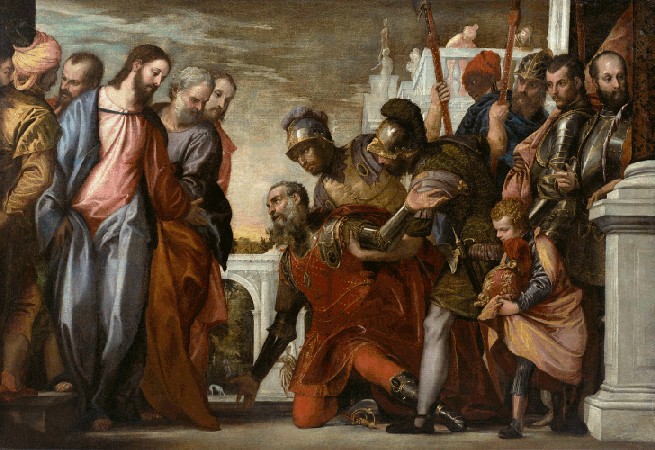
In the Gospel reading, however, we encounter almost exactly the reverse situation. A Roman centurion in the town of Capernaum has a servant who is ill and at the point of death. The centurion is a foreigner in the land of Israel. And as an observant Jew, Jesus is forbidden by the purity regulations of his religion from entering the house of a Gentile. If he does so, he will become ritually unclean, and will have to undergo a process of ritual purification before being allowed to participate again in the life and worship of the Jewish people.
So, where in the first reading we have a foreigner forbidden from entering God’s house, in the second reading we have God Incarnate forbidden from entering a foreigner’s house. The religious boundaries work in both directions!
Centurions were middle-ranking officers in the Roman army, which was divided into units called legions, cohorts, and centuries. Typically, in the first century, a legion consisted of about 4,800 soldiers, and was divided into ten cohorts each comprising 480 men. A cohort was divided in turn into six centuries, each consisting of 80 men and commanded by a centurion, assisted by junior officers.
So in or near Capernaum, the fishing village on the Sea of Galilee that was home to Saint Peter, there was stationed a century of soldiers commanded by this unnamed centurion. Unlike many Roman officers, however, he loved the Jewish nation, and had even built Capernaum’s synagogue. Incidentally, the basalt foundations and floor of the first-century synagogue at Capernaum can still be seen today, beneath the ruins of the fourth-century synagogue that replaced it.
It’s possible that our centurion may have been what was known in the Roman world as a “God-fearer,” that is, a Gentile who admired the Jewish religion, prayed to its God, and tried to follow its ethical teachings, without going the whole way converting, being circumcised, and becoming a Torah-observant Jew.
Be that as it may, a key responsibility of the centurion’s job was to pay close attention to everything that was going on in his immediate vicinity – so that he would be in a position to respond to the first signs of trouble. He would thus have been fully informed about Jesus. Prophets and teachers with a popular following were precisely the sorts of people the Roman authorities wanted to keep a close eye on. So, no doubt, the centurion would have heard about our Lord’s powers as a healer and miracle-worker as well.
No wonder, then, when his beloved servant is at the point of death, that he sends the local elders of the synagogue to seek Jesus’ assistance. In response to his plea, and with the elders’ good recommendation of this centurion, Jesus agrees and comes with them. But when he hears that our Lord is on the way, rather than let him complete the journey and cross the threshold of his house, the centurion sends friends with the message: “Lord … I am not worthy to have you come under my roof. But say the word, and let my servant be healed.”
In other words, in a display of enormous cultural sensitivity and consideration, the centurion is respecting the religious boundaries that Jesus must observe. His statement, “I am not worthy,” refers not to his moral character but rather to his ritually unclean status as a Gentile. He knows that if Jesus enters his house, it will cause him the great inconvenience of having to undergo ritual purification, and could very well cause others to accuse him of being a Roman collaborator.
But the centurion also knows that while as a human being Jesus is restricted by these religious boundaries, as the agent of God’s power he is not. So the centurion affirms his belief that Jesus can heal his servant simply by speaking a word from a distance – just as he himself obeys orders issued from a distance by his superiors, and just as he commands his subordinates to travel great distances to carry out his orders.
In short, while both the centurion and Jesus himself are restricted by the religious boundaries separating Jews and Gentiles, nonetheless, both the centurion’s faith, and our Lord’s power and authority, are able to cross over and transcend all such boundaries. Jesus marvels that not even in Israel has he encountered such faith. And, even from a distance, the centurion’s servant is healed.
Now the great temptation for the preacher at this point would be to conclude that, well, that was then and this is now, and of course we don’t observe such silly religious boundaries anymore. But that conclusion would be profoundly mistaken. The boundaries have changed, to be sure, but they’re still there.
For example, according to the canon law of the Episcopal Church, only those who’ve been baptized may receive Holy Communion. Only priests may celebrate the Eucharist. Only bishops may ordain. The rubrics of the Prayer Book set multiple boundaries on what may and may not be done in our liturgical services. And these religious boundaries are valid, necessary, and appropriate for ordering our life together in the Church.
Yet the message of our readings this morning also remains valid. We’re bound by these boundaries, but God is not. God hears the prayers of all who call upon him, whether Christian or not, whether religious believer or not. And God retains absolute freedom in deciding how he may choose to respond.
Luke 7:1-10
We hear a lot today about boundaries. The maintenance of appropriate professional and personal boundaries is a hot topic. And both our Old Testament and Gospel readings today touch on what might be called religious boundaries.
In the first reading, King Solomon is praying at the dedication of the newly constructed Temple in Jerusalem. He calls on God to listen to and answer the prayer of even the foreigner who comes to Jerusalem to pray towards this house.
At this stage of Israel’s history, a foreigner is by definition a Gentile. Such a foreigner is forbidden to enter the Temple on pain of death. So here we encounter a firm religious and national boundary. Entry into God’s house is restricted to members of God’s people Israel; everyone else must stay outside.
Yet Solomon acknowledges in his prayer that God himself is not bound by such boundaries. When the foreigner prays towards this house, Solomon implores, “hear thou in heaven thy dwelling place, and do according to all for which the foreigner calls unto thee; in order that all the peoples of the earth may know thy name and fear thee …”
In other words, the boundary restricting a foreigner from access to God’s house may be appropriate and necessary in that time and place; but it doesn’t restrict the foreigner’s access to God himself. God is perfectly well able to hear their prayers as well and reach out beyond the boundary to do all that the foreigner asks.
In the Gospel reading, however, we encounter almost exactly the reverse situation. A Roman centurion in the town of Capernaum has a servant who is ill and at the point of death. The centurion is a foreigner in the land of Israel. And as an observant Jew, Jesus is forbidden by the purity regulations of his religion from entering the house of a Gentile. If he does so, he will become ritually unclean, and will have to undergo a process of ritual purification before being allowed to participate again in the life and worship of the Jewish people.
So, where in the first reading we have a foreigner forbidden from entering God’s house, in the second reading we have God Incarnate forbidden from entering a foreigner’s house. The religious boundaries work in both directions!
Centurions were middle-ranking officers in the Roman army, which was divided into units called legions, cohorts, and centuries. Typically, in the first century, a legion consisted of about 4,800 soldiers, and was divided into ten cohorts each comprising 480 men. A cohort was divided in turn into six centuries, each consisting of 80 men and commanded by a centurion, assisted by junior officers.
So in or near Capernaum, the fishing village on the Sea of Galilee that was home to Saint Peter, there was stationed a century of soldiers commanded by this unnamed centurion. Unlike many Roman officers, however, he loved the Jewish nation, and had even built Capernaum’s synagogue. Incidentally, the basalt foundations and floor of the first-century synagogue at Capernaum can still be seen today, beneath the ruins of the fourth-century synagogue that replaced it.
It’s possible that our centurion may have been what was known in the Roman world as a “God-fearer,” that is, a Gentile who admired the Jewish religion, prayed to its God, and tried to follow its ethical teachings, without going the whole way converting, being circumcised, and becoming a Torah-observant Jew.
Be that as it may, a key responsibility of the centurion’s job was to pay close attention to everything that was going on in his immediate vicinity – so that he would be in a position to respond to the first signs of trouble. He would thus have been fully informed about Jesus. Prophets and teachers with a popular following were precisely the sorts of people the Roman authorities wanted to keep a close eye on. So, no doubt, the centurion would have heard about our Lord’s powers as a healer and miracle-worker as well.
No wonder, then, when his beloved servant is at the point of death, that he sends the local elders of the synagogue to seek Jesus’ assistance. In response to his plea, and with the elders’ good recommendation of this centurion, Jesus agrees and comes with them. But when he hears that our Lord is on the way, rather than let him complete the journey and cross the threshold of his house, the centurion sends friends with the message: “Lord … I am not worthy to have you come under my roof. But say the word, and let my servant be healed.”
In other words, in a display of enormous cultural sensitivity and consideration, the centurion is respecting the religious boundaries that Jesus must observe. His statement, “I am not worthy,” refers not to his moral character but rather to his ritually unclean status as a Gentile. He knows that if Jesus enters his house, it will cause him the great inconvenience of having to undergo ritual purification, and could very well cause others to accuse him of being a Roman collaborator.
But the centurion also knows that while as a human being Jesus is restricted by these religious boundaries, as the agent of God’s power he is not. So the centurion affirms his belief that Jesus can heal his servant simply by speaking a word from a distance – just as he himself obeys orders issued from a distance by his superiors, and just as he commands his subordinates to travel great distances to carry out his orders.
In short, while both the centurion and Jesus himself are restricted by the religious boundaries separating Jews and Gentiles, nonetheless, both the centurion’s faith, and our Lord’s power and authority, are able to cross over and transcend all such boundaries. Jesus marvels that not even in Israel has he encountered such faith. And, even from a distance, the centurion’s servant is healed.
Now the great temptation for the preacher at this point would be to conclude that, well, that was then and this is now, and of course we don’t observe such silly religious boundaries anymore. But that conclusion would be profoundly mistaken. The boundaries have changed, to be sure, but they’re still there.
For example, according to the canon law of the Episcopal Church, only those who’ve been baptized may receive Holy Communion. Only priests may celebrate the Eucharist. Only bishops may ordain. The rubrics of the Prayer Book set multiple boundaries on what may and may not be done in our liturgical services. And these religious boundaries are valid, necessary, and appropriate for ordering our life together in the Church.
Yet the message of our readings this morning also remains valid. We’re bound by these boundaries, but God is not. God hears the prayers of all who call upon him, whether Christian or not, whether religious believer or not. And God retains absolute freedom in deciding how he may choose to respond.
Sunday, May 26, 2013
Sermon for Trinity Sunday
The curious thing about Trinity Sunday is that it’s one of the few festivals in the Church calendar that celebrates a doctrine. Many feasts of the liturgical year commemorate events recorded in Scripture – and very often on the date or during the season of the year when we believe them to have happened. Easter falls in the spring around Passover, the time of year when Jesus died and rose again. And following the New Testament chronology exactly, Ascension comes forty days and Pentecost fifty days after Easter.
The date of Christmas is admittedly arbitrary, and appropriately occurs on the date of an old Roman midwinter holiday celebrating the triumph of light over darkness around the time of the winter solstice. But then the Church coordinated the dates of the Annunciation, the Visitation, and the Nativity of Saint John the Baptist to fit in chronologically with the putative date of Christ’s birth at Christmas. Likewise, we keep most saints’ days on the anniversary of the saint’s death: his or her “birthday into heaven.”
But Trinity Sunday is different. We could really observe it at any time of the year, for the mystery it celebrates is timeless. Such events as the Birth of Christ, the Baptism of Christ, and the descent of the Holy Spirit at Pentecost all represent definite historical moments in God’s revelation of himself to his people. For this reason, theologians sometimes speak of the cumulative record of these moments as “salvation history.” But there is no single historical moment when God revealed himself as Trinity. Rather, over several centuries of sustained reflection on the biblical revelation, the Church developed the doctrine of the Trinity – as summarized in the Nicene and Athanasian Creeds – as the only way of speaking about God that could adequately account for the reality of people’s actual experiences of the Father, the Son, and the Holy Spirit.
So, why do we celebrate Trinity Sunday when we do? The reason is simple: For the past six months, from Advent Sunday through the Day of Pentecost, we’ve been retracing the history of God’s self-revelation to his people, from the preaching of the Old Testament prophets, through the Incarnation, death and Resurrection of Christ, to the outpouring of the Holy Spirit upon the Church. Today, we step back and do precisely what the early Christians did: we reflect on what we’ve learned. And the whole history of revelation that we’ve been recapitulating these past six months adds up to this picture of the Triune God given expression by the Trinitarian doctrine.
The word Trinity never occurs in Scripture. It appears to have been coined by the Second Century Roman theologian Tertullian. But the Christians of the first four centuries found that the doctrine made sense of so much: such as the threefold “Holy, Holy, Holy” of the cherubim in the vision of Isaiah; and God’s strange use of the first-person plural in the opening chapter of Genesis: “Let us make man in our own image.”
Most important of all, the doctrine of the Trinity helped the early Christians understand the words and actions of Jesus, who was himself God Incarnate and yet spoke of his Father in heaven and of the Holy Spirit he would send down upon the Church after his Ascension. Moreover, Trinitarian language helped them make sense of their own experience of God: for at one and the same time they had a vivid sense of God as their heavenly creator and father; of Jesus as their Lord, Savior, friend, and brother; and of the Holy Spirit as the guiding and empowering divine presence within. God was indeed one in being, and yet had revealed himself as three Persons.
A good exercise on Trinity Sunday, rather than trying to resolve the paradox of how God can be one and three at the same time, is to ask ourselves how we’ve experienced the three Persons of the Trinity in our own spiritual lives: In what ways have we known God as our Father in heaven; as Jesus our Savior; and as the Holy Spirit who indwells us and gives us inner counsel and strength?
Most of all, the doctrine of the Trinity speaks to us of God’s very nature and being as love. Our God is not a solitary monad subsisting in splendid isolation, but rather a community of three Persons eternally united in mutual relations of perfect self-giving love. And because God has created us in his image, it follows that we find the fulfillment of our nature not in rugged individualism, but rather in relationship and community. In other words, because God is love, we realize our God‑given purpose in life by learning to love and to be loved! And our eternal destiny in Christ is to be caught up forever into that perfect circle of divine love that is God’s own inner life.
So, Trinity Sunday remains a superb way to wrap up and summarize the completed cycle of the liturgical year before we move into Ordinary Time. And it invites us to celebrate the most unique aspect of the Christian revelation: our faith in God who is one in three and three in one, whose very nature and essence is love.
The date of Christmas is admittedly arbitrary, and appropriately occurs on the date of an old Roman midwinter holiday celebrating the triumph of light over darkness around the time of the winter solstice. But then the Church coordinated the dates of the Annunciation, the Visitation, and the Nativity of Saint John the Baptist to fit in chronologically with the putative date of Christ’s birth at Christmas. Likewise, we keep most saints’ days on the anniversary of the saint’s death: his or her “birthday into heaven.”
But Trinity Sunday is different. We could really observe it at any time of the year, for the mystery it celebrates is timeless. Such events as the Birth of Christ, the Baptism of Christ, and the descent of the Holy Spirit at Pentecost all represent definite historical moments in God’s revelation of himself to his people. For this reason, theologians sometimes speak of the cumulative record of these moments as “salvation history.” But there is no single historical moment when God revealed himself as Trinity. Rather, over several centuries of sustained reflection on the biblical revelation, the Church developed the doctrine of the Trinity – as summarized in the Nicene and Athanasian Creeds – as the only way of speaking about God that could adequately account for the reality of people’s actual experiences of the Father, the Son, and the Holy Spirit.
So, why do we celebrate Trinity Sunday when we do? The reason is simple: For the past six months, from Advent Sunday through the Day of Pentecost, we’ve been retracing the history of God’s self-revelation to his people, from the preaching of the Old Testament prophets, through the Incarnation, death and Resurrection of Christ, to the outpouring of the Holy Spirit upon the Church. Today, we step back and do precisely what the early Christians did: we reflect on what we’ve learned. And the whole history of revelation that we’ve been recapitulating these past six months adds up to this picture of the Triune God given expression by the Trinitarian doctrine.
The word Trinity never occurs in Scripture. It appears to have been coined by the Second Century Roman theologian Tertullian. But the Christians of the first four centuries found that the doctrine made sense of so much: such as the threefold “Holy, Holy, Holy” of the cherubim in the vision of Isaiah; and God’s strange use of the first-person plural in the opening chapter of Genesis: “Let us make man in our own image.”
Most important of all, the doctrine of the Trinity helped the early Christians understand the words and actions of Jesus, who was himself God Incarnate and yet spoke of his Father in heaven and of the Holy Spirit he would send down upon the Church after his Ascension. Moreover, Trinitarian language helped them make sense of their own experience of God: for at one and the same time they had a vivid sense of God as their heavenly creator and father; of Jesus as their Lord, Savior, friend, and brother; and of the Holy Spirit as the guiding and empowering divine presence within. God was indeed one in being, and yet had revealed himself as three Persons.
A good exercise on Trinity Sunday, rather than trying to resolve the paradox of how God can be one and three at the same time, is to ask ourselves how we’ve experienced the three Persons of the Trinity in our own spiritual lives: In what ways have we known God as our Father in heaven; as Jesus our Savior; and as the Holy Spirit who indwells us and gives us inner counsel and strength?
Most of all, the doctrine of the Trinity speaks to us of God’s very nature and being as love. Our God is not a solitary monad subsisting in splendid isolation, but rather a community of three Persons eternally united in mutual relations of perfect self-giving love. And because God has created us in his image, it follows that we find the fulfillment of our nature not in rugged individualism, but rather in relationship and community. In other words, because God is love, we realize our God‑given purpose in life by learning to love and to be loved! And our eternal destiny in Christ is to be caught up forever into that perfect circle of divine love that is God’s own inner life.
So, Trinity Sunday remains a superb way to wrap up and summarize the completed cycle of the liturgical year before we move into Ordinary Time. And it invites us to celebrate the most unique aspect of the Christian revelation: our faith in God who is one in three and three in one, whose very nature and essence is love.
Sunday, May 12, 2013
Easter VII -- Year C [Sunday after the Ascension]
John 17:20-26
The opening chapter of the Acts of the Apostles tells us that after our Lord’s Ascension into heaven, the Apostles together with the women and Mary, the mother of the Lord, returned to Jerusalem. And: “All these with one accord devoted themselves to prayer …” This period of prayer culminated, of course, in the descent of the Holy Spirit on the Day of Pentecost.
In the cycle of the Church Year, we find ourselves in the corresponding period. We celebrated the Ascension on Thursday; and we shall celebrate Pentecost a week from today. Christ has ascended into heaven; but the Holy Spirit has not yet descended. So for us, as for Mary and the Apostles in the Upper Room, it’s a time of waiting and prayer.
Although in many places it’s become the practice to transfer the Ascension from Thursday to Sunday, nonetheless I think we lose something vital by doing so. For the Sunday after the Ascension has much to teach us about praying for the coming of the Holy Spirit. And this is particularly the case with today’s reading from Saint John’s Gospel.
The setting is the Last Supper. Our Lord is praying for his disciples on the eve of his arrest, trial, and death. He prays specifically for their unity in love after he’s taken from them. So this prayer exactly anticipates their situation after his Ascension. He’s no longer physically present with them; yet he’s entrusted them with the mission of preaching the Gospel to the ends of the earth. They cannot possibly fulfill this mission without prayer. So here he prays for them and for us as well.
A helpful hint for understanding today’s Gospel is that when we hear it read, we need to assume the posture of people being prayed for. After his Ascension, Jesus stands in the presence of the Father continually making intercession for us. And in today’s Gospel we have the privilege of hearing a snippet of what his prayer for us sounds like.
He prays that we all may be one, as he and the Father are one. During the past century, this passage has become one of the proof texts for the ecumenical movement, which has striven mightily to overcome the various divisions within the Body of Christ.
A key development in the history of Christianity in the twentieth century was the growing realization among Christians that our disunity hinders the Church’s mission and witness in the world. Thus, Christians who had once seen themselves as being in competition and rivalry – Methodists, Baptists, Presbyterians, Lutherans, Roman Catholics – began to discover the rewards of getting to know each other, exchanging ideas, and exploring areas of potential co-operation.
By the 1960s and 1970s, conversations between Roman Catholics, Anglicans, Eastern Orthodox, Lutherans, and Methodists had gained great momentum, occasioning enormous optimism about the ecumenical future. Yet in the following decades, disillusionment began to set in. While these dialogues produced some interesting agreed statements on doctrinal matters, and in some cases formal intercommunion – such as between the Lutherans and us – early hopes for quick corporate reunion have largely met with frustration.
In response, some proposed changing the movement’s goals and methods. In 1995, for example, Konrad Raiser, Secretary General of the World Council of Churches, proposed that the various church bodies should give up seeking doctrinal agreement and structural unity, and instead devote themselves to co-operation on issues of justice, peace, and protection of the environment.
Others sought to ignore, minimize, or trivialize the differences between Christians. For example, also in the 1990s, when I was in my previous parish, I participated in a great ecumenical service at a local Lutheran church for the Week of Prayer for Christian unity. About forty clergy of different traditions processed and sat together. The vestments and robes ranged from Geneva pulpit gowns to cassocks and lacy surplices. The musical offerings featured traditional choral music, an African American Gospel choir, and a folk rock group. A Baptist preacher and a Roman Catholic priest both gave outstanding sermons. About four hundred people packed the church to standing room only. It was a moving and powerful witness to our shared commitment to Christian unity.
Imagine my disappointment the next morning when I opened the local paper and read the first line in the story: “Christians of all denominations came together last night to demonstrate that doctrine doesn’t matter.” What a profound misreading of that service’s meaning! Doctrine does matter! Yet in that ecumenical service we’d come together to express, first, our conviction that our shared beliefs and practices outweigh our differences; and, second, our commitment to praying and working together to resolve and overcome the very real differences that still divide us.
For the unity that we seek, the unity for which Christ prayed, is nothing less than unity in the fullness of truth and love. Such unity can’t be achieved by warm fuzzy feelings of togetherness fostering the illusion that differences in belief don’t matter. It can’t be achieved solely by new bureaucratic structures, or by carefully crafted statements concealing unresolved differences behind compromise formulas and ambiguous language. It really can’t be achieved by human effort at all. Rather, it’s a gift of the Holy Spirit, which can only be prayed for and received in God’s good time.
Listen again to our Lord’s words: “that they may be one; even as thou, Father, art in me, and I in thee, that they may also be in us . . . that they may be one even as we are one, I in them and thou in me, that they may become perfectly one . . .”
This unity, which Jesus has with his Father in heaven, is a complete harmony of heart, mind, and will. In John’s Gospel, Jesus emphasizes again and again that he has come to speak the words and to do the will of his Father in heaven. And here Jesus is praying that his disciples may likewise be of one heart, mind, and will—both with him, and with each other.
And such complete harmony of heart, mind, and will is humanly impossible. But notice that here Jesus is praying for his disciples. He’s not commanding us to be one; he’s not promising that we shall be one; he’s praying that we may be one. In other words, we cannot achieve this true unity on our own. We can only pray for it, and we can only receive it as a gift from God.
One of the signs of the presence of the Holy Spirit in our midst is the unity of our hearts, minds, and wills in the truth of God’s Word. A key work of the Holy Spirit is to reconcile those who are divided and at enmity. And so, in this interval between the Lord’s Ascension and the coming of the Holy Spirit at Pentecost, we join with our Lady and the Apostles praying in the upper room – the same room, incidentally, where Jesus prayed at the Last Supper – that we may all be one, even as he and the Father are one.
The opening chapter of the Acts of the Apostles tells us that after our Lord’s Ascension into heaven, the Apostles together with the women and Mary, the mother of the Lord, returned to Jerusalem. And: “All these with one accord devoted themselves to prayer …” This period of prayer culminated, of course, in the descent of the Holy Spirit on the Day of Pentecost.
In the cycle of the Church Year, we find ourselves in the corresponding period. We celebrated the Ascension on Thursday; and we shall celebrate Pentecost a week from today. Christ has ascended into heaven; but the Holy Spirit has not yet descended. So for us, as for Mary and the Apostles in the Upper Room, it’s a time of waiting and prayer.
Although in many places it’s become the practice to transfer the Ascension from Thursday to Sunday, nonetheless I think we lose something vital by doing so. For the Sunday after the Ascension has much to teach us about praying for the coming of the Holy Spirit. And this is particularly the case with today’s reading from Saint John’s Gospel.
The setting is the Last Supper. Our Lord is praying for his disciples on the eve of his arrest, trial, and death. He prays specifically for their unity in love after he’s taken from them. So this prayer exactly anticipates their situation after his Ascension. He’s no longer physically present with them; yet he’s entrusted them with the mission of preaching the Gospel to the ends of the earth. They cannot possibly fulfill this mission without prayer. So here he prays for them and for us as well.
A helpful hint for understanding today’s Gospel is that when we hear it read, we need to assume the posture of people being prayed for. After his Ascension, Jesus stands in the presence of the Father continually making intercession for us. And in today’s Gospel we have the privilege of hearing a snippet of what his prayer for us sounds like.
He prays that we all may be one, as he and the Father are one. During the past century, this passage has become one of the proof texts for the ecumenical movement, which has striven mightily to overcome the various divisions within the Body of Christ.
A key development in the history of Christianity in the twentieth century was the growing realization among Christians that our disunity hinders the Church’s mission and witness in the world. Thus, Christians who had once seen themselves as being in competition and rivalry – Methodists, Baptists, Presbyterians, Lutherans, Roman Catholics – began to discover the rewards of getting to know each other, exchanging ideas, and exploring areas of potential co-operation.
By the 1960s and 1970s, conversations between Roman Catholics, Anglicans, Eastern Orthodox, Lutherans, and Methodists had gained great momentum, occasioning enormous optimism about the ecumenical future. Yet in the following decades, disillusionment began to set in. While these dialogues produced some interesting agreed statements on doctrinal matters, and in some cases formal intercommunion – such as between the Lutherans and us – early hopes for quick corporate reunion have largely met with frustration.
In response, some proposed changing the movement’s goals and methods. In 1995, for example, Konrad Raiser, Secretary General of the World Council of Churches, proposed that the various church bodies should give up seeking doctrinal agreement and structural unity, and instead devote themselves to co-operation on issues of justice, peace, and protection of the environment.
Others sought to ignore, minimize, or trivialize the differences between Christians. For example, also in the 1990s, when I was in my previous parish, I participated in a great ecumenical service at a local Lutheran church for the Week of Prayer for Christian unity. About forty clergy of different traditions processed and sat together. The vestments and robes ranged from Geneva pulpit gowns to cassocks and lacy surplices. The musical offerings featured traditional choral music, an African American Gospel choir, and a folk rock group. A Baptist preacher and a Roman Catholic priest both gave outstanding sermons. About four hundred people packed the church to standing room only. It was a moving and powerful witness to our shared commitment to Christian unity.
Imagine my disappointment the next morning when I opened the local paper and read the first line in the story: “Christians of all denominations came together last night to demonstrate that doctrine doesn’t matter.” What a profound misreading of that service’s meaning! Doctrine does matter! Yet in that ecumenical service we’d come together to express, first, our conviction that our shared beliefs and practices outweigh our differences; and, second, our commitment to praying and working together to resolve and overcome the very real differences that still divide us.
For the unity that we seek, the unity for which Christ prayed, is nothing less than unity in the fullness of truth and love. Such unity can’t be achieved by warm fuzzy feelings of togetherness fostering the illusion that differences in belief don’t matter. It can’t be achieved solely by new bureaucratic structures, or by carefully crafted statements concealing unresolved differences behind compromise formulas and ambiguous language. It really can’t be achieved by human effort at all. Rather, it’s a gift of the Holy Spirit, which can only be prayed for and received in God’s good time.
Listen again to our Lord’s words: “that they may be one; even as thou, Father, art in me, and I in thee, that they may also be in us . . . that they may be one even as we are one, I in them and thou in me, that they may become perfectly one . . .”
This unity, which Jesus has with his Father in heaven, is a complete harmony of heart, mind, and will. In John’s Gospel, Jesus emphasizes again and again that he has come to speak the words and to do the will of his Father in heaven. And here Jesus is praying that his disciples may likewise be of one heart, mind, and will—both with him, and with each other.
And such complete harmony of heart, mind, and will is humanly impossible. But notice that here Jesus is praying for his disciples. He’s not commanding us to be one; he’s not promising that we shall be one; he’s praying that we may be one. In other words, we cannot achieve this true unity on our own. We can only pray for it, and we can only receive it as a gift from God.
One of the signs of the presence of the Holy Spirit in our midst is the unity of our hearts, minds, and wills in the truth of God’s Word. A key work of the Holy Spirit is to reconcile those who are divided and at enmity. And so, in this interval between the Lord’s Ascension and the coming of the Holy Spirit at Pentecost, we join with our Lady and the Apostles praying in the upper room – the same room, incidentally, where Jesus prayed at the Last Supper – that we may all be one, even as he and the Father are one.
Thursday, May 9, 2013
Ascension of the Lord
In my end is my beginning. The motto of Mary Queen of Scots famously quoted by T.S. Eliot in East Coker might well sum up the relationship between today’s readings from the Acts of the Apostles and the Gospel according to Saint Luke.
Actually, the placement of the first and third readings in today’s liturgy exactly reverses Luke’s sequence in his two books. The Acts of the Apostles is Luke’s sequel to his Gospel. So the third reading this evening comes from the very end of Luke’s Gospel, which comes first; whereas our opening reading came from the very beginning of the sequel, in which Luke tells the story of the early Church.
In any case, for Luke, the Ascension of the Lord is so pivotal an episode that he tells it twice: first at the end of his Gospel as the climax of his story of Jesus; and then at the beginning of the Acts of the Apostles as the commencement of his story of the early Church. And the Ascension is pivotal for us today in our life as Christians as well.
What really happened on Ascension Day? The short answer is that we don’t know. Perhaps the story is just a symbolic way of saying that Jesus has returned to his Father in heaven. Or, perhaps Jesus really did literally lift off from the ground and soar up into the clouds. The priest and writer Robert Farrar Capon once commented that Jesus only needed to get up as far as the first cloud in order to make his point – a visual point that his disciples would have understood perfectly in terms of their own world view and cosmology. The underlying theological principle here is that God always accommodates himself to our limitations by speaking in a language, whether verbal or visual, that we can understand.
The question, then, is what difference it makes to us. It used to be fashionable for theologians to write books attempting to tease out the relationship between the Jesus of history and the Christ of faith: that is, between the historical figure of Jesus about whom we read in the Gospels; and the Christ whom we worship and obey as Lord in the Church today. The Ascension teaches us, however, that the Jesus of history and the Christ of faith are absolutely one and the same person. In other words, the Jesus about whom we read in the Bible is not merely an historical figure who lived and died in the ancient past, but rather someone who is alive even now in the fullest possible sense of the word.
The Ascension is absolutely critical to our Christian faith because it addresses the question: Where is Jesus now? The answer is that he’s been exalted to the right hand of his Father in heaven, where he reigns as Lord over all creation.
Yet, precisely because he’s returned to his Father in heaven, he can be present for us in the Church here and now. We can know him not only as someone whose words and deeds we read about in the Bible as a distant figure from the past, but also as a living presence in our midst – and more specifically, as the one who still speaks to us in his Word, who still comes among us in his Sacraments, and who still claims our deepest loyalty, allegiance, faith, and obedience as our Lord and Savior.
Paradoxically, then, the Ascension marks the beginning not of the absence of Jesus from his Church on earth, but rather of his presence in a new mode. During our Lord’s earthly Incarnation, his presence to his disciples was localized in his human body. After his Ascension, however, Jesus becomes present in the Spirit wherever his disciples travel, wherever the Church gathers in his name, wherever his Word is preached, wherever his Sacraments are celebrated.
So the Ascension is both end and beginning. It marks the end of the story of our Lord’s earthly Incarnation at a definite time and place in human history. But it also marks the beginning of our story as the Church, the Body of Christ on earth, the community of those who continue his mission and find new life in him.
Actually, the placement of the first and third readings in today’s liturgy exactly reverses Luke’s sequence in his two books. The Acts of the Apostles is Luke’s sequel to his Gospel. So the third reading this evening comes from the very end of Luke’s Gospel, which comes first; whereas our opening reading came from the very beginning of the sequel, in which Luke tells the story of the early Church.
In any case, for Luke, the Ascension of the Lord is so pivotal an episode that he tells it twice: first at the end of his Gospel as the climax of his story of Jesus; and then at the beginning of the Acts of the Apostles as the commencement of his story of the early Church. And the Ascension is pivotal for us today in our life as Christians as well.
What really happened on Ascension Day? The short answer is that we don’t know. Perhaps the story is just a symbolic way of saying that Jesus has returned to his Father in heaven. Or, perhaps Jesus really did literally lift off from the ground and soar up into the clouds. The priest and writer Robert Farrar Capon once commented that Jesus only needed to get up as far as the first cloud in order to make his point – a visual point that his disciples would have understood perfectly in terms of their own world view and cosmology. The underlying theological principle here is that God always accommodates himself to our limitations by speaking in a language, whether verbal or visual, that we can understand.
The question, then, is what difference it makes to us. It used to be fashionable for theologians to write books attempting to tease out the relationship between the Jesus of history and the Christ of faith: that is, between the historical figure of Jesus about whom we read in the Gospels; and the Christ whom we worship and obey as Lord in the Church today. The Ascension teaches us, however, that the Jesus of history and the Christ of faith are absolutely one and the same person. In other words, the Jesus about whom we read in the Bible is not merely an historical figure who lived and died in the ancient past, but rather someone who is alive even now in the fullest possible sense of the word.
The Ascension is absolutely critical to our Christian faith because it addresses the question: Where is Jesus now? The answer is that he’s been exalted to the right hand of his Father in heaven, where he reigns as Lord over all creation.
Yet, precisely because he’s returned to his Father in heaven, he can be present for us in the Church here and now. We can know him not only as someone whose words and deeds we read about in the Bible as a distant figure from the past, but also as a living presence in our midst – and more specifically, as the one who still speaks to us in his Word, who still comes among us in his Sacraments, and who still claims our deepest loyalty, allegiance, faith, and obedience as our Lord and Savior.
Paradoxically, then, the Ascension marks the beginning not of the absence of Jesus from his Church on earth, but rather of his presence in a new mode. During our Lord’s earthly Incarnation, his presence to his disciples was localized in his human body. After his Ascension, however, Jesus becomes present in the Spirit wherever his disciples travel, wherever the Church gathers in his name, wherever his Word is preached, wherever his Sacraments are celebrated.
So the Ascension is both end and beginning. It marks the end of the story of our Lord’s earthly Incarnation at a definite time and place in human history. But it also marks the beginning of our story as the Church, the Body of Christ on earth, the community of those who continue his mission and find new life in him.
Sunday, April 28, 2013
Fifth Sunday of Easter, Year C
John 13:31-35
At one level, this saying of Jesus seems simple. There’s nothing very surprising or startling about telling his disciples to love one another. But, especially in John’s Gospel, it’s often worth taking a closer look at our Lord’s words and paying attention to the details.
A new commandment I give to you. Notice, first of all, that Jesus calls this saying a commandment: not a suggestion, recommendation, invitation, good advice, or exhortation, but a commandment. Spoken on the night before his death, these words are part of what is often called his farewell speech. If you want to continue to be my disciples after I’m gone, here’s what you must do. These are your marching orders.
Notice, also, that Jesus calls this saying not merely a commandment but a new commandment: something that the disciples presumably haven’t heard before. And that raises the question: In what sense is the instruction to love one another new?
Well, for one thing, there are the words “one another.” In the Old Testament, God had given Israel the commandment to “love your neighbor as yourself.” Elsewhere in the Gospels, Jesus tells the disciples to love even their enemies. But here he’s narrowing the focus to speak specifically of love within the community of disciples. In other words, from now on the members of his Church must be known to the world as people who love one another.
Even more than that, this commandment to love one another is a new commandment on account of what comes next: “as I have loved you.” There’s the kicker. It’s really not that hard to love your neighbor as yourself. You just need to be willing to do for your neighbor whatever you’d expect your neighbor to do for you. So, for example, if when I’m not feeling well I’d like you to go to the pharmacy for me and get my prescription filled, then I’d better be prepared to go to the pharmacy for you and get your prescription filled when you’re not feeling well.
But our Lord’s love far surpasses that kind of love. For us, he dies on the cross. That’s not something we’d ever expect anyone else to do for us. Yet for us, Jesus offers up everything, with no thought for himself. The love he demonstrates on the cross is self-giving and sacrificial: love that dies to self for the sake of the beloved.
It’s this quality of self-giving, self-denying love that Jesus commands us to exhibit in our life together as Christians. This does not necessarily mean that we shall literally be called to suffer martyrdom on account of our Christian commitment – although in many parts of the world giving one’s life for Christ remains a very real possibility. But it does mean that in the life of the Church we need to be willing to put each other’s interests before our own interests, and to put the collective good of the community before our own individual good. In this way, we learn to love one another, even as Christ has loved us.
And to a large extent we can already see this love for one another in lives of our parish and diocesan communities. Here at S. Stephen’s, I’m often touched, even moved, by the ways in which parishioners reach out to express concern for one another in times of loss, or to lend a helping hand in time of need. True, we’re not a cozy little suburban parish where everybody minds everybody else’s business; and I’m just as glad for that. But nonetheless our life together in this rather eclectic collection of occasionally eccentric personalities – entirely typical of Anglo-Catholic parishes – is marked by genuine Christian love in all sorts of quiet and unobtrusive ways. And that’s very good.
But loving one another as Christ has loved us entails even more basic commitments. And the most basic commitment of all is simply to be here: to come faithfully to Mass on Sundays and principal holy days throughout the year; and to support by our presence the various other parish activities and events on the schedule as we’re able. In other words, the first step in loving one another as Christ has loved us is simply to be here for one another – even when, especially when, a dozen other claims on our time and attention seem more pressing.
The second step in loving one another as Christ has loved us is to assume collective responsibility for those activities that express our identity and fulfill our mission as a parish. If we truly love one another here at S. Stephen’s, and if we truly love our parish community as a whole, then we shall want to do everything we can to facilitate its participation in the spreading of the Gospel and the up-building of God’s kingdom.
Two opportunities in particular stand before us at this time. First, this coming Friday and Saturday, we shall be hosting Bishop Lindsay Urwin of the Anglican Shrine at Walsingham in England. He shall be giving an address at 6 pm on Friday evening followed by a panel discussion and Vespers of our Lady. And then on Saturday he’ll be our preacher at the Annual Mass and Meeting of the Society of Mary, beginning at 11 am. A number of visitors and guests are likely to be present. Coming out to support our parish in these activities is one concrete way in which we express our love for one another as Christ has loved us.
The other opportunity is perhaps a bit more challenging. We really need more parishioners coming to our daily Offices and Masses. Opening our doors daily for worship has been an integral part of this parish’s mission since 1896. Currently, weekday attendance is running at between two and three people, including the priest; and that’s really not enough to keep these daily services going as an active and vibrant ministry. I know in my bones that there are more parishioners out there who could come to at least some of these daily services if they simply made the decision to do so.
Here is a key example of what I mean by assuming collective responsibility for those activities that express our identity and fulfill our mission. Making the decision to come to one or more of our weekday Masses would be a profound expression of our love for God, for our parish, and for one another.
The point is that loving one another begins with such simple steps as these. They’re not always easy at the outset; they’re not always convenient; and they’re not always what we feel like doing at the moment. And yet, such little sacrifices school us in the art of loving one another as Jesus has loved us. In this way, those in the wider world will know that we’re his disciples, and may even be drawn in turn to joining us.
Sunday, April 7, 2013
Easter 2, Year C [Low Sunday]
When he had said this, he showed them his hands and his side.
A curious feature of the resurrection narrative in today’s Gospel is the emphasis placed on the wounds of the risen Christ. The Evangelist John mentions them twice.
First, Jesus appears, stands among the disciples, and says, “Peace be with you.” That greeting suggests that the disciples need reassurance. John has already told us that they’re hiding behind closed doors because they’re afraid of the authorities. But perhaps they’re also afraid of this mysterious figure that has suddenly appeared from nowhere—and certainly without having come in through the closed doors.
Then, after he says, “Peace be with you,” he shows them his hands and his side. Only then do the disciples recognize him: “Then the disciples were glad when they saw the Lord.” In other words, the disciples realize that it’s Jesus standing before them, risen from the dead, precisely because they see his wounds.
Throughout the various resurrection appearances, even those who were closest to Jesus during his earthly life have trouble recognizing him at first. But then there comes a moment when it becomes overwhelmingly clear who he is. Here, in this account, the clear markers of his identity are the scars in his hands and his side. Christ is gloriously risen; yet he reveals himself by means of his wounds.
This detail casts new light on the story of doubting Thomas that follows immediately afterwards. Here is the second instance where John mentions the wounds of the risen Christ. When the disciples tell Thomas, “We have seen the Lord,” he responds, “Unless I see in his hands the print of the nails, and place my finger in the mark of the nails, and place my hand in his side, I will not believe.”
On account of these words, Thomas has become known and loved down through the centuries as the patron saint of skeptics everywhere. But perhaps what he’s saying is not so much that he disbelieves the story, as that the only way that he will recognize this mysterious figure appearing to the disciples as Jesus is by touching his wounds.
In other words, perhaps Thomas doesn’t doubt that someone or something—a ghost, an angel, or a demon—is really appearing to the disciples. In those days, such supernatural apparitions were believed to be commonplace occurrences. But the only Jesus that Thomas wants anything to do with is the same Jesus that he knew during his earthly life, the same Jesus whom he saw crucified and laid in the tomb. No ghostly phantom will do.
In that case, Thomas’s attitude is not so much as doubt or lack of faith as an admirable insistence on the reality of Christ’s sufferings. One of the first heresies to trouble the early Church was known as docetism. The word comes from the Greek verb meaning “to appear” or “to seem.” According to this false teaching Jesus was indeed fully divine but had only the appearance or semblance of a human being. Thus, he could not suffer or die, and only appeared to suffer and die on the cross. It was all a sham. And three days later, he appeared to the disciples to reveal that his death was only an illusion after all. Everything was fine and there was nothing to worry about.
The Church rightly condemned this teaching as a dangerous heresy. Unless Jesus is truly human, unless he has shared fully in the human condition, then he cannot be the savior of real human beings. Unless he has truly suffered and died, he cannot redeem us from suffering and death. By repudiating docetism, the Church effectively took its stand with Thomas and said, “Unless we can place our fingers in the mark of the nails, and place our hands in his side, we don’t have a faith worth believing.”
In the course of my priestly ministry, I’ve discovered that as I get to know parishioners really well, there often comes a moment when they either come into my office or invite me into their home and sit me down and tell me the story of the worst things that have ever happened to them—bereavements, family tragedies, divorces, accidents, injuries, crimes, betrayals, assaults, incarcerations, incidents of childhood neglect or abuse.
It’s a privileged moment, and very humbling. I've come to think of it as "the showing of the wounds." The underlying premise is that I don’t really know you until I’ve seen your wounds. And by revealing your scars, you entrust me with the knowledge of who you really are, and you invite me into a closer pastoral relationship with you. And that’s precisely what the risen Jesus does when he shows the disciples—when he shows us—his wounds. He reveals to us who he really is, the crucified Savior, and invites us into the closest possible relationship with him.
Some years ago I read the story of a woman who’d suffered a great trauma, being assaulted in broad daylight in her own back yard. While her physical injuries were minimal, the psychological and emotional shock was overwhelming. She was hospitalized for several weeks and then spent months recovering on heavy doses of medication and frequent sessions with her therapist. Although everyone knew that something was wrong, the only people who knew what had happened were the police, her doctors, her therapist, and her pastor. Outside that circle, she just couldn’t talk about it.
Finally, her therapist suggested that a necessary step on the path of healing would be to tell someone else, perhaps a close friend. She told her pastor of this suggestion, and then said: “I want to tell my story to Joe.” The pastor was surprised. Although a member of the congregation, Joe seemed an odd candidate. Joe’s life seemed straightened out now, but several years back he’d become addicted to drugs, lost his career, lost his family, and had spent years in and out of rehab clinics. Now he mostly kept to himself. “Why Joe?” he asked. “Because,” she replied, “the only person I can talk to right now is someone who knows what it’s like to have been to hell and back.”
The message of today’s Easter Gospel is that we worship a risen Lord who has literally been to hell and back. He can understand anything we tell him and help us through anything we ever have to suffer. And he’s got the scars to prove it.
A curious feature of the resurrection narrative in today’s Gospel is the emphasis placed on the wounds of the risen Christ. The Evangelist John mentions them twice.
First, Jesus appears, stands among the disciples, and says, “Peace be with you.” That greeting suggests that the disciples need reassurance. John has already told us that they’re hiding behind closed doors because they’re afraid of the authorities. But perhaps they’re also afraid of this mysterious figure that has suddenly appeared from nowhere—and certainly without having come in through the closed doors.
Then, after he says, “Peace be with you,” he shows them his hands and his side. Only then do the disciples recognize him: “Then the disciples were glad when they saw the Lord.” In other words, the disciples realize that it’s Jesus standing before them, risen from the dead, precisely because they see his wounds.
Throughout the various resurrection appearances, even those who were closest to Jesus during his earthly life have trouble recognizing him at first. But then there comes a moment when it becomes overwhelmingly clear who he is. Here, in this account, the clear markers of his identity are the scars in his hands and his side. Christ is gloriously risen; yet he reveals himself by means of his wounds.
This detail casts new light on the story of doubting Thomas that follows immediately afterwards. Here is the second instance where John mentions the wounds of the risen Christ. When the disciples tell Thomas, “We have seen the Lord,” he responds, “Unless I see in his hands the print of the nails, and place my finger in the mark of the nails, and place my hand in his side, I will not believe.”
On account of these words, Thomas has become known and loved down through the centuries as the patron saint of skeptics everywhere. But perhaps what he’s saying is not so much that he disbelieves the story, as that the only way that he will recognize this mysterious figure appearing to the disciples as Jesus is by touching his wounds.
In other words, perhaps Thomas doesn’t doubt that someone or something—a ghost, an angel, or a demon—is really appearing to the disciples. In those days, such supernatural apparitions were believed to be commonplace occurrences. But the only Jesus that Thomas wants anything to do with is the same Jesus that he knew during his earthly life, the same Jesus whom he saw crucified and laid in the tomb. No ghostly phantom will do.
In that case, Thomas’s attitude is not so much as doubt or lack of faith as an admirable insistence on the reality of Christ’s sufferings. One of the first heresies to trouble the early Church was known as docetism. The word comes from the Greek verb meaning “to appear” or “to seem.” According to this false teaching Jesus was indeed fully divine but had only the appearance or semblance of a human being. Thus, he could not suffer or die, and only appeared to suffer and die on the cross. It was all a sham. And three days later, he appeared to the disciples to reveal that his death was only an illusion after all. Everything was fine and there was nothing to worry about.
The Church rightly condemned this teaching as a dangerous heresy. Unless Jesus is truly human, unless he has shared fully in the human condition, then he cannot be the savior of real human beings. Unless he has truly suffered and died, he cannot redeem us from suffering and death. By repudiating docetism, the Church effectively took its stand with Thomas and said, “Unless we can place our fingers in the mark of the nails, and place our hands in his side, we don’t have a faith worth believing.”
In the course of my priestly ministry, I’ve discovered that as I get to know parishioners really well, there often comes a moment when they either come into my office or invite me into their home and sit me down and tell me the story of the worst things that have ever happened to them—bereavements, family tragedies, divorces, accidents, injuries, crimes, betrayals, assaults, incarcerations, incidents of childhood neglect or abuse.
It’s a privileged moment, and very humbling. I've come to think of it as "the showing of the wounds." The underlying premise is that I don’t really know you until I’ve seen your wounds. And by revealing your scars, you entrust me with the knowledge of who you really are, and you invite me into a closer pastoral relationship with you. And that’s precisely what the risen Jesus does when he shows the disciples—when he shows us—his wounds. He reveals to us who he really is, the crucified Savior, and invites us into the closest possible relationship with him.
Some years ago I read the story of a woman who’d suffered a great trauma, being assaulted in broad daylight in her own back yard. While her physical injuries were minimal, the psychological and emotional shock was overwhelming. She was hospitalized for several weeks and then spent months recovering on heavy doses of medication and frequent sessions with her therapist. Although everyone knew that something was wrong, the only people who knew what had happened were the police, her doctors, her therapist, and her pastor. Outside that circle, she just couldn’t talk about it.
Finally, her therapist suggested that a necessary step on the path of healing would be to tell someone else, perhaps a close friend. She told her pastor of this suggestion, and then said: “I want to tell my story to Joe.” The pastor was surprised. Although a member of the congregation, Joe seemed an odd candidate. Joe’s life seemed straightened out now, but several years back he’d become addicted to drugs, lost his career, lost his family, and had spent years in and out of rehab clinics. Now he mostly kept to himself. “Why Joe?” he asked. “Because,” she replied, “the only person I can talk to right now is someone who knows what it’s like to have been to hell and back.”
The message of today’s Easter Gospel is that we worship a risen Lord who has literally been to hell and back. He can understand anything we tell him and help us through anything we ever have to suffer. And he’s got the scars to prove it.
Acknowledgment: Key ideas for this sermon came from William R. Willimon, “He showed them his scars,” Pulpit Resource, Vol. 25, No. 2 (April, May, June 1997), 3-6.
Sunday, March 31, 2013
Easter Sunday 2013
![]() |
| Duccio di Buoninsegna [1260-1318] The Three Marys at the Tomb, c. 1308-1311 |
As I did last night at the Great Vigil of Easter, I want to begin my remarks this morning by reflecting on a depiction of Christ’s Resurrection in Christian art. If you would look at the illustration on the cover of our program, it shows an Italo-Byzantine painting of three women encountering an angel at the tomb on the first Easter Sunday morning. In the Western tradition they’re sometimes known as the three Marys; in the Eastern tradition they’re known as the holy myrrh-bearing women.
The resurrection narrative in Saint Luke’s Gospel, which we’ve just heard, names them as Mary Magdalene, Joana, and Mary the mother of James. The other Gospels feature slight variations on their names and number. All four Gospels are clear, however, that before dawn on the first Easter Sunday a small group of women go to the tomb, but find it empty, and encounter heavenly messengers telling them that he is not there, for he is risen from the dead.
The women are then instructed to go and tell the disciples what they’ve heard and seen. For this reason, they are sometimes known as “apostles to the apostles”; and in the Eastern Orthodox tradition they have the title “equal to the apostles.” They’re witnesses to the events of both Good Friday and Easter Sunday. They’d followed Jesus from Galilee to Jerusalem. They were present when Jesus was taken down dead from the cross, wrapped in a linen shroud, and laid to rest in the tomb. Then it seemed that their whole world had fallen apart, their hopes dashed. But when they return after the Sabbath to anoint the body, they’re first to find the tomb empty.
Beyond the joy of realizing that something unimaginably wonderful has happened, they receive the crucial assignment of bearing witness to what they’ve seen and heard. In Jewish law, a fact can be established by the unanimous testimony of three witnesses, men or women – hence the importance of there having been at least three women at the tomb.
The Church’s faith in the resurrection of Christ rests in large part on their testimony. In recent years, some New Testament scholars have pointed out that belief in Christ’s resurrection from the dead depends on two pieces of evidence taken together: the empty tomb, and the subsequent appearances of the risen Christ to his disciples.
By itself, the empty tomb proves nothing. The body could have been stolen by his enemies, or surreptitiously removed by his followers. And by themselves, the appearances of the risen Christ can be explained away either as a delusion, or as the apparitions of a ghost. In the ancient world, as in many times and places since, it was not uncommon for grieving relatives and friends to encounter spirits of the departed.
But combine these two pieces of evidence – the empty tomb and the resurrection appearances – and it becomes clear that we’re dealing with an event that’s unique, unprecedented, and mysterious. One who was really and truly dead has now been raised to not just new life but a whole new state of existence. This is not merely the resuscitation of a corpse, but a passage from earthly life through death to eternal life. In the risen Christ, death itself has been defeated, and life has gained the victory.
Of this victory, both the women at the tomb and the disciples are made witnesses. The women are sent to bear witness to the disciples; and the disciples are in turn sent to bear witness to all nations and peoples of the earth. And from then until now, the Church has not ceased to continue this mission of bearing witness to the Lord’s Resurrection.
Years ago, when I was in the process of discerning my vocation to the priesthood, and going through all the steps necessary to secure approval to go to seminary, a friend of mine focused this point for me in a way that I’ve never forgotten. He went to the same seminary I did, in Virginia, three years ahead of me. In the middle of his second year, I went to visit him there, both to catch up with how he was doing, and to see the seminary for myself, since I was already thinking of going there.
In the course of our conversations, he remarked: “I’m a cradle Episcopalian. I grew up attending Sunday School, participating in the Youth Group, and serving as an acolyte. But in my first year of seminary I began to realize that I’d been wrong about much of what I thought were the purposes of the Church’s existence, its reasons for being. Worship and prayer; preaching, study, and teaching; mission, evangelism, and good works in the world – are all ordered towards serving the main purpose, the primary purpose, which is to bear witness to the Lord’s Resurrection. If we’re not doing that, then we’re not fulfilling our mission as the Church; we’re not being the Church.”
Those were challenging words; and I’ve often called them to mind when I’ve encountered people and groups in the Church who seem to think that the Resurrection is an optional extra that we don’t have to believe in if we don’t want to: or perhaps a metaphor for some sort of subjective experience of renewal on the part of the disciples and, by extension, on our part as well. No. Bearing witness to the Lord’s bodily Resurrection is the key activity that defines our identity and mission as the Church.
But can we believe in the Resurrection today and maintain our intellectual integrity? Yes we can. True, we live in a skeptical world which discourages belief in anything supernatural or miraculous. But where we end up so often depends on where we start. Some time ago, someone told me that she couldn’t accept Christianity because it was impossible to believe all its stories about miracles. For once, the right answer occurred to me on the spot, right there and then, rather than in the shower the next morning; and I replied: “No, you’ve got it exactly the wrong way round. It’s not that you can’t accept Christianity because you don’t believe in miracles; it’s that you can’t believe in miracles because you don’t accept Christianity.” In other words, if the Christian God is the sort of God that the Scriptures claim him to be, then miracles are no problem. If God created the universe and everything in it out of nothing, then he’s certainly capable of creative actions in the world that surpass human understanding, including raising the dead.
Here, then, is the reason for our joyful gathering this morning and, indeed, every Sunday morning. We gather as the Church to continue the witness begun by the women at the tomb. Christ is not dead but alive; and he makes himself available to us as a living presence in each of our lives if only we invite him in. Because he lives, we also have the promise of eternal life. And it’s our mission as the Church never to cease bearing witness to this good news.
Easter Vigil 2013
Saturday 30 March 2013
Not surprisingly, the Resurrection of Christ is a principal subject of Christian art. In the Churches of the West, both Catholic and Reformed, both paintings and statues tend to depict the Risen Christ emerging triumphant from the tomb, perhaps with the soldiers sleeping on either side of the rolled back stone.
In the Eastern Church, however, the artistic tradition is different. The illustration on the cover of your service booklet shows a typical Eastern Orthodox icon of the Resurrection or Anastasis.
Standing astride a great set of fallen gates – which have landed in the figure of a cross – with the nail-prints visible in his hands and feet, Christ reaches down to grasp the hand of a man rising from a tomb. The man is Adam, our first parent. Beside him is Eve. Behind her, the figure with the shepherd’s crook is likely King David. To the left, stand John the Baptist and one of the kings of Israel, probably Solomon.
This strange image symbolically depicts what happened between our Lord’s death on the cross on Good Friday, and his rising from the tomb on Easter Sunday: namely, his descent into hell. The Apostles’ Creed states that after Jesus died and was buried, “he descended into hell, and on the third day he rose again.” Yet often during Holy Week it’s possible to go straight from the death and burial on Friday afternoon to the Resurrection on Sunday morning, without pausing to consider anything in between.
Over the years, people have occasionally asked me the same question about the Great Vigil of Easter: why are you celebrating Easter when it’s not yet Easter Sunday? Part of the answer is that on Easter Sunday we celebrate the resurrection appearances to the women and the disciples; while during the Great Vigil we instead on the resurrection itself: the deep mystery of what happens in the dark solitude of Christ’s tomb before dawn. So, on this most holy night, it seems appropriate to say a few words about Christ’s harrowing of hell.
The Bible briefly mentions this descent into hell in several places. Perhaps the best-known reference occurs in the First Letter of Peter. The apostle writes that Jesus was “put to death in the flesh but made alive in the spirit; in which he went and preached to the spirits in prison” (3:18-19). A bit later, he adds: “For this is why the gospel was preached even to the dead, that though judged in the flesh like men, they might live in the spirit like God” (4:6).
Paul writes in his Letter to the Ephesians, that Christ “descended into the lower parts of the earth,” and then later “ascended far above all the heavens, that he might fill all things” (4:9-10).
In the Acts of the Apostles, the apostle Peter, in his sermon on the day of Pentecost, quotes Psalm 16, which says, “You will not abandon my soul to Hades, nor let your Holy One see corruption.” Peter then says that in the psalm David “foresaw and spoke of the resurrection of Christ, that he was not abandoned to Hades, nor did his flesh see corruption” (2:31). These words suggest that Christ’s soul went to the place called Hades, but was not abandoned there, while his body remained incorrupt in the tomb.
One final hint is that in the many places where the New Testament writers speak of Christ being raised from the dead, the phrase “from the dead” in the original Greek means not “from the state of death,” but rather, literally, “from among the dead ones.”
The Church’s traditional understanding is that when Jesus died and his body was placed in the tomb, his soul left his body and descended into the place known in Hebrew as Sheol, and in Greek as Hades: not the hell of eternal damnation and punishment that awaits the unrepentant after the Last Judgment, but rather that shadowy realm where the spirits of the dead were awaiting the coming of the Redeemer.
Here, rather than becoming a prisoner himself, Christ trampled down the gates, crushed the power of the devil, preached the Gospel, and set free the souls of the dead. Finally, his soul ascended and rejoined his body, which was lying incorrupt in the tomb awaiting resurrection.
This doctrine of Christ’s descent into hell points to at least three truths of importance.
First, Jesus truly experienced death. From his conception, he went through all the stages of human existence, both on this side of the grave and beyond. And this means that he’s present for us in every stage of our life and death. Even as we go down into the grave, he’s already there waiting for us. Not even death can separate us from the love of God in Christ Jesus.
Second, by descending into hell, Christ has made his presence known in every part of creation, from the highest heaven to the lowest depths of the earth. In particular, by preaching the Gospel to those who had died before him, he shows that his offer of salvation extends to all people in all times and in all places.
And third, by ascending from hell after descending there, he accomplishes his victory over death and the grave: a victory which will be made manifest when he appears to the women and the disciples on Easter Sunday; and a victory in which we share by being baptized into his Body, the Church.
Tomorrow morning we shall celebrate the discovery of the empty tomb and the appearances of the Risen Lord to his followers. But this evening, we rejoice, give thanks, and celebrate -- for in the words of the Exsultet: “The night is come, wherein the bonds of death were loosed, and Christ harrowing hell rose again in triumph.”
Not surprisingly, the Resurrection of Christ is a principal subject of Christian art. In the Churches of the West, both Catholic and Reformed, both paintings and statues tend to depict the Risen Christ emerging triumphant from the tomb, perhaps with the soldiers sleeping on either side of the rolled back stone.
In the Eastern Church, however, the artistic tradition is different. The illustration on the cover of your service booklet shows a typical Eastern Orthodox icon of the Resurrection or Anastasis.
Standing astride a great set of fallen gates – which have landed in the figure of a cross – with the nail-prints visible in his hands and feet, Christ reaches down to grasp the hand of a man rising from a tomb. The man is Adam, our first parent. Beside him is Eve. Behind her, the figure with the shepherd’s crook is likely King David. To the left, stand John the Baptist and one of the kings of Israel, probably Solomon.
This strange image symbolically depicts what happened between our Lord’s death on the cross on Good Friday, and his rising from the tomb on Easter Sunday: namely, his descent into hell. The Apostles’ Creed states that after Jesus died and was buried, “he descended into hell, and on the third day he rose again.” Yet often during Holy Week it’s possible to go straight from the death and burial on Friday afternoon to the Resurrection on Sunday morning, without pausing to consider anything in between.
Over the years, people have occasionally asked me the same question about the Great Vigil of Easter: why are you celebrating Easter when it’s not yet Easter Sunday? Part of the answer is that on Easter Sunday we celebrate the resurrection appearances to the women and the disciples; while during the Great Vigil we instead on the resurrection itself: the deep mystery of what happens in the dark solitude of Christ’s tomb before dawn. So, on this most holy night, it seems appropriate to say a few words about Christ’s harrowing of hell.
The Bible briefly mentions this descent into hell in several places. Perhaps the best-known reference occurs in the First Letter of Peter. The apostle writes that Jesus was “put to death in the flesh but made alive in the spirit; in which he went and preached to the spirits in prison” (3:18-19). A bit later, he adds: “For this is why the gospel was preached even to the dead, that though judged in the flesh like men, they might live in the spirit like God” (4:6).
Paul writes in his Letter to the Ephesians, that Christ “descended into the lower parts of the earth,” and then later “ascended far above all the heavens, that he might fill all things” (4:9-10).
In the Acts of the Apostles, the apostle Peter, in his sermon on the day of Pentecost, quotes Psalm 16, which says, “You will not abandon my soul to Hades, nor let your Holy One see corruption.” Peter then says that in the psalm David “foresaw and spoke of the resurrection of Christ, that he was not abandoned to Hades, nor did his flesh see corruption” (2:31). These words suggest that Christ’s soul went to the place called Hades, but was not abandoned there, while his body remained incorrupt in the tomb.
One final hint is that in the many places where the New Testament writers speak of Christ being raised from the dead, the phrase “from the dead” in the original Greek means not “from the state of death,” but rather, literally, “from among the dead ones.”
The Church’s traditional understanding is that when Jesus died and his body was placed in the tomb, his soul left his body and descended into the place known in Hebrew as Sheol, and in Greek as Hades: not the hell of eternal damnation and punishment that awaits the unrepentant after the Last Judgment, but rather that shadowy realm where the spirits of the dead were awaiting the coming of the Redeemer.
Here, rather than becoming a prisoner himself, Christ trampled down the gates, crushed the power of the devil, preached the Gospel, and set free the souls of the dead. Finally, his soul ascended and rejoined his body, which was lying incorrupt in the tomb awaiting resurrection.
This doctrine of Christ’s descent into hell points to at least three truths of importance.
First, Jesus truly experienced death. From his conception, he went through all the stages of human existence, both on this side of the grave and beyond. And this means that he’s present for us in every stage of our life and death. Even as we go down into the grave, he’s already there waiting for us. Not even death can separate us from the love of God in Christ Jesus.
Second, by descending into hell, Christ has made his presence known in every part of creation, from the highest heaven to the lowest depths of the earth. In particular, by preaching the Gospel to those who had died before him, he shows that his offer of salvation extends to all people in all times and in all places.
And third, by ascending from hell after descending there, he accomplishes his victory over death and the grave: a victory which will be made manifest when he appears to the women and the disciples on Easter Sunday; and a victory in which we share by being baptized into his Body, the Church.
Tomorrow morning we shall celebrate the discovery of the empty tomb and the appearances of the Risen Lord to his followers. But this evening, we rejoice, give thanks, and celebrate -- for in the words of the Exsultet: “The night is come, wherein the bonds of death were loosed, and Christ harrowing hell rose again in triumph.”
Subscribe to:
Posts (Atom)