Sunday, October 28, 2012

Saint Simon and Saint Jude -- Sermon at the 10 am Mass

First: Just a word about what we’re doing this morning and why. When a major saint’s day falls on a Sunday, most Episcopal parishes transfer it to the first available open day during the coming week, in conformity with a rubric on page 16 of the Prayer Book. But, during Ordinary Time, the very same paragraph allows the Collect, Preface, and Lessons for the saint’s day to be substituted for those of the Sunday. And because so many more people come to Mass on Sundays than on weekdays, taking advantage of this option has always seemed a good way to give as many of us as possible some exposure to the major saints’ days of the church year. And, here at S. Stephen’s, we split the difference and use the readings and prayers for the Sunday at the 8 o’clock; and the readings and prayers for the saint’s day at the 10 o’clock.

Today, then, we are celebrating the Feast of Saint Simon and Saint Jude. It’s been observed that nobody wants to be in last place. And yet Simon and Jude seem to come in last in more ways than one. In all four of New Testament lists of the twelve apostles, their names always take the tenth and eleventh place—right before Judas Iscariot, the traitor.

Their feast day is the last commemoration of apostles in the church year. After Simon and Jude on October 28th, we have All Saints on November 1st, and then a new church year starts on Advent Sunday at the beginning of December. Herbert O’Driscoll comments that it seems as though Simon and Jude were put into the Church Kalendar almost as an afterthought.

While the New Testament contains an Epistle attributed to Saint Jude, it is the very last of all the Epistles, coming just before the Revelation to John, the very last book in the Bible. And Saint Jude is known in popular devotion as the saint of last resort, the patron of lost causes – the saint to whom we turn when all else has failed. Not so long ago, in Catholic colleges and universities, students would ask the prayers of Saint Jude on the day of final exams—as a last resort when all other options had been exhausted, in aid of the lost cause of getting a good grade.

So, in all these ways, Simon and Jude stand last among the twelve apostles. Moreover, we know so very little about either of them.

The various New Testament lists of the Twelve describe Simon as Simon the Cananean or Simon the Zealot. This title has led to speculation that Simon was part of the revolutionary Jewish independence movement known for its violent tactics of assassination and insurrection. But it’s equally possible that the title simply means that Simon was known for his zeal and enthusiasm for the Jewish Law and customs. Beyond that, the New Testament says nothing about him.

We know a little more about Jude. Some of the lists give his name as Thaddeus, and identify him either as the brother or the son of James the Son of Alphaeus, also known as James the Less. The Gospel of John records a question that Jude asked Jesus at the Last Supper, about why he revealed himself only to the disciples. Beyond that, however, the New Testament is silent about Jude. And the Letter attributed to Jude toward the end of the New Testament is almost certainly the work of a later author writing in Jude’s name.

Interestingly enough, the lists of the so-called brothers of Jesus in the Gospels of Matthew and Mark include the names Simon and Jude; so some commentators have identified the apostles Simon and Jude as relatives of Jesus. For the Greek word adelphos can mean “cousin” or “kinsman” as well as “brother.” But this identification seems unlikely, since the Gospels give several indications that the actual family of Jesus was less than fully supportive of his ministry during his earthly life.

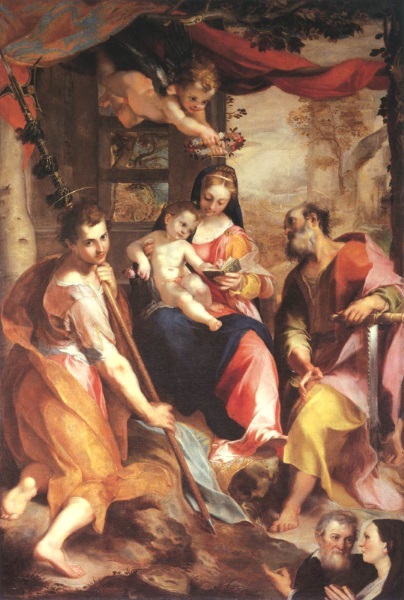
A post-biblical tradition relates that after the Lord’s Resurrection, Simon and Jude traveled to Persia, where they preached the Gospel and suffered martyrdom together. According to one tradition, Simon was sawed in half with a large saw; and Jude was beaten to death with a club. What are claimed to be their relics ended up interred together in Saint Peter’s Basilica in Rome. Either their martyrdom on the same day or the translation of their relics would account for their sharing the same feast day in the Kalendar. But it’s impossible to be certain.

Thomas Hardy gave the protagonist of one of his novels the title “Jude the Obscure.” I don’t know whether Hardy had the biblical Saint Jude in mind as the inspiration for the name of his character. Nonetheless, the description certainly fits both Simon and Jude very well. They are both obscure apostles.

And yet—despite their obscurity, Simon and Jude were still numbered among the Twelve. And perhaps that’s all we really need to know about them. For it was the Twelve who bore witness to the Lord’s death and resurrection, handing on the deposit of faith that was committed to writing in the New Testament and handed down from generation to generation in the Church. Just next month, the thirteenth bishop of Rhode Island will be consecrated; and that ceremony, with its laying-on-of-hands by multiple bishops, signifies that the bishops are the successors of the Apostles in our own time, charged to guard the Church’s faith and unity. My guess is that in heaven Simon and Jude don’t mind in the least that no one remembers their earthly words and deeds, because their apostolic ministry was never meant to be about themselves. It was about proclaiming the Gospel and bearing witness to Christ. What would please them is seeing us in our day continuing faithfully in the same teaching that they in their day handed on to their successors.

Simon and Jude may be last among the apostles, but as our Lord says, that the first shall be last and the last shall be first. And so today we give Simon and Jude first place as we commemorate them on their feast day. If it weren’t for Simon, Jude, and all the other apostles, we wouldn’t have a Christian faith to believe in or a Christian Church to belong to. It falls to us, then, to guard and cherish the apostolic heritage that we’ve received from them; and to pass it on with all care to those who come after us.

Proper 25, Year B -- Sermon at the 8 am Mass

Mark 10:46-52

The story of blind Bartimaeus in today’s Gospel is full of the rich and vivid detail characteristic of an eyewitness account. In New Testament times, the road from Jericho to Jerusalem was often traveled by those going up to worship in the Holy City. Just as today in Europe one often encounters beggars outside the entrances to great cathedrals and shrines, so in those days the road from Jericho to Jerusalem would have been a prime location for a beggar such as Bartimaeus to seek the kindness of religious people on pilgrimage.

The early Church fathers no doubt read the story literally, and understood Bartimaeus to be an actual person whom Jesus had really and truly restored to sight on the way from Jericho to Jerusalem. But they also understood him as a symbolic figure representing all who come to Christ seeking salvation.

According to ancient Christian commentaries on this Gospel, the figure of blind Bartimaeus sitting by the roadside represents the wretchedness of fallen humanity. He has learned about Jesus by the stories people have told, just as today people learn about Jesus by the preaching of the Gospel. So, when Bartimaeus hears that Jesus is passing by and calls out, “Son of David, have mercy on me,” he represents all who call upon the name of the Lord.

That Jesus doesn’t go to Bartimaeus himself but rather tells the crowd to call him signifies that we come to Christ only with the help and support of those who are already his followers. Jesus first questions Bartimaeus, and then gives him his sight. The early Church fathers understood this miracle as pointing to baptism, which was preceded by a questioning of the candidate, and which was widely known in the early Church as “enlightenment.” Finally, his sight restored, Bartimaeus follows Jesus on the way – and the New Testament Church used the term “the Way” to refer to the Christian life itself.

In the context of this figurative interpretation, one detail of the story merits particular attention -- the question that Jesus puts to Bartimaeus: “What do you want me to do for you?” For it’s a question of enormous importance.

In my own exercise of the priestly ministry, I’ve discovered just how important this question can be. For example, someone comes into my office, sits down, and starts telling me about some complicated and stressful situation in their life. As I sit there listening and trying to take it all in, sometimes I realize that I’m not sure what, if anything, I’m being asked for. Does this person want spiritual direction, concrete assistance, or just a sympathetic ear? Sometimes I find myself biting my tongue because although I think I can see the immediate and obvious solution to this person’s problems; I’ve discovered through bitter experience that it’s generally best to wait until I’m asked before I volunteer my opinion, my ideas, or my help. Sometimes, indeed, it’s prudent to ask explicitly: “How can I be of assistance to you?” “Are you asking my advice?” “Do you want my opinion?” Or as Jesus says to Bartimaeus, “What do you want me to do for you?”

Therein lies a profound theological point. Jesus stands ready to help anyone in need, but we must first know our need and want to be helped. No doubt Jesus already knows that Bartimaeus is blind and needs his sight restored. Nevertheless, before Jesus can help him, Bartimaeus must make clear what he’s asking for; after all, he may want just a handout rather than a whole new life.

In Mark’s Gospel this episode comes immediately after the story we heard last week, which begins with James and John, the sons of Zebedee, saying to Jesus, “Teacher, we want you to do whatever we ask of you.” In response, Jesus asks James and John exactly the same question he asks Bartimaeus in today’s Gospel; in both the English translation and the original Greek, the wording is identical: “What do you want me to do for you?” James and John answer, “Grant us to sit one at your right hand and one at your left in your glory.”

So to James and John, on one hand, and to Bartimaeus, on the other, Jesus puts exactly the same question, but what different answers! In their ambition and jockeying for position, James and John show themselves to be spiritually blind. There’s still so much that they don’t understand. By contrast, Bartimaeus in his physical blindness has the advantage of knowing his own wretchedness, his own need, and his own utter helplessness to help himself. And so he begs Jesus, “Master, let me receive my sight.” Jesus is pleased with the faith implicit in this answer, and so he gives Bartimaeus his sight and makes him his disciple.

This question that Jesus puts to James and John, as well as to Bartimaeus, is a question that he puts to each one of us. It forces us to sort through our priorities and come to terms with our deepest desires. “What do you want me to do for you?” If Jesus stood among us right now, and asked each of us that question, how would we answer?

It’s a good meditative exercise. Imagine Jesus asking us that question. How will we respond? Will our requests be more like that of Bartimaeus, or that of James and John? However we respond, whatever we ask of Jesus, we need to let our requests come from deep within our hearts. Then, once we’ve told our Lord whatever we want him to do for us, we need to stop, be quiet, and take a moment to listen to whatever he has to say to us. In that way, a conversation can get started. Who knows where it may lead? We may receive some gift that our Lord has been waiting to give us. We may even find ourselves brought to a new level of commitment to following him on the way.

Sunday, October 21, 2012

Remarks at Concert in Thanksgiving for the Ministry of Bishop Geralyn Wolf

 Our purpose is to offer this concert in thanksgiving to God for the ministry of the Right Reverend Geralyn Wolf, twelfth Bishop of the Episcopal Diocese of Rhode Island. On November 17, Bishop Wolf will be passing the crosier to her successor, the Very Reverend Nicholas Knisely, until recently Dean of the Cathedral in Phoenix, Arizona. The Diocese had its own celebration of Bishop Wolf’s ministry last month. But we wanted to do something as a parish as well. So here we are.

When Geralyn Wolf was first elected Bishop of Rhode Island, women bishops were a relatively new phenomenon in the Episcopal Church. Many observers wondered how her sacramental ministrations would be received in the diocese’s two Anglo-Catholic parishes: Saint Stephen’s, Providence, and Saint John’s, Newport. As it happened, Saint Stephen’s was divided, with a majority inclined to welcome Bishop Wolf’s ministry; Saint John’s was almost unanimously opposed.

Bishop Wolf quickly made it clear, however, that she would make room for everybody and not force anyone’s conscience. When I arrived as rector in 2000, I quickly realized that Bishop’s Wolf’s attitude towards our tradition was one of profound admiration and respect. In my first year here, for example, Saint Stephen’s was asked to host a conference of Anglo-Catholic rectors from across the Episcopal Church; and I invited Bishop Wolf to come and address the group. Afterwards, one of the most traditionalist rectors in the group stood up and said, “Well, I really liked her. She speaks our language.”

It was true. In her emphasis on the priority of worship and the critical importance of regular spiritual disciplines in the Christian life, Bishop Wolf speaks a language that we in this parish can understand. Over the years, we’ve come to appreciate her deep integrity and commitment to the principles that allowed her to make tough decisions that she sometimes knew would be unpopular. She has proven herself a faithful friend to S. Stephen’s. For our part, we’ve done our best to reciprocate that friendship; and we’ve remained loyal and supportive during the times when some in the wider diocese were grumbling like the Israelites against Moses and Aaron in the wilderness.

We are indeed excited about welcoming our new bishop on November 17 and we look forward eagerly to working together with him in the coming months and years. But this evening, we pause to make this musical offering in thanksgiving for the past sixteen years; and we join together in saying to Bishop Wolf: Thank you for being there for us; thank you for being here with us.

Sunday Sermon -- Proper 24, Year B

Mark 10:35-45

Today’s Gospel focuses our attention on the place of servanthood in the Christian life. We live in a society that tends to draw a sharp distinction between those who hold the positions of power and prestige, on the one hand; and those who provide the services and support, on the other. One of the marks of success in our world – of really having made it – is having lots of people work for you.

Some years ago, I was telling a certain gentleman that before coming to S. Stephen’s I had been rector of a parish in Staten Island, New York. “Ah yes, Staten Island,” he said. “When I worked on Wall Street many of the help used to come over from Staten Island. The housing there is affordable, and it’s so easy to get to the City on the ferry.” I was somewhat taken aback and not quite sure what to make of what seemed something of a put-down. I’d never thought of my former parishioners who worked in Manhattan as anybody’s “help,” but clearly this gentleman regarded them as near the bottom of the pecking order of his professional and social world.

In the ancient world, the same sorts of distinctions applied to an even greater extent. One mark of being an important person, a great person, a noble person was having lots of servants to work for you: to manage and run your estates, to keep your financial accounts, to cook your meals, to run your bath and help you get dressed, and so forth. To be a servant, on the other hand, was generally a position of low status – though this might vary with the type of service performed and the status of the master being served. Still, a servant could never be valued as a truly great or important person in his or her own right.

Yet, in today’s Gospel, however, Jesus reverses the world’s valuation of the relationship between greatness and servitude. James and John, two of his closest disciples, come to him saying, “Teacher, we want you to do for us whatever we ask of you.” Wisely, however, rather than just saying, “Okay, whatever you want, just name it,” Jesus probes a little: “What do you have in mind?” They respond: “Grant us to sit, one at your right and one at your left, in your glory.”

This request reveals their blindness, for Jesus has just finished predicting for the third time his coming death and passion. So, he replies, “You do not know what you are asking. Are you able to drink the cup that I am to drink or to be baptized with the baptism with which I am baptized?” James and John answer: “We are able.”

In the Bible, these two images, cup and baptism, each carry two opposite meanings: blessing and woe. On one hand, a cup can signify rejoicing and festivity, as in the twenty-third Psalm, “My cup runneth over.” On the other hand, a cup can signify punishment, wrath, and suffering, as, for example, in Psalm 78, verse 8: “In the Lord’s hand there is a cup full of spiced and foaming wine, which he pours out; and all the wicked of the earth shall drink and drain the dregs.”

James and John are most likely imagining a cup of blessing and celebration. Little do they realize that Jesus is speaking instead of his passion and death: as when he prays in the Garden of Gethsemene: “My Father, if it be possible, let this cup pass from me; nevertheless, not as I will, but as thou wilt.”

Likewise, the image of baptism carries two opposite meanings. In Greek, the verb to baptize means to wash, rinse, or bathe something (or someone) in water. In the biblical thought-world, such washing is a sign of cleansing: something done to rid oneself of ritual impurity, repent of one’s sins, or prepare oneself to participate in worship or to attend a social gathering such as a meal or banquet. For example, Psalm 26: “I will wash my hands in innocence, O Lord, that I may go in procession round your altar.” But the image has a dark side as well, when the waters become a torrent or flood that threatens death by drowning: for example, Psalm 69: “Save me, O God, for the waters have risen up to my neck … I have come into deep waters, and the torrent washes over me.”

Here again, when our Lord speaks of the baptism with which he is baptized, James and John most likely imagine a refreshing bath prior to dressing up for the victory celebrations of the kingdom. Little do they realize that he is instead using the biblical image of being overwhelmed and swept away by a deadly flood to signify his approaching passion and death on the cross.

Surprisingly, however, Jesus doesn’t tell them that they won’t share this cup and this baptism, but rather that they will. As his apostles, they will suffer many trials, tribulations, and persecutions for the sake of his name. Yet at this point Jesus leaves to his Father the question of who will end up seated at his right hand and his left in his glory.

When the rest of the disciples begin to get indignant at James and John, Jesus proceeds to explain that worrying about who gets the greatest honor and prestige, and jockeying for position, is really to miss the point of what the kingdom of heaven is all about: “whoever would be great among you must be your servant; and whoever would be first among you must be slave of all.”

Here Jesus completely reverses the world’s values. Greatness in the kingdom of heaven consists not in having others serve you but in serving others. And of such greatness Jesus is himself the supreme example, having come not to be served but to serve, and to give his life as a ransom for many.

This Gospel reminds us in a profound way that leadership in the church must always be understood and exercised as a form of service. We must never seek power and authority as ends in themselves, but rather use them as means of serving God and those whom God has entrusted into our care. To some extent, this ideal of servant leadership marks one place where Christianity has historically made a positive imprint on the cultural and political life of western civilization. I suspect that the ideal of government officials and lawmakers as public servants – not as our lords and masters but as our servants—derives in some measure from this Gospel ideal.

In today’s Gospel, then, Jesus is telling us that the way to true greatness is precisely through self-sacrifice and service. He promises us nothing more and nothing less than to drink the same cup that he drinks, and to be baptized with the same baptism with which he is baptized. Yet by the power of his death and resurrection, the destroying flood is ultimately transformed into a purifying bath; the cup of wrath into a cup of blessing and joy.

Thursday, October 18, 2012

Saint Luke the Evangelist -- Homily at Mass

Saint Luke is mentioned in three of Paul’s Epistles. The Letter to Philemon names him as one of Paul’s fellow workers; in Colossians 4:14 Paul describes Luke as “the beloved physician”; and in Second Timothy 4:11, written in Rome towards the end of Paul’s life, Paul declares that “Luke alone is with me.” Early sources beginning with the Muratorian fragment in about 170 and the writings of Irenaeus in 180 identify Luke as the author of the third Gospel and the Acts of the Apostles; and this is the commonly accepted view today.

From this identification we can deduce certain details of Luke’s life. At the beginning of his Gospel, Luke writes that he was not among the eyewitnesses to the events he describes, but that he has written down what he has received from the eyewitnesses. Then, at a certain point in Acts – chapter 16, verse 10 to be precise, when on his Second Missionary Journey Paul is in Troas in Asia Minor and has a vision of a man of Macedonia saying “Come over to Macedonia and help us” – Luke starts using the word “we,” indicating that he was personally present with Paul from that time on. This has led some scholars to speculate that Luke resided in Troas. The three sections in Acts that use the first person plural pronoun “we” include Paul’s final arrival in Rome; which confirms the text from Second Timothy just mentioned.

The literary style of both Luke and Acts indicates that Luke was well educated. There is some speculation that Luke was a Gentile since in Colossians Paul seems to distinguish him from other colleagues whom he describes as “of the circumcision.” But this phrase could also be used to distinguish Jewish Christians who strictly observed the Law from those who did not.

Luke writes in the tradition of ancient historiography. He addresses his works to a certain Theophilus, explaining that his aim is to provide an ordered account of the events that have taken place among us. He is an accomplished storyteller. He is not attempting to write an objective historical record, but to proclaim the Good News disclosed in the narrative of Jesus Christ and the early Church. He is careful to locate the story at identifiable points in world history: “In the days of Herod, king of Judea, there was a priest named Zechariah …” (Luke 15); and again: “In those days a decree went out from Caesar Augustus that all the world should be enrolled. This was the first enrollment, when Quirinius was governor of Syria …” (Luke 2:1-2). Likewise, Luke’s emphasizes the geographic progression of the preaching of the Gospel, beginning from Jerusalem, to all the nations (Luke 24:47). Luke’s Gospel is marked by the developed infancy narratives of both Jesus and John the Baptist – including the Annunciation and Visitation – from which we derive much of our knowledge of Mary, the mother of the Lord; and also by his emphasis on social justice and concern for the poor. For example, where Matthew has Jesus say, “Blessed are the poor in spirit,” Luke has him say simply, “Blessed are you poor.”

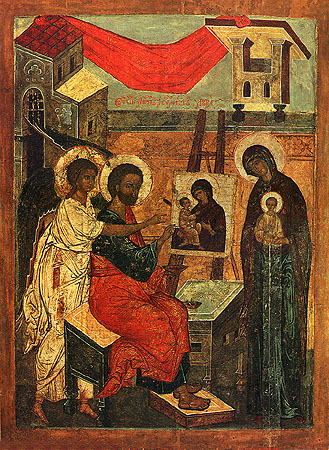
According to an ancient Eastern tradition, Luke was also the first Christian iconographer, painting the first icon of the Virgin Mary. In the legend dating from at least the sixth century, in the days after Christ’s Resurrection and Ascension, when Mary lived in the home of Saint John, Luke visited her and painted her portrait on the top of a table that Jesus had built in the workshop of Joseph in Nazareth. He listened to her stories of Jesus and later incorporated them into his Gospel. In Eastern Orthodox tradition, icons of the Hodegetria type are modeled on the prototype originally painted by Luke. Among a number of icons claiming to be painted by Luke is that known as the Salus Populi Romani in the Basilica of Santa Maria Maggiore in Rome.

According to tradition, Luke was martyred at the age of 84 in Boethia in Greece. His tomb was said to have been located in Thebes; his relics were transferred to Constantinople in 357. Stolen by the Crusaders and taken to Italy, the relics of Saint Luke are today divided into three principal parts: his body at the Abbey of Saint Justina in Padua; his head at St. Vitus Cathedral in Prague; and since 1922 one of his ribs at the traditional tomb of Saint Luke in Thebes, Greece.

Luke is the patron saint of painters, physicians, notaries, and butchers. His symbol as one of the Four Evangelists is the ox.

Sunday, October 7, 2012

Feast of the Dedication -- Sunday Sermon

At the back of the north aisle of this church, the stained glass window bears the memorial inscription “Robert Hale Ives, Jr. Antietam, 1862.” The date of the battle, September 17, 1862, is sometimes called “America’s Bloodiest Day” because more soldiers lost their lives than on any other day in American military history. On that day, this church building was brand new, having been consecrated just the previous February. So, during this sesquicentennial year, it seems appropriate on the Feast of the Dedication to reflect on the life and death of the young man memorialized in that stained glass window.

Robert Hale Ives, Jr., was born in Providence on April 3, 1837. The Ives family was part of the mercantile aristocracy of nineteenth century Rhode Island. He graduated from Brown University in 1857 at the age of twenty. During the following two years, he twice visited Europe for study and travel, as was the fashion among cultured young gentlemen of the time. On his final return in 1860, he went into business as a partner in the firm of his cousins, the Goddard brothers of Providence.

Ives was confirmed at S. Stephen’s Church in June of 1859 – perhaps in between his two European trips. From that time forward, he adopted S. Stephen’s as his spiritual home, regularly attending worship and devoutly receiving Holy Communion. Then located on Benefit Street in the building now occupied by the Barker Playhouse, S. Stephen’s was about to embark on the construction of the Gothic revival church in which we’re now sitting. From the beginning, Ives enthusiastically involved himself in the project and was a member of the committee appointed to raise funds.

When the Civil War broke out in the summer of 1861, Ives desperately wanted to volunteer. But family and business obligations deterred him from doing so. In particular, he was his parents’ only son, and the family was already bereaved by the death of his older sister the previous year. During the summer of 1862, however, after a series of Union defeats and Confederate forces preparing to invade Maryland and encircle Washington DC, Ives made the decision to volunteer. Some of his friends tried to persuade him that he could do as much for his country in other ways, and that as the only son of his parents he ought not to leave them. Ives had no military ambitions or desire for adventure; his decision proceeded purely from a religious sense of duty.

On August 19, 1862, the Governor of Rhode Island commissioned Ives a first lieutenant with orders to report for duty to serve as an aide to General Isaac Rodman. On September 1, Ives departed from Providence to join Rodman in Washington. Rodman was then in command of the third division of General Ambrose Burnside’s ninth Army, about to move into Maryland which had now been invaded by the Confederate forces. The army departed Washington on September 7, and on September 12 reached Frederick, Maryland, where they engaged the enemy and drove them from the city. The Confederates retreated to South Mountain, where they made a stand, and a bloody battle was fought on September 14. General Rodman’s division was fully engaged in the fighting; it was the first time that Lieutenant Ives saw action, and his coolness and courage under enemy fire earned him the respect of his general and fellow officers.

The Confederates then retreated towards Sharpsburg and occupied the heights near the Antietam River, pursued by the Union forces who took up position to engage them. The battle began at sunrise on Wednesday, September 17. At about three o’clock, having crossed the Antietam River, General Rodman’s forces were ordered to attack a battery of enemy guns on the heights to the left of the Union line. In the charge that followed, both General Rodman and Lieutenant Ives were mortally wounded. A cannon ball hit Ives in the right thigh, killing his horse underneath him. He was taken to a field hospital where it was initially thought that he would likely recover.

His father and two companions arrived at the hospital tent four days later, in the evening of Sunday, September 21. They decided to move Lieutenant Ives to Hagerstown, Maryland, some sixteen miles away. Although Hagerstown had been stripped of virtually all supplies and left in a shambles by two succeeding occupying armies, a lady of the town received the wounded officer into her home, and saw that he was made comfortable.

After about a week, however, it became clear that Ives was not going to recover. Most likely, infection had set in. Ives was told that he was dying. By all accounts he received the news calmly, in a spirit of humble submission to God’s will, and spent the remaining hours of his life in prayer and also in naming the gifts to be made in the distribution of his estate. A local Episcopal priest celebrated the Eucharist at a makeshift altar erected at his bedside and gave him Holy Communion. Ives died on September 27, at the age of twenty-five. His body was brought back to Providence and his funeral took place here in S. Stephen’s Church on October 1, exactly a month from the day of his departure from home.

On the day before his death Ives requested his father to offer $5,000 towards paying off the $20,000 debt that S. Stephen’s had incurred in the construction of this building – provided that the remaining $15,000 be raised within one year of his death. It was, in effect, a deathbed “challenge grant.” The parish corporation voted on October 23 to accept the gift; and by April 5, 1863, the $15,000 had been raised and the debt was cleared. (By the way, $20,000 in 1862 would be equivalent to about $460,000 today; and $5,000 would be about $115,000. So, Ives bequeathed the equivalent of $115,000 on condition that the parish raise the equivalent of $345,000 within a year.)

Although these events happened a hundred and fifty years ago, it’s important for us to know this story, because we’re the beneficiaries of the legacy left to us by Robert Hale Ives, Jr. and all the other founders and benefactors of this parish. Their generosity and sacrifices made possible what we have here today. Our calling, likewise, is to serve as stewards of this legacy in our own time so that we may faithfully hand it on to the future generations who will come after us. In just over a month, at a dinner to be held at the Hope Club on Tuesday, November 13, we shall kick off a capital fund drive to address some urgent needs for renovation and repair of the fabric of our buildings – including but not limited to the stained glass windows in the north aisle where Robert Hale Ives, Jr. is memorialized. I invite us all to reflect on the gifts that we’ve received from those who’ve gone before us in this place. How fitting it is, a hundred and fifty years on, to have this opportunity to put into practice in our own time the virtues of generosity and self-sacrifice that they exemplified in theirs.