 |
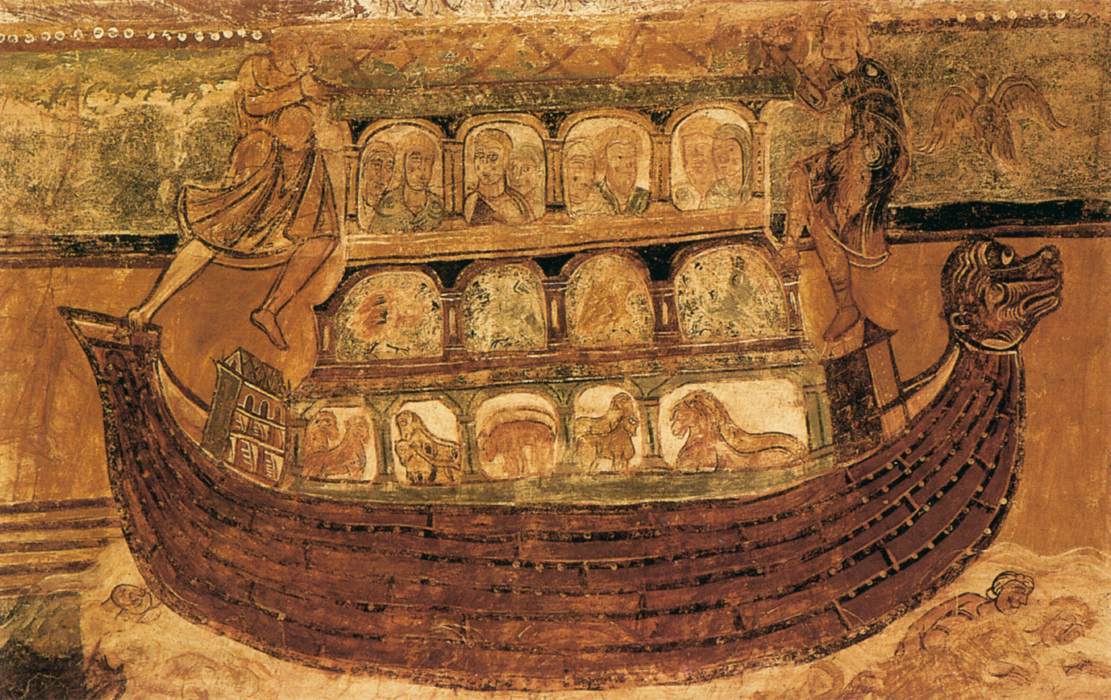
| Noah's Ark, English circa. 1100 |
Sunday 22 February 2015
In the ancient world, a covenant was an agreement or treaty between two parties. Today, we’re more familiar with the idea of a contract. In a contract, two parties sign an agreement attested by witnesses and enforceable by law. If either party breaks the contract, the injured party has recourse to the courts to have the terms of the contract enforced by a judge.
In the ancient world, however, a covenant was an agreement made between two parties in the absence of any judge or court to enforce its terms. Both parties would make solemn promises concerning their future behavior. Two kings, for example, might make a covenant to live at peace with each other, to respect each other’s trade routes, and to come to each other’s aid if attacked. More often, though, a covenant was not between equals, but rather between unequals, such as a lord and a vassal. In this case, the superior party typically promised to protect and care for the inferior party, and in return the inferior party typically promised loyalty and obedience to the superior party.
To ratify the covenant, the parties would participate in a solemn ceremony that might include an animal sacrifice or a ritual meal, invoking blessings on themselves if they kept the covenant, and curses if they broke it. Finally, they might erect some sort of public monument or sign – perhaps an engraved obelisk, plaque, or stone marker – to stand as a perpetual reminder of the covenant they had made.
To ratify the covenant, the parties would participate in a solemn ceremony that might include an animal sacrifice or a ritual meal, invoking blessings on themselves if they kept the covenant, and curses if they broke it. Finally, they might erect some sort of public monument or sign – perhaps an engraved obelisk, plaque, or stone marker – to stand as a perpetual reminder of the covenant they had made.
Throughout the Bible, God reveals himself and discloses his purposes by means of ideas and concepts that people already know from the world of their everyday experience. In other words, God accommodates himself to the limits of our human understanding by speaking our language. And since covenant agreements were so familiar in the ancient world, it’s not surprising that God made use of them to initiate and establish relationships with his people. In the Old Testament, God makes at least four covenants: with Noah, with Abraham, with Moses, and with David. In each case, the covenant spells out a promise on God’s part, and sometimes also stipulates corresponding obligations on the people’s part.
This background is crucial for understanding the story of Noah. The Book of Genesis tells us that after God creates the world, the wickedness of the human race multiplies, from the original disobedience of Adam and Eve in the Garden; through the murder of Abel by Cain; to the blasphemous attempt to build a tower that reaches to heaven, the Tower of Babel. God regrets having created human beings, and so resolves to put an end to their wickedness by means of a great flood that will inundate the whole earth.
Amidst the whole wicked human race, God sees one righteous man, Noah; so God tells Noah to build a ship, the Ark, and to take into the Ark both his family and a male and female specimen of every animal upon the earth. So, Noah and his three sons and their wives – eight persons in all – enter the Ark. Then God opens the floodgates of the Great Deep, and it rains for forty days and forty nights. All living creatures on the earth are destroyed, except Noah, his family, and all the animals on the Ark. At length, the waters recede, the dry land re-appears; and Noah, his family, and all the animals go forth from the Ark to re-inhabit and repopulate a new creation.
God then makes a covenant with Noah promising never again to destroy the earth by water. This covenant is truly universal in scope; God makes it not with any particular race or nation but with all generations that shall come after Noah: and not only with all the people of the earth, but with every living creature as well. And the sign of this covenant is the rainbow that God puts in the clouds as a perpetual reminder of his promise.
The story of Noah makes the point, on one hand, that a holy and righteous God cannot abide human sin and wickedness. When people do evil, they bring God’s judgment upon themselves. But, on the other hand, God’s judgment always contains within itself a deeper purpose of redemption and salvation. So, in the Flood story, we see God executing judgment on a sinful and disobedient world and yet, at the same time, through Noah and the Ark, making possible that same world’s re-creation and renewal.
In other words, God’s final purpose is never to annihilate and destroy but always to redeem and save, to start over and make new. Our God is above all a God of second chances and fresh starts.
We need to remember this truth at those times of crisis in our lives – times for example of illness, death, bereavement, conflict, or separation – when it seems that the flood is raging around us and our world is coming to an end. Even in the moments of greatest darkness, God is still present and at work to realize his purposes of redemption and salvation in ways that we can’t yet see and don’t yet understand.
This biblical pattern – of judgment carrying within itself the seeds of redemption – finds its ultimate expression and fulfillment on the cross. To all outward appearances, the death by crucifixion of Jesus represents unmitigated disaster and total defeat, and yet it bears within itself the seeds of cosmic victory and eternal life.
We begin to share in that life through Holy Baptism, which in today’s Epistle reading Saint Peter likens to the Flood. The analogy is that just as the Deluge drowned a sinful world while the Ark saved Noah and brought the members of his household to a creation made new, so the waters of Baptism drown out our old sinful natures and bring us to the new creation begun in Jesus Christ. The only reason we keep on sinning is that we’ve not yet fully lived into the reality of what God has already done for us in Baptism.
Even though our sins have merited God’s judgment, then, our Baptism holds out God’s promise and pledge of salvation. So, perhaps the best way to begin our Lenten pilgrimage is simply by renewing our trust in God’s promises. For the story of Noah reminds us that God’s desire above all else is to redeem and save his creation, which he loves.

