Sunday, December 30, 2012

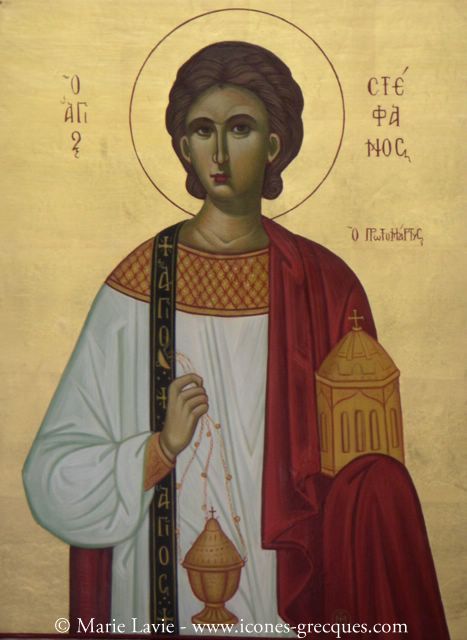
Saint Stephen, Protomartyr -- Sermon at Sunday Mass

The Christmas story is a message of hope and life. Yet the accounts of the birth of Jesus in the Gospels of Matthew and Luke already contain ominous anticipations of the opposition that will ultimately lead to his betrayal, arrest, trial, crucifixion, and death.

In Saint Matthew’s Gospel, the opposition is explicit and deadly. When wise men come from the East seeking him who is born King of the Jews, the then-reigning King of the Jews, Herod the Great, senses a threat to his throne. He seeks to kill the child, forcing the Holy Family to flee into Egypt to escape the slaughter of all the male children two years of age and under in the vicinity of Bethlehem. No sooner has Jesus come into this world than the powers of this world are trying to destroy him.

In Saint Luke’s Gospel, the intimation of future opposition is more subtle. When Mary and Joseph bring the infant Jesus to the Temple forty days after his birth to present him to the Lord, the aged prophet Simeon takes him into his arms, sings a song of praise to God, and then utters a strange prophecy: “Behold, this child is set for the falling and rising of many in Israel, and for a sign that is spoken against.” Some translations say: “a sign of contradiction.”

Simeon is foretelling the effect that Jesus will have on those who encounter him. The people who hear his teachings and witness his miracles will be forced either to accept him as the Messiah and follow him as Lord; or to reject and oppose him. In this way, he will become a sign of contradiction and a source of division. Precisely in the act of forming judgments about him, people will bring themselves under judgment. Those who reject him will fall away from God’s kingdom; while those who accept and follow him will be raised up and exalted.

It’s appropriate that on the day after Christmas – when we’ve just celebrated the birth of Christ into the world – we commemorate the first Christian martyr, Stephen. For by coming into the world, the Christ Child sets in motion the dynamic by which his followers and his enemies choose for or against him; and his enemies seek to put his followers to death just as they put him to death.

Because Stephen preaches the Gospel of Christ boldly, and without compromise, his listeners must heed his message and be converted, or else reject his message and silence the messenger in the only way they know how, by killing him. Stephen thus becomes, like his Lord, a sign of contradiction and a source of division.

Here in this parish dedicated to Saint Stephen, I sometimes wonder if we’ve understood this aspect of our Christian vocation as well as we might. I’m not sure that we’ve really taken on board the profound truth that to be faithful to Christ and his teachings is to incur the hostility and opposition of the world. Stephen clearly understood this, but do we?

Once, when I was in seminary, I was teaching a class in my fieldwork parish on the writings of the second-century bishop Ignatius of Antioch. As he was being taken in chains to Rome to die a martyr’s death in the arena, Ignatius wrote, “The greatness of Christianity consists not in its being loved by the world but in its being hated by the world.”

One of the participants in the class became very upset when he read that, and challenged me to interpret what Ignatius could have meant by such an outrageous and offensive statement. His assumption was clearly that if we Christians are doing what we’re supposed to be doing – feeding the hungry, healing the sick, sheltering the homeless, and so forth – then the world will have no choice but to appreciate our goodness and love us for it.

More and more, I notice a tendency not only among Episcopalians but among members of mainline liberal churches in general to blame Christians of certain other persuasions and styles for Christianity’s bad reputation in the secular culture. We boast to ourselves and anyone else who will listen: “After all, we’re not like those nasty fundamentalists or those reactionary Roman Catholics! If only people could see what well-educated, reasonable, open-minded, sophisticated, and tolerant people we really are … they wouldn’t tar us with the same brush.” And so we’re tempted to try to develop evangelism strategies based on differentiating ourselves from those bigoted and intolerant others who give Christianity a bad name.

Such a strategy is, however, profoundly misguided and fatally flawed because it totally misunderstands the nature of the forces arrayed against us. As Anglicans, and as Anglo-Catholics, we do indeed have significant differences with some of the other strands of contemporary American Christianity. But advertising those differences is never going to impress the partisans of militant secularism because their opposition to the Church and all it stands for goes far deeper than any quibbles we may have with our fellow Christians on today’s hot-button moral and political issues.

Christianity entails a word view that is irreconcilably incompatible with the modern secular world view, and the secularists know it. Modern secularism places humanity at the center, and insists that we are the measure of all things. Christianity places God at the center, and insists that God is the measure of all things. Modern secularism regards the goal of life as human fulfillment and self-actualization. Christianity regards the goal of life as serving God in this world and enjoying him forever in the next. Modern secularism makes enlightened self-interest the criterion of all moral judgment. Christianity makes God’s law the criterion of all moral judgment. Modern secularism holds that we can only know for certain those things that are scientifically proven and empirically verified. Christianity holds that the most important things we can ever know are those that God reveals and that we receive in faith. Modern secularism teaches that the remedy for human problems is a therapeutic process of becoming well-adjusted and learning to accept ourselves as we are. Christianity teaches that the remedy for human problems is repenting of our sins and turning in faith to Jesus Christ as the one whose death and resurrection saves us as we can never save ourselves.

I could go on, and still not do more than scratch the surface of the differences between the two world views. My point is simply that if we’re true to our Christian beliefs and commitments, it should never come as a surprise when the world hates us, ridicules us, and despises us – when colleagues, associates, and even friends and family members make snide remarks and put us down when they learn of even just our church membership and Mass attendance. It’s all part of the package that we signed on to at our baptism. Just ask St. Stephen. But the good news is that as our patron Stephen watches over us and prays for us, along with the whole Communion of Saints. And from him we can derive all the strength and courage we need to withstand anything that the world can throw at us.

Tuesday, December 25, 2012

Solemn Mass of the Nativity -- Sermon

Luke 2:1-20

“And this will be a sign for you: you will find a babe wrapped in swaddling cloths and lying in a manger.”

A striking feature of the Nativity story in Saint Luke’s Gospel is its focus on the shepherds. More than one commentator has remarked that Luke disposes of Our Lord’s birth itself in one verse: “And she gave birth to her first-born son and wrapped him in swaddling cloths, and laid him in a manger, because there was no room for them in the inn.”

And then he immediately switches to the shepherds in the field. Something miraculous happens that first Christmas night, but it’s not the birth of the infant Jesus. We often speak of the “Virgin Birth,” but the real miracle there has happened nine months previously: the Virginal Conception of Jesus by the Holy Spirit in the womb of Mary, which we celebrate on March 25, the Feast of the Annunciation.

No, the miraculous event of the first Christmas does not directly involve Jesus, Mary, and Joseph. The canonical Gospels give us no reason to suppose that anything takes place other than a normal human birth. The miracle involves instead the shepherds, who receive a supernatural announcement of that birth.

Luke sets the scene by describing the shepherds keeping watch over their flocks by night. During the past four weeks, in the Church we’ve done our best to practice the Advent disciplines of watching and waiting, because the Word of God typically comes to those who stay awake and watch, albeit not always in such a dramatic form as to those shepherds.

The annunciation to the shepherds follows a fairly standard biblical pattern. An angel appears to them, and the glory of the Lord – the supernatural light of God’s presence – shines round about them. As in almost all such biblical accounts of appearances of heavenly messengers, the shepherd’s reaction is one of sheer terror. Angels are frightening to behold. And so the first words of such heavenly messengers are almost invariably, “Fear not,” or “Be not afraid.”

The angel proceeds to deliver the announcement: “I bring you good news of a great joy which will come to all the people …” Here, Luke uses the same verb “to bring good news” that will later be translated “preach the Gospel” when he is writing of Jesus and the apostles. The angel’s message thus inaugurates the Gospel proclamation of the good news of God’s salvation.

The angel continues: “For to you is born this day in the City of David a Savior, who is Christ the Lord.” Here the angel’s proclamation takes a form resembling that of a herald announcing, say, the birth of an heir to the throne of an earthly kingdom or empire. But the three titles – Savior, Christ, and Lord – signify unmistakably to the shepherds that this birth is none other than that of Israel’s long-awaited Messiah, the anointed one of God.

Then the angel gives a sign. In the Bible, the purpose of signs accompanying announcements from messengers of God is to provide a means of verification, so that the recipient may know that the message is true, and not a hallucination or deception. For the shepherds, the sign shall be “a babe wrapped in swaddling cloths and lying in a manger.”

The key point to note about this sign is that it is simultaneously unremarkable and yet distinctive. Without having heard the angelic announcement, onlookers and passersby in Bethlehem might not think anything much of the event itself: an infant born to a traveling couple in makeshift lodgings with a feeding trough converted into a makeshift cradle. So long as the child is warm, wrapped up in his swaddling cloths, there’s nothing to worry about.

At the same time, however, the sign is sufficiently distinctive and unusual that when the shepherds see it, they cannot but recognize it as what the angel told them to look for. So, we have an event, and the announcement of that event. The event and the announcement stand in a relationship of reciprocity to each other: the announcement interprets the meaning of the birth; and the circumstances of the birth verify and confirm the contents of the announcement.

And the third element in the story is Luke’s account of the varying reactions of the different characters to what they’ve heard and seen. Here we have the opportunity to reflect and ask ourselves with whom in the story we identify most.

The first reaction is that of the multitude of the heavenly host, who break into a song of praise: “Glory to God in the highest, and on earth peace among men with whom he is pleased.” This song is the first Christmas carol; and every year when we sing the hymns and anthems of the season, we are, in effect, joining in the never-ending angelic chorus praising Christ’s birth.

Then we have the shepherds. Their immediate reaction is obedience to the message: they make haste into Bethlehem to see this thing that the angel has made known to them. And once they find it, they make known the angelic message to everyone there. Luke describes the reaction of those who hear the shepherds’ testimony as one of astonishment. Finally, having completed their mission, the shepherds return to their flocks, praising God for all that they’ve heard and seen.

The final reaction that Luke describes is that of Mary, the child’s mother. She keeps all these things in her heart, pondering them. Some commentators suggest here an implicit contrast with the shepherds, who return to their daily lives and work, and are not heard from again. In this way, perhaps, Luke is holding up Mary, rather than the shepherds, as the truest model of Christian discipleship. Even though she doesn’t yet fully understand the deepest significance of all that has been happening, she holds on to it, stores it all up, and muses on what it all might mean.

As we celebrate Christmas, perhaps it’s tempting to join in the seasonal festivities, to sing the carols, to exchange greetings and give gifts, and then forget all about it until the same time next year, and the year again after that. Perhaps that is what the shepherds did when they returned to their flocks – carried on with the rest of their lives as if nothing had happened, save for occasionally remembering the strange proceedings of a winter’s night and perhaps wondering whatever became of that couple and their babe in the manger ...

But Mary kept all these things and pondered them in her heart. We do well to follow her example. If some aspect of our celebration of Christmas touches you this evening, or in the days to come, even if you don’t understand all at once what it all means – nonetheless, don’t let it go. Hold on to it. Ponder it in your heart. Who knows how it may grow, and where it might lead?

Sunday, December 23, 2012

Advent 4, Year C -- Sermon at Sunday Mass

Hans Memling
Last Judgment Triptych (Detail), 1471
The Four Last Things
Part Four: Hell 


In twenty years of ordained ministry, I must admit that I’ve very seldom preached on hell. But then, I’m an Episcopalian. And few things are as damning to a priest’s reputation as the report that he preaches sermons on damnation. So, the traditional course of Advent sermons on the Four Last Things – Death, Judgment, Heaven, and Hell – is a good discipline for me as well as for you, because it compels us to examine together topics that we might otherwise prefer to avoid.

The most common objection raised by believers and nonbelievers alike to the idea of hell is that it contradicts God’s nature. How could a good, loving, and forgiving God condemn anyone to eternal punishment simply for not believing in him or for not being a Christian? It seems so unfair, so unjust. By the way, during my teenage agnostic years, this was my principal argument against Christianity.

Of course, that objection proceeds from some unfounded assumptions about what Christianity teaches. The Catholic tradition has always affirmed that non-Christians and nonbelievers can be saved. But it also affirms that hell is a very real possibility for any of us.

Part of the reason is that the Bible witnesses clearly to the existence of hell, particularly in the New Testament, and particularly in the teachings of Jesus himself. It’s a popular fallacy that Jesus spoke only comforting words of love and forgiveness, in contrast to, say, the fiery prophets of the Old Testament, or those who came after him like the Apostle Paul. When we read the Gospels, we discover that Jesus preached his share of fire and brimstone sermons too.

Boston College professor Peter Kreeft argues that the doctrine of hell follows logically from two prior doctrines: namely heaven and free will: “If there is a heaven,” he writes, “there can be a not-heaven. And if there is free will, we can act on it and abuse it. Those who deny hell must also deny either heaven (as does Western secularism) or free will (as does Eastern pantheism).”

Here we encounter the paradox that the existence of hell, rather than denying God’s love, instead manifests God’s love. True love never seeks to force itself on the beloved. It always respects the freedom of the beloved to respond in love or not. So it is with God. He loves us, but if we reject his love, he will respect our choice and not force us to love him against our wills. So in his love for us, God gives us the option to reject his love and spend eternity living in that rejection. C.S. Lewis says somewhere that, in the end, there are only two categories of people: those who say to God, “Thy will be done;” and those to whom God says, “Very well, then, thy will be done.”

I once explained this to a friend of mine years ago, who was fascinated with the idea that hell is somewhere people might actually choose to go. If it’s not really a place of punishment, burning in eternal flames and being poked by pitchfork-wielding devils, he mused, then it might not be such a bad place after all.

But that is to miss the point entirely. Hell is nowhere we ever want to be. The images for hell in Scripture are horrible and frightening, but they’re symbolic depictions of a spiritual reality that is even worse. The pain of loss – of losing God who is the source of all human happiness and joy – is infinitely worse than any torture. C.S. Lewis writes: “All your life an unattainable ecstasy has hovered just beyond the grasp of your consciousness. The day is coming when you will wake to find, beyond all hope, that you have attained it—or else that it was within your grasp and you have lost it forever.”

What is hell like? Peter Kreeft offers the fascinating speculation that heaven and hell may represent the same objective reality, namely God’s love, experienced oppositely by opposite souls, just as two people sitting next to each other at the same symphony or rock concert may be having two completely opposite experiences: heavenly ecstasy for the one and a hellish nightmare for the other. Just so, Kreeft writes:

The fires of hell may be made of the very love of God, experienced as torture by those who hate him: the very light of God’s truth, hated and fled from in vain by those who love darkness. Imagine a man in hell—no, a ghost—endlessly chasing his own shadow, and the light of God shines endlessly behind him. If he would only turn and face the light, he would be saved. But he refuses to—forever.

What that quotation makes clear is that hell is not so much a place where God sends us as a state that we choose for ourselves, either explicitly or implicitly, by turning away from God and rejecting his love. There is no hell but that of our own making.

The practical question, then, is how to avoid hell. The theological term is salvation. It means being saved from hell, and for heaven. And the answer is that we cannot save ourselves. Jesus is the Savior. He’s the only one who can rescue us from hell and bring us safely home.

We receive his salvation by believing in him, and by living in him so that we can be renewed and transformed by his life in us. And he gives us the normative means to do this in the corporate life, worship, and sacraments of his Church.

Again, this is not to say that non-Christians and non-believers cannot be saved. Faith in Christ can be implicit as well as explicit. Christ can offer the grace of his salvation to whomever he pleases. And there are many anonymous Christians out there who will discover that even though they did not know Christ in their earthly lives, nonetheless he is the one who sums up and embodies all that they ever regarded as good, beautiful, and true. In the end they, too, will recognize him as the one who saved them.

On the other hand, those of us who call ourselves Christians need to recognize that even for us hell remains a possibility. We cannot take our salvation for granted; and we need continually to renew our faith in Christ and to make use of the Church’s appointed means of grace to increase his life in us.

Here, then, is the deepest significance of our celebrations of the Lord’s Nativity tomorrow evening and Tuesday morning. Christmas celebrates the birth into this world of the one who comes to save us from death and hell. We greet him as our Savior now, so that in the Last Day we shall not be afraid to meet him as our Judge.


Source cited: Peter Kreeft, Fundamentals of the Faith: Essays in Christian Apologetics. San Francisco: Ignatius, 1988. pp. 162-4.

Friday, December 21, 2012

Requiem for the Victims in Newtown -- Homily

(Note: The regularly scheduled 8:30 am Mass this morning was offered as a Week's Mind Requiem for the shooting victims in Newtown, Connecticut. Saint Thomas the Apostle will be commemorated tomorrow at the 9:30 am Mass.)

In a time of national grief, our purpose here this morning is simply to do what the Church does on such occasions: to gather in worship, and to offer our prayers for the souls of those who’ve lost their lives.

The images on TV and the internet these past few days have been heartbreaking: twenty beautiful children between the ages of six and seven senselessly murdered; six educators who died trying heroically to protect those in their care; an entire community left wounded. As Yeats put it, “The blood-dimmed tide is loosed, and everywhere the ceremony of innocence is drowned.”

We cannot forget the shooter’s mother, no less a victim herself whatever mistakes she may have made. And then there is the shooter. To what diabolical evil did he yield himself in his mental disturbance? Unimaginable. He’s not an innocent victim, to be sure, but a victim nonetheless. It’s part of the nature of evil, what the Church calls the mysterium iniquitatis, the mystery of iniquity, to consume and destroy both the innocent and guilty alike, as we saw happen a week ago today.

Some people criticize the traditional prayers of the Requiem Mass as focusing too much on God’s judgment and wrath. And in planning this service I was tempted to omit some of these prayers, because after all the children who died were certainly innocents – like the Holy Innocents of Bethlehem – and they’re safe in the arms of Jesus, who said, “Truly, I say to you, unless you turn and become like children, you will never enter the kingdom of heaven.” They have nothing to fear from God's judgment now that they've suffered the worst that this world can do to them.

But then I thought better, and decided no, leave the traditional prayers intact. There’s plenty of guilt to go around in a world where this can happen, and we all need to be reminded of our common need for God’s forgiveness. “All alike have sinned and fallen short of the glory of God;” and yet this traditional liturgy of prayer for the dead proclaims that all those who cast themselves on God’s mercy in faith and repentance will be saved. The shooter now has God for his judge; and unlike all human judgment “the judgments of the Lord and true and righteous altogether.”

For me, one of the most disturbing aspects of this episode was its almost immediate politicization. The national reaction has magnified the deep ideological cleavages dividing our society. From the liberal-left side of the political spectrum came immediate calls for stricter gun control laws and attacks on the NRA and the gun culture that it represents, which in turn drew counter-attacks from those who felt that they were being scapegoated and demonized, and some of whom argued that it’s time for teachers to start carrying firearms.

Meanwhile, from the conservative-right came suggestions that this massacre was somehow related to the numbers of abortions performed in this country, or perhaps secularization as manifested in the banning of prayer and religious symbols from the public schools; and from the extreme religious right came allegations that this was somehow God’s judgment on American decadence and sexual immorality. No doubt if the shooter had lived, we would be embroiled in yet another national debate about the death penalty.

These various knee-jerk reactions from both the right and the left suggest that as a society we’ve lost the ability to create a space for mourning in the appropriate season. Instead, we short-circuit our grief by trying to assign blame so that we can prescribe remedies to ensure that this won’t happen again. But how this could have happened is a complex problem for which there are no simple solutions or quick fixes. The mutual recrimination and polarization that we’ve experienced in the past week is unseemly and does not honor the memory of the victims. It simply drives us further apart at a time when we need more than ever to come together in sorrow and grief.

Now, I’m not saying that we aren’t entitled to our political opinions, or that we don’t need to continue addressing such issues as gun control and mental health care policy –and I applaud President Obama’s plan to appoint a task force to investigate the issues and report back with concrete policy recommendations. But I am saying that as a society we need to regain the ability, if we ever had it, of putting aside our differences for a period to observe the rituals and practices of collective mourning. Our body politic will be healthier for it.

My final plea is that we allow the deaths of these twenty innocent schoolchildren to raise our awareness of those places in the world where children remain vulnerable to random violent death almost as a matter of course. When massacres occur in American upper middle-class suburban white communities, at least part of the shock is the feeling that this sort of thing isn’t supposed to happen here. That reaction betrays the unspoken assumption that there are places in the world where this sort of thing can be taken for granted and not given much second thought. But massacres of children anywhere in the world – from Chechnya, to Liberia, to Syria – merit our moral outrage just as much as they do a hundred miles from Providence. And perhaps one positive response to this national calamity would be to investigate how we can work to help protect children from violence worldwide.

Be all that as it may, again, our purpose here today is simply to do what the Church does: to gather in worship and prayer to commend the souls of the departed into the care and safekeeping of Almighty God. May they rest in peace. Amen.

Tuesday, December 11, 2012

Tuesday in Advent 2 -- Homily at Mass

Amos 5:18-24
Psalm 50:5-15
Matthew 18:12-14

It is sometimes said that throughout the Bible God comforts the afflicted and afflicts the comfortable. When we begin to get complacent and take our good standing with God for granted, along come some dire warnings of divine judgment and wrath to shake us up and prod us to examine and amend our lives. But lest these warnings drive us to desperation, along come some comforting passages to reassure us of God’s love and will to save.

Today’s readings are a case in point. The Old Testament lesson from the prophet Amos and the verses from Psalm 50 sound urgent notes of warning and condemnation. But then the Gospel reading from Saint Matthew reassures us of God’s will to save by means of the imagery of the shepherd who goes in search of the one lost sheep in the wilderness.

As Anglo-Catholics, however, we need to pay special heed to the warnings in today’s Old Testament reading and psalm. The prophet Amos – one of my favorite prophets, by the way – relates the Lord’s condemnation of the people’s worship and sacrifices. His language is scathing:

I hate, I despise your feasts, and I take no delight in your solemn assemblies. Even though you offer me your burnt offerings and cereal offerings, I will not accept them, and the peace offerings of your fatted beasts I will not look upon. Take away from me the noise of your songs; to the melody of your harps I will not listen. 

Amos prophesied in the eighth century BC in the northern Kingdom of Israel, by the way, so the worship he was condemning was that at the royal shrine at Bethel rather than at the Temple in Jerusalem. But while later generations might have said that no sacrifices outside Jerusalem were legitimate, that is not Amos’s reason for condemning them. Rather, the judgment is that the people are resting content with observing the outward forms of worship without living lives marked by holiness and righteousness.

Much of the Book of Amos is taken up with descriptions and vigorous denunciations of an unjust society in which the rich grow rich at the expense of the poor, and pervert the course of justice by bribing judges and royal officials. Against the background of such corruption and oppression, the worship of God becomes a travesty—even though the people participate in it enthusiastically and joyfully. But they do so to their own damnation. And so, Amos sounds the prophetic cry: “Let justice roll down like waters, and righteousness like an ever-flowing stream.”

The emphasis in Psalm 50 is slightly different. Writing in the name of God putting his case against the people, the psalmist proclaims: “I do not reprove you because of your sacrifices; your burnt offerings are continually before me. I will accept no bull from your house, nor he-goat from your folds. For every beast of the forest is mine; the cattle on a thousand hills … If I were hungry I would not tell you; for the world and all that is in it is mine. Do I eat the flesh of bulls, or drink the blood of goats?”

What is lacking is the inward disposition to match the outward offering. And so the psalmist declares: “Offer to God a sacrifice of thanksgiving, and pay your vows to the Most High; and call upon me in the day of trouble, and I will deliver you and you shall glorify me.”

In other words, the psalmist is saying that the outward forms of worship are without value unless they reflect and reinforce the relationship between God and his people that they are meant to express. Both Amos and the psalmist warn us that we cannot get away with trying to use worship as a means of buying God off. Worship must arise from and in turn form the community’s character as a people set apart for God. It is a means of, but cannot be a substitute for, living into that relationship.

Monday, December 10, 2012

Monday in Advent 2 -- Homily at Mass

Isaiah 35:1-10
Luke 5:17-26

Today’s readings fall into the classical biblical pattern of promise and fulfillment. The Old Testament reading from Isaiah describes the coming of the Lord to redeem his people in many wonderful images, including verses 5 and 6: “Then shall the eyes of the blind be opened, and the ears of the deaf unstopped; then shall the lame man leap like an hart, and the tongue of the dumb sing for joy ...”

The Gospel shows the fulfillment of the specific part of the promise concerning the healing of the lame in the story of the paralyzed man brought on a stretcher to Jesus and lowered down to him from an opening in the roof of the house where he was. The healing of the paralyzed man serves as a twofold sign: first of the fulfillment of the old prophecies concerning the dawning of the messianic age; and second as confirmation of our Lord’s authority to forgive sins in the name of God.

The biblical pattern of promise and fulfillment is actually threefold. Between the two there is usually given a sign that serves to confirm the promise. Thus, for example, at the beginning of Saint Luke's Gospel Zechariah is struck dumb as a sign that the promise given him by the angel Gabriel will be fulfilled in its time, despite his doubt. And likewise Mary is given the sign to confirm the angel’s message to her: “Behold your kinswoman Elizabeth in her old age has also conceived a son; and this is the sixth month with her who was called barren.” In this latter instance, the fulfillment of one promise—namely the conception and gestation of John the Baptist—becomes the sign confirming the imminent fulfillment of another promise—the conception of Jesus himself.

And I think something like this pattern is at work in today’s readings: the fulfillment of one promise becomes in turn the sign of the more wonderful fulfillment of still greater promises. The underlying point is that God keeps his word. And when we see the fulfillment of some promises having already taken place, we are thereby given assurance that God will fulfill all his promises to us.

For this reason, we do well to think of the ministry of Jesus as described in the Gospels as the dawning of the messianic age, the inauguration of the kingdom of God. Theologians often say that we live between the times, in the interim period between our Lord’s first and second comings. And during this in-between time, the kingdom is already-but-not-yet. In the life of the Church, in the Sacraments, and in the many mysterious ways in which God works in our midst, we experience the stirrings of the kingdom, even though we continue to live in a world whose redemption has not yet been made fully manifest.

Yet even now we catch glimpses of the fulfillment of God’s promises. And those become in turn signs to us that everything that he has promised will come to fruition in its own time. C.S. Lewis says somewhere that when we reach our final destination, be it heaven or hell, we will realize that it was the state in which we were living all along. The only difference is that it has now become not only fully manifest and all-encompassing, but also fixed, permanent, and irrevocable. The weekday Mass readings of this Advent season exhort us to be alert for signs of the fulfillment of God’s promises in our midst, here and now, so that we can embrace and hold fast the eschatological and eternal realities to which they point.

Sunday, December 9, 2012

Advent 2, Year C -- Sermon at Sunday Mass


The Four Last Things 
Part Two: Judgment 

You’re judging me! That seems to be one of the worst accusations anyone can make against anyone else today. The thought that others may be judging us makes many people resentful. And the notion that God may judge us makes many people even more nervous and uncomfortable.

This Advent I’m preaching the traditional course of sermons on the four last things: death, judgment, heaven, and hell. So, today we come to judgment. Every Sunday, in the Nicene Creed, we proclaim that Christ “shall come again, with glory, to judge both the quick and the dead.” Yet, in today’s Episcopal Church, the idea of God as judge is not often talked about; we’re far more likely to hear sermons about God’s unconditional love.

Yet, when we look at the word judgment itself, it’s not clear why it should have these negative connotations. According to one definition, judgment involves discerning the positives and negatives—or, in more traditional language, the good or evil—present in a person, situation, or action with a view to reaching a decision on how to respond. By this definition, we judge one another all the time, deciding, for example, who among our acquaintances are trustworthy, reliable, or worth cultivating as friends.

In the Bible, divine judgment comes at the very beginning, in the first chapter of the Book of Genesis. On the third day of creation, God has just separated the dry land from the seas, and verse 10 tells us: “And God saw that it was good.” That refrain punctuates each of the succeeding days as God continues creating plants and vegetation, birds, sea creatures, animals and, finally, human beings. And then at the end of the sixth day: “God saw everything that he had made, and behold, it was very good.”

The original divine judgment on creation is thus entirely positive. And, if we’re honest, we welcome positive judgment from other people. The next time someone says, “You’re judging me,” an interesting response would be, “Yes, because I want to see the good in you.”

Yet we still resist judgment. One reason we don’t want to be judged is that we know from experience the imperfection of most human judges and we don’t want to be judged unfairly. We human beings tend to evaluate and judge one another with a critical eye that is quick to notice faults and flaws, quick to point out mistakes and missteps.

Yet, where human beings are prone to biased and defective judgments, God alone is the perfect judge who sees and knows us exactly as we are. God may judge us, indeed he will judge us, but he will never judge us unfairly.

But there is perhaps another reason why we resist the idea of judgment, and especially divine judgment. Right judgment always brings the truth to light; and in most cases there are still truths about ourselves that we’d rather not have to face: at least not yet. And so, like Adam and Eve in the Garden after eating the forbidden fruit, we hide ourselves and try to evade the judgment of a God who sees everything and knows all.

Last week, we considered death, the first of the four last things. What happens to us after death? The biblical revelation on the subject is couched in highly symbolic imagery and mysterious language that can only hint at rather than fully describe the realities to which it points. But the tradition distinguishes two judgments that we undergo after death: a particular judgment and a general judgment.

In the hour of our death, our soul is separated from our body and is brought into the presence of God. Immediately a judgment takes place based on how we lived our earthly life. If we lived and died in such a way as to completely reject God and all that he represents – if our lives entailed a willful rejection of all truth and goodness—then our soul is banished eternally from God’s presence and that is hell.

If, on the other hand, we lived and died in such a way as to have attained complete holiness and purity, then our soul is admitted directly into heaven. Most people, I suspect, fit into neither category – they are on the way but still have a way to go before they’re ready for heaven; and for them the immediate destination is that state of continued growth and purification that our tradition calls Purgatory.

And so, in the Particular Judgment in the hour of death, the soul, separated from the body, is assigned to Heaven, Hell, or Purgatory. Whatever happens in that hour, however, I suspect that the soul will recognize the judgment rendered as completely fair and just.

The biblical imagery of the General Judgment at the end of time is even more mysterious. At the Second Coming, when Christ returns to judge the living and the dead, there will take place the General Resurrection, when our bodies will be raised from the dead, reconstituted from the elements, and reunited with our souls. Then will follow the Last Judgment, described in chapter 25 of Saint Matthew’s Gospel in the symbolic imagery of the king sitting on his glorious throne separating the righteous from the unrighteous as a shepherd separates the sheep from the goats. To the righteous, he will say, “Come, O blessed of my Father, inherit the kingdom prepared for you from before the foundation of the world …” But to the unrighteous he will say, “Depart from me, ye cursed, into the eternal fire prepared for the devil and his angels …”

How, we may well ask, did such a negative judgment become possible? The answer is that the possibility of such divine condemnation is the necessary concomitant of human freedom and responsibility. Back in the Garden, Adam and Eve ate of the fruit of the tree of the knowledge of good and evil, which God had forbidden them to eat. The forbidden fruit symbolizes the aspiration to make choices based on our own judgment of what is good and evil. By misusing this freedom in the exercise of false judgments, however, we introduced sin into the world. Down through the generations, social evils have multiplied, from crime to poverty to war to destruction of the natural environment. And the only way that the whole creation can be redeemed and restored to its original state as very good in the eyes of God is by a process of divine judgment that begins in the Incarnation, death, and resurrection of Jesus Christ and ends in the return of Christ to judge the living and the dead at the end of time.

The season of Advent calls us to prepare to meet Christ as our judge. If we feel unprepared, the good news is that we still have time. But we don’t have forever. We are accountable to God for all our thoughts, words, and deeds. The choices we make in this life have eternal consequences. And on the remaining two Sundays of Advent, we shall have occasion to look at those consequences in more detail.

Sunday, December 2, 2012

First Sunday of Advent, Year C -- Sermon at Mass

The Four Last Things

Part One: Death


About twenty years ago or so, a priest-monk of the Community of the Resurrection in England came to this country and gave a series of teaching missions in various parishes. His name was Fr. Augustine Hoey, CR, he was well in his eighties, and none of those who heard him speak could ever forget him. I never heard him, but I know several people who did. The sessions took place on successive weekday evenings over the course of a week; and as word spread of his remarkable talks, attendance grew and multiplied from one day to the next.

His presentations were highly dramatic and theatrical, making use of lots of elaborate props. On one evening in particular, the congregation would arrive in a church that had been decorated as for an old-fashioned Victorian funeral, with black crepe draperies, black altar vestments, unbleached wax candles, and somber music quietly played on the organ. At the front, in the crossing, was a bier flanked by six bier lights, but no coffin.

Then came a loud knocking on the back doors, which had been closed; six pall bearers entered carrying a coffin on their shoulders, processed up the center aisle, and laid the coffin on the bier in the crossing. The tension would mount. Finally, the lid of the coffin would open to reveal Fr. Hoey himself lying within, in full mass vestments, his hands clasped and his eyes closed.

After another few minutes in which the tension became almost unbearable, Fr. Hoey opened his eyes, sat up in the coffin, surveyed the congregation, and announced: “Ladies and gentlemen: this evening I would like to speak about that moment to which we all look forward with joyful anticipation: our death!”

Unfortunately, I haven’t been told what he said after that, but what an attention-getter! His techniques were typical of some of the Anglo-Catholic preaching missions of the early twentieth century, and borrowed much from vaudeville and the music hall. But the shock of that particular opening lay in its direct challenge to our death-avoidant culture.

We don’t like to talk about death. In my first year in my previous parish, as a brand new rector, I thought it would be a clever idea to organize a Lenten teaching series on Christian preparation for death. I invited a series of speakers to address such topics as Episcopal funeral customs, options for burial versus cremation, and estate-planning. To the surprise of my neophyte naivety, there was a good deal of grumbling and complaining in the parish, and a bit of pushback as well. One lady summed it up by declaring: “I come to church to feel good; I don’t come to hear things that depress me.”

Yet, one of the duties the Church lays on the clergy is that of instructing the congregation in the Christian understanding of and approach to death. And one of the traditional times for doing so has been Advent. It used to be the custom on the four Sundays of Advent to preach on the “Four Last Things” – Death, Judgment, Heaven, and Hell. And this year it occurred to me for the first time in my priestly ministry to tackle this traditional course of Advent sermons.

The paradox is that while the Church challenges our death-avoidance, she unequivocally affirms the value of life against what has been described as a culture of death that has made ever greater inroads into the contemporary world. From medical ethics to the ethics of war and peace, and crime and punishment, the Church bears consistent witness to life as a gift of God to be received, cherished, and embraced with joyful gratitude. The Gospel imperative is to choose life. Death is never to be deliberately caused or hastened while life remains a viable option.

And yet, when death becomes inevitable, as it ultimately must for all of us, the ideal Christian response is a spirit of resignation and acceptance. The Christian spiritual tradition commends the practice of praying for the grace of a holy death: that is, a death that we’ve had adequate opportunity to prepare for by repenting of our sins, forgiving our enemies, setting our affairs in order, and arranging for the responsible and charitable disposal of our worldly possessions. It was in this spirit that Saint Francis of Assisi was able to sing, “Praise to you, my Lord, through our Sister Bodily Death, from whom no one living can escape.”

Certain modern philosophers rightly point out that the reality of our death is always present to us in the background of our awareness as a kind of “limiting horizon.” In other words, if we could expect to live indefinitely, we’d lose a great deal of our focus and sense of purpose. The knowledge that we have only a finite amount of time to live concentrates our minds and motivates us to make definite choices about what to do with our lives. If we could expect to live indefinitely, it would likely not matter much to us which goals we failed to achieve or which projects we failed to complete because we’d always have more time to get to them later. But the horizon of death limits that time and so impels us to try to respond to our callings and fulfill our vocations in the limited time that God gives us on this earth.

The readings, prayers, and hymns of Advent testify to the reality of the Lord’s coming in glorious majesty with anticipation, longing, hope, joy, and maybe also a little fear and trembling. Just so, for each of us, our death represents our own personal Advent of the Lord. What the Second Coming of Christ will be to the entire cosmos, our death will be to each of us personally: the end of our present world, and the gateway to the world to come.

It follows that all the Season of Advent bids us do together as the Church in anticipation of the Coming of the Lord at the end time – all the traditional practices of watching, waiting, praying, and preparing – the season also bids each one of us do in anticipation of our own personal meeting with the Lord in the hour of our death. And to aid in this preparation, we shall continue next week by considering the second of the Four Last Things, namely judgment.

Sunday, November 11, 2012

Remembrance Sunday -- Sermon at the 10 am Mass

Today’s Old Testament reading offers us a glimpse of the future reign of peace in the Kingdom of God. “They shall beat their swords into plowshares, and their spears into pruning hooks; nation shall not lift up sword against nation, neither shall they learn war any more.”

The Church at its best has always held up this vision of universal peace as the goal and end of human history. Yet the sad reality is that our world is not at peace. Throughout recorded history, up to the present day, nations have continued to wage wars with one another—and have continued to experience within themselves civil unrest, revolutions, and violent political upheavals.

As Christians, we find ourselves caught between our ideal of peace and the reality of the world we inhabit. We live in the tension between the already and the not yet—between our proclamation of a future reign of peace on earth and life in a world that still falls far short of that promise.

Throughout history, Christians have attempted to resolve this tension in various ways. The great church historian Roland Bainton once wrote a book called Christian Attitudes to War and Peace, which outlines three principal traditions of thought on the question.

The earliest Christians were pacifists. They taught that once you were baptized, you were called to leave the ways of the fallen world behind and start living according to the standards of God’s Kingdom. And that meant you could not be a soldier, bear arms, or even assume a position in government that might involve sending others into battle. Such occupations were off limits to members of the earliest Church.

Although pacifism eventually became the minority position within Christianity, it nonetheless remains a position to which many Christians believe themselves called to this day. Christian pacifists argue eloquently that the Gospel requires us to bear witness to the coming reign of God by being peacemakers in the present age; and that this witness entails the refusal to participate in or support war in any form.

While the Church honors the pacifist witness as the vocation of some of its members, however, it has consistently refused to require this witness of all of its members. Since at least the fourth century, the Church has recognized that some Christians have the alternative vocation to take responsibility for the safety and well-being of others in ways that might require bearing arms and even fighting in wars.

In Bainton’s scheme of Christian attitudes towards war and peace, the very opposite of pacifism is the approach known as the crusade or holy war. The crusading mentality glorifies war as an activity undertaken in obedience to God’s will. One characteristic belief of this approach is that peace on earth can only come about when God’s enemies have been defeated; and it’s our job to defeat them. The world is divided into spheres of light versus darkness, good versus evil, truth versus falsehood. There are no shades of gray. And when you’re convinced that God is on your side, and that your enemies are God’s enemies, then all kinds of atrocities and crimes against humanity become possible.

Very different from either pacifism or the crusading mentality is a third Christian approach known as the Just War tradition. This approach takes as its starting point the doctrines of the Fall and Original Sin. One of the earliest exponents of the Chrsitian Just War tradition was Saint Augustine of Hippo, who came to the conclusion that in a fallen and dangerous world, Christians are sometimes morally compelled to take actions on behalf of others and the common good that they would never undertake on their own behalf. Saint Augustine believed that killing in self-defense is wrong; in his view it is morally preferable to give up one’s own life than to incur the guilt of taking another human life, even in self-defense. And such was the standard pacifist view of the early Church. But, he went on to argue, those who are entrusted with the public welfare – such as soldiers, police, judges, and executioners – may be required to take life not on their own behalf but to protect and defend the innocent.

From this fundamental insight, the Church’s Just War tradition evolved down through the centuries to specify detailed lists of criteria to aid in the evaluation of whether undertaking a particular war is morally justified—just cause, lawful authority, right intention, last resort, reasonable chance of success, and so forth.

The tradition also came to articulate moral criteria for the conduct of war – such as noncombatant immunity -- to try to minimize the suffering and destruction caused by war. The Christian Just War tradition had enormous influence on secular political thought from the Renaissance on, and in particular has left its imprint in the development of international law.

Such, then, are the three principal Christian attitudes to war and peace as summarized by Roland Bainton: pacifism, crusade, and the just war. In the end, Bainton ended up endorsing pacifism as the Church’s most authentic witness to the Gospel. But different Christians find themselves in different place on the spectrum of these various attitudes.

For my part, as I’ve reflected on these questions over the years, I’ve come more and more to understand Christian ethics as involving what I like to call “default positions” that in some cases may admit of exceptions under certain well-defined circumstances.

Thus, for example, the Christian default position on marriage is in favor of lifelong marriage and against divorce and remarriage. But the default position admits certain exceptions; and in the Episcopal Church the bishop can approve remarriage after divorce on a case-by-case basis. In other words, the default position holds up the Gospel ideal; and even when we admit exceptions that doesn’t mean we’ve given up on the ideal.

Likewise, it seems to me that on matters of war and peace the Church’s default position has to be pacifism. Peace is the Christian standard and ideal; and the Just War tradition functions as a way of specifying the circumstances that may permit possible exceptions to that default position. This understanding allows us to honor both those Christians who fight and die for their country in war, and also those Christians who discern a vocation to pacifist witness both within the Church and in the wider society. Whether we agree or disagree with the stand taken by pacifists against any particular conflict, they nonetheless remind us that the Church’s default position must always be in favor of peace; and that going to war can only ever be justified when it’s absolutely necessary and completely unavoidable.

Today, then, as we pray for those who have given their lives in war, we pray also for the coming of God’s kingdom and peace on earth. And we do well to resolve never to ask our young men and young women to take up arms and sacrifice their lives when other policy options remain open.

Proper 27, Year B -- Sermon at the 8 am Mass

Ruth 3:1-5; 4:13-17
Hebrews 9:24-28
Mark 12:38-44

An interesting coincidence in today’s readings is that the Old Testament and the Gospel both mention widows. I say “coincidence” because it really is that: In the cycle of the Revised Common Lectionary that we’re now using, the Old Testament readings are selected to follow their own sequence, and not to match themes in the Gospel readings for the same Sunday.

Both last Sunday and today, the Old Testament readings have been taken from the Book of Ruth, one of the most delightful stories of the Bible. During a famine in the time of the Judges, an Israelite family from Bethlehem – consisting of Elimelech, his wife Naomi, and their sons Mahlon and Chilion – emigrate to the country of Moab, in what is present-day Jordan. There, Elimelech dies. The sons marry two Moabite women: Mahlon marries Ruth; and Chilion marries Orpah.

Then the two sons of Naomi themselves die. So Naomi decides to return to Bethlehem. She tells her daughters-in-law to return to their own families and remarry. Orpah reluctantly departs, but Ruth pleads with her: "Entreat me not to leave you or to return from following you; for where you go I will go, and where you lodge I will lodge; your people shall be my people, and your God my God; where you die I will die, and there will I be buried."

So Naomi brings Ruth with her back to Bethlehem. And today’s reading tells how Ruth goes to the barley field of Naomi’s kinsman Boaz, and there becomes his wife. What the reading does not tell us is that by levirate law Boaz is obliged to marry Ruth in order to carry on Mahlon’s family line. So the pair get married and have a son, Obed, who in turn becomes the father of Jesse, the Father of David, and hence an ancestor of Jesus.

Now the Book of Ruth was probably written after the Jews’ return from the Babylonian Exile as a protest against the prohibition against taking foreign wives by the leaders Ezra and Nehemiah. But in the context of our readings for today, the point of significance is the vulnerable position in which Naomi finds herself as a widow bereft of a husband and sons to take care of her. Presumably too old to remarry herself, she is dependent on her widowed daughter-in-law Ruth to take a husband so that she herself will have a home as the mother-in-law. Otherwise, she would be left without any means of support. The position of widows in biblical times was precarious, to say the least.

Our Gospel reading likewise centers on a widow. Jesus is sitting in the Temple precincts opposite the treasury. Here, thirteen large receptacles shaped like horns or trumpets are set up to receive the people’s offerings for the upkeep of the Temple. As people walk by they toss in their coins. A sound of clanging reverberates as the pieces hit the insides of the receptacles and roll down to the bottom. The bigger, heavier, and more numerous the coins you throw in, the more noise they make; so the louder the clanging, the greater the charity announced by the noise.

But then Jesus notices a poor widow shuffle up to one of the horns and carefully drop in two lepta—the smallest coins in circulation, each worth only 1/64th of a denarius, the day’s wage of an unskilled laborer. These small, light coins make hardly any noise at all. Yet, perhaps supernaturally, Jesus intuits the depth of the widow’s sacrifice.

He calls his disciples and points out the contrast: she has given more than all who are giving to the treasury. For they gave out of their surplus; but she has given everything she has. The point is not to criticize or belittle the larger offerings of the better off, but simply to observe that she has given more in her complete generosity and trust in God to provide for all her needs.

Notice that in the Old Testament reading, Ruth’s loyalty to Naomi requires the same sort of trust in God to provide. Naomi’s advice to her two daughters-in-law to return to their families is the more realistic counsel. But when Ruth replies, “Your God shall be my God,” she implicitly puts her trust in the God of Israel to provide for both of them as they return to Bethlehem.

To return to the Gospel, however, perhaps the reason why Jesus notices the poor widow’s offering is that he’s all too well aware of the complete and total self-offering that he himself must soon make. For this episode is talking place during the final week of his life. In just a few days, he shall be betrayed, arrested, tried, and sent to die on a cross.

And this is where the epistle reading from Hebrews ties in. This passage contrasts the Levitical priesthood of the Jerusalem Temple with the eternal priesthood of Christ. Where the Temple priests offer to God the blood of sacrifices not their own, Christ has offered to God the sacrifice of his own blood. Christ’s sacrifice on the cross costs him everything: complete and total self-surrender to God.

From time to time, the Christian life involves sacrifices. In many parts of the world today, just doing what we’re doing here, coming to church and participating in the Mass, are activities by which people risk their lives. In this part of the world, following Christ is unlikely to entail having to sacrifice our lives, or even to give up everything we have like the poor widow in today’s Gospel.

But fulfilling our Christian duties and obligations sometimes requires us to do things that we’d rather not do, or to incur costs that we think we can’t afford. It’s a sacrifice to get up and come to Mass on Sunday morning when we’ve been out late Saturday evening and would rather stay in bed. It’s a sacrifice to pledge an amount to the church that requires us to give up something else that we’d rather spend the money on instead. It’s a sacrifice to take a public stand on some issue on behalf of the faith that brings scorn, ridicule, and hostility down upon our heads. 

When we find ourselves called upon to make such sacrifices, we need to remember, first, the complete generosity and self-offering of the widow in today’s Gospel; second, the complete trust in God that alone makes such generosity possible; and, third, the supreme self-sacrifice of Christ for our salvation. On the cross, he offers up everything for us. How then can we withhold anything that he may ask of us in return?

Sunday, November 4, 2012

Proper 26, Year B -- Sermon at the 8 am Mass

Mark 12:28-34

(Note: The text of the sermon preached at the 10 am Solemn High Mass can be found here.)

In this morning’s Gospel, we have Mark’s version of the Great Commandment. A scribe asks our Lord: “Which Commandment is the first of all?” It was a common question among the rabbis of the time: which one of all the hundreds of commandments stands first in importance as summing up and interpreting the meaning of the rest?

In his response, our Lord gives not one text from the Torah but two. First, he quotes the text from Deuteronomy 6:5 known as the Shema, recited twice daily by pious Jews, “Hear O Israel, the Lord our God, the Lord is one; and you shall love the Lord your God with all your heart, and with all your soul, and with all your mind, and with all your strength.” And to this he joins a second text from Leviticus 19:18, “You shall love your neighbor as yourself.”

According to some commentators, this answer differed significantly from many other answers given by various priests, scribes, and rabbis of the time. Some argued that keeping the Sabbath was the most important commandment; others that it was circumcision; others that it was the offering of the Temple sacrifices.

Yet at least some teachers gave answers similar to that of Jesus. The great rabbi Hillel the Elder, who lived in the first century BC, was once asked to sum up the entire Torah concisely to a gentile who wanted to become a Jew, and he answered: “What is hateful to thee, do not do unto thy fellow man: this is the whole Law, the rest is commentary; go and learn.” Likewise, the rabbi Akiva ben Joseph, who lived in the late first and early second centuries, called “Thou shalt love thy neighbor as thyself” the most important principle of Judaism.

The great genius of our Lord’s response, however, was to join the two verses together: “Thou shalt love the Lord thy God …” and “Thou shalt love thy neighbor as thyself.” To my knowledge, none of the other Jewish teachers of the time made this move. And together, these two commandments passed into the Christian tradition as the Summary of the Law, Matthew’s version of which we recite in the Episcopal Church at the beginning of every Rite I Mass.

As any of the kids who’ve been through my Confirmation class can tell you, the Summary of the Law furnishes the two headings under which the Ten Commandments are arranged. Commandments 1 through 4 tell us what it means to love the Lord your God with all your heart, mind, and strength: You shall have no other Gods before me; you shall not worship idols; you shall not take the Lord’s name in vain; keep holy the Sabbath day.

And Commandments 5 through 10 explain what’s involved in loving your neighbor as yourself: Honor your father and mother; Do not commit murder; Do not commit adultery; Do not steal; Do not bear false witness; Do not covet anything that belongs to your neighbor.

And of course under the subheadings of each of the Ten Commandments, Christian ethicists have extrapolated many more principles, rules, and precepts of moral behavior. But in the end they all fall under the wide umbrella of our Lord’s Summary of the Law: Love the Lord your God; Love your neighbor as yourself.

A key message for us is that the way of Christian discipleship isn’t ultimately about obeying rules: It is rather about love; or, more precisely, about learning to love the right things; and learning to love them rightly. Love is at the heart of the Gospel. As Saint John says, “God is love.” In his life, death, and resurrection, Christ reveals and manifests the depth of God’s love for us. Through baptism, and participation in the liturgical and sacramental life of the Church, we are engrafted into Christ’s Body and his life becomes our life; we live in him and he lives in us. And it follows that his life becomes manifest in us precisely insofar as we learn to love as he loves. Indeed, it is Christ alone who has perfectly fulfilled his own commandments: loving God with all his heart, mind, soul, and strength; and loving his neighbor as himself. In John’s Gospel, Jesus makes his command explicit: “Love one another, as I have loved you.”

And so, when we’re contemplating the ethics of one course of action versus another, a key question is whether the action under consideration adequately expresses our love for God and our love for our neighbor. Or does it place, say, the love of self or of some created commodity in place of both? It’s a fairly simple test; and a question that we can all benefit from asking ourselves periodically.

The Jewish rabbis whose sayings are recorded in the Mishnah and the Talmud agreed that we love God by behaving in such a way that brings honor to God in the sight of all our fellow creatures. And one way in which we express our love for both God and our neighbor is by regular attendance at worship. Even before we kneel down and say our prayers, the very effort of getting up and getting here to Mass is a visible expression of our love for God, a public testimony to God’s place in our lives. Moreover, it is an expression of our love for our neighbor, because believe it or not, when you come to Mass you give encouragement and support to your fellow parishioners, many of whom are glad to see you, and conversely are disappointed when they don’t see you.

The genius of our Lord’s Summary of the Law is the joining together of two commandments that really are inseparable. We cannot love God adequately without loving our neighbor. But neither can we love our neighbor adequately without loving God. Some years ago, a couple told me they were stopping coming to church because they felt that their time and money would be better spent helping those in need, for example, by contributing to the Rhode Island food bank. On reflection, it seems that they got only half of the Summary of the Law, but at least they got it right: You shall love your neighbor as yourself. Still, they were missing the first half: You shall love the Lord your God with all your heart, soul, mind, and strength. As Christians, we’re not given the option of picking one or the other. We’re called to do both.

Friday, November 2, 2012

All Souls Day -- Homily at Mass

More than twelve years ago, when I first entered this church building, I immediately noticed the various memorials around the walls of the nave. How very English! For the interior walls of cathedrals and parish churches in England are typically plastered with busts and statues, reliefs and inscriptions, extolling the virtues and accomplishments of deceased parishioners.

The erection of monuments is part of a wider pattern of offerings and gifts to memorialize the departed. As in many other parishes, here at S. Stephen’s we have lots of memorials – items given in memory of departed loved ones: from the Webster Memorial Guild House, to the Goddard Organ, to the stain glass windows, to individual Prayer Books and Hymnals in the pews, to flowers on the altar. In the narthex you can see the book in which these memorials are lovingly recorded.

On this All Souls Day, then, it seems appropriate to reflect on this natural human impulse to memorialize the departed. Why do we do it? Such memorial offerings fulfill some deep-seated human needs.

For example, they express the human emotions of sorrow and mourning. Particularly in England, many of the Victorian monuments adorning the churches and graveyards feature weeping angels, winged hourglasses, broken vases, and other symbols of loss and desolation. One gets the impression that such monuments serve to memorialize the grief of the living as much as the memory of the dead.

Such memorial offerings also express thanksgiving for the deceased person’s life. This is particularly true of monuments erected to public figures, such as the Washington Monument and the Jefferson and Lincoln Memorials in Washington DC. And here in Church people likewise offer memorial gifts in thanksgiving for the ways in which the departed enriched the lives of family, friends, parish, and community.

Most of all, perhaps, these memorial offerings express the natural human desire to ensure that the deceased person will be remembered and not forgotten. The literal meaning of the word “memorial,” after all, is an aid to memory, a reminder, a stimulus to remembrance: lest we forget. We offer these memorials so that those who them they will remember the ones in whose memory they were given.

Sometimes it works, even for generations: the name of the Webster Memorial Guildhouse still calls to mind the young curate of this parish who drowned at sea in the year 1898. The Waterman Communion vessels still remind us of the fifth rector of this parish who presided over the construction of this church building in the early 1860s.

So, the impulse to offer memorial gifts responds to the human need to express in tangible form our mourning and grief, our gratitude for the life of the deceased, and our desire to keep their memory alive for generations to come. All this is perfectly natural and entirely good. And yet – everything I’ve described so far can be done just as well by atheists and agnostics as by people of faith.

All Souls Day reminds us that as members of the Church we have the opportunity to do something more. In addition to memorializing the dead we also pray for them. This practice hinges on the conviction that even though the departed are no longer with us, nonetheless they are alive in Christ.

The doctrine of the Communion of the Saints teaches us that in Christ we have fellowship with both the living and the dead. Just we pray for each other here on earth, so the saints in heaven pray for us; and both they and we pray for the souls of the faithful departed. We have the assurance that somehow in God’s providence our prayers really do benefit and help the departed in their continuing heavenward journey. And we have the hope that just as we pray for the dead, so too, after our time comes, the members of the Church on earth will pray for us as well.

Bereavement, the loss of a loved one, is a painful ordeal. When someone in our community loses someone, it’s often difficult to know what to say. We want to say something lest it seem that we don’t care; yet I’ve noticed that here in New England especially we’re also reluctant to say anything too intrusive. Our therapeutic culture responds to almost every life event in terms of how we feel about it and how it makes us feel. But people who’ve been recently bereaved often tell me that the last thing they need is well-meaning people prying into how they’re processing their feelings about their loss, or worse, telling them how they must or should be feeling.

The good news is that the Christian tradition gives us a language for speaking of death and bereavement very different from the language of our therapeutic culture. When we encounter someone who’s just lost a loved one, above and beyond such conventional sentiments as “I’m very sorry for your loss,” we can also say something like, “I will pray for her; and I will pray for you as well.” That is not a sanctimonious platitude – provided that we follow through and actually say the prayers that we promise! In my experience, ninety-nine per cent of the time, people are touched, grateful, and even comforted to be told that we’re praying for their departed loved ones, no matter what their religious beliefs or lack thereof may be.

Now, of course, we pray for the departed not so that we can have something comforting to say to the bereaved, but because we believe that such prayers are intrinsically worthwhile. My point is simply that if we take seriously the Church’s teaching and practice on prayer for the departed, we gain a whole new language for responding to death, loss, and bereavement that is clearly counter-cultural, but that can also be remarkably effective in offering solace and comfort as well.

While I’m on the subject, I want to put in a word for the Guild of All Souls: the international Anglican devotional society that prays every day of the year for the departed on the anniversaries of their deaths. By enrolling in the Guild, you ensure that after you die, the Guild’s members will pray for you in perpetuity. And if you want to memorialize someone who has died, one option is to enroll that person in the Guild posthumously, thus adding his or name to the list of those who are prayed for every year on their year’s mind. I cannot think of a more touching memorial.

This evening, then, we gather to offer the Holy Sacrifice of the Mass for all the faithful departed. All Souls Day reminds us that as Christians we’re called not only to memorialize the dead, but also to pray for them. And, throughout the year, whenever we encounter a memorial gift given in loving memory of someone departed this life – even something as simple as flowers at the altar – we do well always to remember to say a prayer for that person’s soul.

Thursday, November 1, 2012

Feast of All Saints -- Sermon at Mass

The Feast of All Saints commemorates those Christians, known to us and unknown, who having completed the course of this earthly life, have entered into heaven and attained the beatific vision. Collectively, the Saints in heaven are sometimes called the Church Triumphant.

The commemoration of saints figures prominently in the Church’s daily round of worship. At the weekday Mass here at S. Stephen’s, we often celebrate the life of the saint whose day in the calendar it is. Some of these saints are very ancient and obscure figures, such as Crispin and Crispianian, martyrs in fourth century Gaul. Others are much more recent figures whose lives are better documented and better known to us, such as Therese of Lisieux in nineteenth-century France.

But one aspect of the commemoration of the saints that has caught my attention and captured my imagination more and more over the past year or so is what I like to call its geographical dimension. What I mean is that a particular holy person often becomes an important figure in the Church calendar not only because of the intrinsic merits of his or her earthly life, but also because of the specific communities and places where that saint has become known as a living presence in the years and even centuries after his or her death.

When we trace the posthumous careers of various saints through the different communities that have honored them, down to the cathedrals, basilicas, and shrines dedicated to them today, we gradually build up a working knowledge of the sacred geography of the Christian world. For example, whether or nor Saint James the Apostle ever visited Spain, what are claimed to be his relics are certainly enshrined at the cathedral in Santiago de Compostella – a destination for millions of pilgrims down through the centuries since the Middle Ages.

Moreover, the doctrine of the Communion of Saints teaches, among other things, that the saint in heaven watches over and intercedes for the communities and places where he or she is venerated on earth. Archbishop of Canterbury William Temple once wrote that on account of the Incarnation, Christianity is the most materialistic of the world’s great religions. For this reason, physical tokens and reminders of a saint’s earthly life are not unimportant. For example, Saint Augustine of Hippo wrote in his great work The City of God of the many miracles that accompanied the arrival of some relics of our patron saint Stephen in North Africa in the fifth century. When we invoke a saint in the presence of his relics on earth, he explained, the saint in heaven prays for us in turn with powerful effect.

What, then, can we say about the Feast of All Saints? In the early centuries of Church history, Christians visited the tombs of their local martyrs on the anniversaries of their deaths. In this practice lie the origins of the Church’s calendar of saints. As the numbers of martyrs multiplied, however, especially in the third and fourth centuries, the practice developed in some places of setting aside a day to commemorate all the martyrs, so that none would be overlooked. By the fifth century or so, several of the Eastern Churches had designated such a commemoration on May 13.

Then, in the early seventh century, the Byzantine Emperor gave the building in Rome known as the Pantheon into the care of Pope Boniface IV. The Pantheon had been built in the first century by the Emperor Agrippa as a temple to all the gods and goddesses. So, at its consecration as a church on May 13, 609, Boniface decided to undo its former pagan dedication by rededicating it to Saint Mary and all the Martyrs. And as part of the consecration ceremony, cartloads of bones of the martyrs were brought from the catacombs and deposited under the high altar. This event apparently marked several firsts: the first time that a former pagan temple was converted into a church, that relics of the saints were translated from the catacombs to a church in Rome, and that a church was dedicated not just to one martyr saint but to all of them. Incidentally, being made into a church ensured that the Pantheon became one of the few Roman architectural masterworks that did not fall into ruin.

Subsequently, in about the year 732, Pope Gregory III dedicated a chapel in the old Saint Peter’s Basilica to All the Saints on November 1. The date may already have been kept as a feast of all the saints in the Frankish Empire, so that Gregory picked it as a suitable date for dedicating his chapel; or the celebration of All Saints on November 1 may arise as the keeping of the anniversary of the dedication of Gregory’s chapel. We’re not sure.

Either way, Gregory’s reasons for dedicating this chapel were enormously significant. In the East, the Iconoclastic heresy had just gained the ascendancy in the Byzantine Empire. And the Iconoclasts not only disputed the validity of the use of images of Christ and the saints in Christian worship, but they also attacked the invocation of the saints and the veneration of relics. Not only did they smash icons but they also broke open shrines and burned the bodies of saints or threw their relics into the sea. In addition to condemning these sacrileges, Pope Gregory made a point of paying special honor to both images and relics of the saints. In Saint Peter’s, he had an iconostasis or icon-screen installed; and he had the aforementioned chapel constructed to house a number of saints’ relics. The chapel itself did not survive the rebuilding of Saint Peter’s in the sixteenth century, but ever since its dedication November 1 has been the established date of the feast of All Saints in the West.

In the Eastern Church, the Iconoclastic heresy was condemned by the Seventh Ecumenical Council in 787, and finally suppressed in 842. Later in the ninth century, the Byzantine Emperor Leo VI built the first Church dedicated to All Saints in Constantinople. The Churches of the East celebrate All Saints not on November 1, however, but in the Spring, on the first Sunday after Pentecost.

The point I want to make, then, is that the Church’s solemn celebration of the Feast of All Saints is not the result of some clever abstract speculation on the part of some monk or theologian in his free time. Instead, the feast gained traction and grew in importance precisely because it upheld crucial principles, doctrines, and practices that were under attack – particularly concerning the place of images, relics, and the invocation of the saints in the life of the Church. As we continue the celebration of the Feast of All Saints in our own day, we do well to consider the place of these same principles, doctrines, and practices in our own life in Christ.

Sunday, October 28, 2012

Saint Simon and Saint Jude -- Sermon at the 10 am Mass

First: Just a word about what we’re doing this morning and why. When a major saint’s day falls on a Sunday, most Episcopal parishes transfer it to the first available open day during the coming week, in conformity with a rubric on page 16 of the Prayer Book. But, during Ordinary Time, the very same paragraph allows the Collect, Preface, and Lessons for the saint’s day to be substituted for those of the Sunday. And because so many more people come to Mass on Sundays than on weekdays, taking advantage of this option has always seemed a good way to give as many of us as possible some exposure to the major saints’ days of the church year. And, here at S. Stephen’s, we split the difference and use the readings and prayers for the Sunday at the 8 o’clock; and the readings and prayers for the saint’s day at the 10 o’clock.

Today, then, we are celebrating the Feast of Saint Simon and Saint Jude. It’s been observed that nobody wants to be in last place. And yet Simon and Jude seem to come in last in more ways than one. In all four of New Testament lists of the twelve apostles, their names always take the tenth and eleventh place—right before Judas Iscariot, the traitor.

Their feast day is the last commemoration of apostles in the church year. After Simon and Jude on October 28th, we have All Saints on November 1st, and then a new church year starts on Advent Sunday at the beginning of December. Herbert O’Driscoll comments that it seems as though Simon and Jude were put into the Church Kalendar almost as an afterthought.

While the New Testament contains an Epistle attributed to Saint Jude, it is the very last of all the Epistles, coming just before the Revelation to John, the very last book in the Bible. And Saint Jude is known in popular devotion as the saint of last resort, the patron of lost causes – the saint to whom we turn when all else has failed. Not so long ago, in Catholic colleges and universities, students would ask the prayers of Saint Jude on the day of final exams—as a last resort when all other options had been exhausted, in aid of the lost cause of getting a good grade.

So, in all these ways, Simon and Jude stand last among the twelve apostles. Moreover, we know so very little about either of them.

The various New Testament lists of the Twelve describe Simon as Simon the Cananean or Simon the Zealot. This title has led to speculation that Simon was part of the revolutionary Jewish independence movement known for its violent tactics of assassination and insurrection. But it’s equally possible that the title simply means that Simon was known for his zeal and enthusiasm for the Jewish Law and customs. Beyond that, the New Testament says nothing about him.

We know a little more about Jude. Some of the lists give his name as Thaddeus, and identify him either as the brother or the son of James the Son of Alphaeus, also known as James the Less. The Gospel of John records a question that Jude asked Jesus at the Last Supper, about why he revealed himself only to the disciples. Beyond that, however, the New Testament is silent about Jude. And the Letter attributed to Jude toward the end of the New Testament is almost certainly the work of a later author writing in Jude’s name.

Interestingly enough, the lists of the so-called brothers of Jesus in the Gospels of Matthew and Mark include the names Simon and Jude; so some commentators have identified the apostles Simon and Jude as relatives of Jesus. For the Greek word adelphos can mean “cousin” or “kinsman” as well as “brother.” But this identification seems unlikely, since the Gospels give several indications that the actual family of Jesus was less than fully supportive of his ministry during his earthly life.

A post-biblical tradition relates that after the Lord’s Resurrection, Simon and Jude traveled to Persia, where they preached the Gospel and suffered martyrdom together. According to one tradition, Simon was sawed in half with a large saw; and Jude was beaten to death with a club. What are claimed to be their relics ended up interred together in Saint Peter’s Basilica in Rome. Either their martyrdom on the same day or the translation of their relics would account for their sharing the same feast day in the Kalendar. But it’s impossible to be certain.

Thomas Hardy gave the protagonist of one of his novels the title “Jude the Obscure.” I don’t know whether Hardy had the biblical Saint Jude in mind as the inspiration for the name of his character. Nonetheless, the description certainly fits both Simon and Jude very well. They are both obscure apostles.

And yet—despite their obscurity, Simon and Jude were still numbered among the Twelve. And perhaps that’s all we really need to know about them. For it was the Twelve who bore witness to the Lord’s death and resurrection, handing on the deposit of faith that was committed to writing in the New Testament and handed down from generation to generation in the Church. Just next month, the thirteenth bishop of Rhode Island will be consecrated; and that ceremony, with its laying-on-of-hands by multiple bishops, signifies that the bishops are the successors of the Apostles in our own time, charged to guard the Church’s faith and unity. My guess is that in heaven Simon and Jude don’t mind in the least that no one remembers their earthly words and deeds, because their apostolic ministry was never meant to be about themselves. It was about proclaiming the Gospel and bearing witness to Christ. What would please them is seeing us in our day continuing faithfully in the same teaching that they in their day handed on to their successors.

Simon and Jude may be last among the apostles, but as our Lord says, that the first shall be last and the last shall be first. And so today we give Simon and Jude first place as we commemorate them on their feast day. If it weren’t for Simon, Jude, and all the other apostles, we wouldn’t have a Christian faith to believe in or a Christian Church to belong to. It falls to us, then, to guard and cherish the apostolic heritage that we’ve received from them; and to pass it on with all care to those who come after us.

Proper 25, Year B -- Sermon at the 8 am Mass

Mark 10:46-52

The story of blind Bartimaeus in today’s Gospel is full of the rich and vivid detail characteristic of an eyewitness account. In New Testament times, the road from Jericho to Jerusalem was often traveled by those going up to worship in the Holy City. Just as today in Europe one often encounters beggars outside the entrances to great cathedrals and shrines, so in those days the road from Jericho to Jerusalem would have been a prime location for a beggar such as Bartimaeus to seek the kindness of religious people on pilgrimage.

The early Church fathers no doubt read the story literally, and understood Bartimaeus to be an actual person whom Jesus had really and truly restored to sight on the way from Jericho to Jerusalem. But they also understood him as a symbolic figure representing all who come to Christ seeking salvation.

According to ancient Christian commentaries on this Gospel, the figure of blind Bartimaeus sitting by the roadside represents the wretchedness of fallen humanity. He has learned about Jesus by the stories people have told, just as today people learn about Jesus by the preaching of the Gospel. So, when Bartimaeus hears that Jesus is passing by and calls out, “Son of David, have mercy on me,” he represents all who call upon the name of the Lord.

That Jesus doesn’t go to Bartimaeus himself but rather tells the crowd to call him signifies that we come to Christ only with the help and support of those who are already his followers. Jesus first questions Bartimaeus, and then gives him his sight. The early Church fathers understood this miracle as pointing to baptism, which was preceded by a questioning of the candidate, and which was widely known in the early Church as “enlightenment.” Finally, his sight restored, Bartimaeus follows Jesus on the way – and the New Testament Church used the term “the Way” to refer to the Christian life itself.

In the context of this figurative interpretation, one detail of the story merits particular attention -- the question that Jesus puts to Bartimaeus: “What do you want me to do for you?” For it’s a question of enormous importance.

In my own exercise of the priestly ministry, I’ve discovered just how important this question can be. For example, someone comes into my office, sits down, and starts telling me about some complicated and stressful situation in their life. As I sit there listening and trying to take it all in, sometimes I realize that I’m not sure what, if anything, I’m being asked for. Does this person want spiritual direction, concrete assistance, or just a sympathetic ear? Sometimes I find myself biting my tongue because although I think I can see the immediate and obvious solution to this person’s problems; I’ve discovered through bitter experience that it’s generally best to wait until I’m asked before I volunteer my opinion, my ideas, or my help. Sometimes, indeed, it’s prudent to ask explicitly: “How can I be of assistance to you?” “Are you asking my advice?” “Do you want my opinion?” Or as Jesus says to Bartimaeus, “What do you want me to do for you?”

Therein lies a profound theological point. Jesus stands ready to help anyone in need, but we must first know our need and want to be helped. No doubt Jesus already knows that Bartimaeus is blind and needs his sight restored. Nevertheless, before Jesus can help him, Bartimaeus must make clear what he’s asking for; after all, he may want just a handout rather than a whole new life.

In Mark’s Gospel this episode comes immediately after the story we heard last week, which begins with James and John, the sons of Zebedee, saying to Jesus, “Teacher, we want you to do whatever we ask of you.” In response, Jesus asks James and John exactly the same question he asks Bartimaeus in today’s Gospel; in both the English translation and the original Greek, the wording is identical: “What do you want me to do for you?” James and John answer, “Grant us to sit one at your right hand and one at your left in your glory.”

So to James and John, on one hand, and to Bartimaeus, on the other, Jesus puts exactly the same question, but what different answers! In their ambition and jockeying for position, James and John show themselves to be spiritually blind. There’s still so much that they don’t understand. By contrast, Bartimaeus in his physical blindness has the advantage of knowing his own wretchedness, his own need, and his own utter helplessness to help himself. And so he begs Jesus, “Master, let me receive my sight.” Jesus is pleased with the faith implicit in this answer, and so he gives Bartimaeus his sight and makes him his disciple.

This question that Jesus puts to James and John, as well as to Bartimaeus, is a question that he puts to each one of us. It forces us to sort through our priorities and come to terms with our deepest desires. “What do you want me to do for you?” If Jesus stood among us right now, and asked each of us that question, how would we answer?

It’s a good meditative exercise. Imagine Jesus asking us that question. How will we respond? Will our requests be more like that of Bartimaeus, or that of James and John? However we respond, whatever we ask of Jesus, we need to let our requests come from deep within our hearts. Then, once we’ve told our Lord whatever we want him to do for us, we need to stop, be quiet, and take a moment to listen to whatever he has to say to us. In that way, a conversation can get started. Who knows where it may lead? We may receive some gift that our Lord has been waiting to give us. We may even find ourselves brought to a new level of commitment to following him on the way.

Sunday, October 21, 2012

Remarks at Concert in Thanksgiving for the Ministry of Bishop Geralyn Wolf

 Our purpose is to offer this concert in thanksgiving to God for the ministry of the Right Reverend Geralyn Wolf, twelfth Bishop of the Episcopal Diocese of Rhode Island. On November 17, Bishop Wolf will be passing the crosier to her successor, the Very Reverend Nicholas Knisely, until recently Dean of the Cathedral in Phoenix, Arizona. The Diocese had its own celebration of Bishop Wolf’s ministry last month. But we wanted to do something as a parish as well. So here we are.

When Geralyn Wolf was first elected Bishop of Rhode Island, women bishops were a relatively new phenomenon in the Episcopal Church. Many observers wondered how her sacramental ministrations would be received in the diocese’s two Anglo-Catholic parishes: Saint Stephen’s, Providence, and Saint John’s, Newport. As it happened, Saint Stephen’s was divided, with a majority inclined to welcome Bishop Wolf’s ministry; Saint John’s was almost unanimously opposed.

Bishop Wolf quickly made it clear, however, that she would make room for everybody and not force anyone’s conscience. When I arrived as rector in 2000, I quickly realized that Bishop’s Wolf’s attitude towards our tradition was one of profound admiration and respect. In my first year here, for example, Saint Stephen’s was asked to host a conference of Anglo-Catholic rectors from across the Episcopal Church; and I invited Bishop Wolf to come and address the group. Afterwards, one of the most traditionalist rectors in the group stood up and said, “Well, I really liked her. She speaks our language.”

It was true. In her emphasis on the priority of worship and the critical importance of regular spiritual disciplines in the Christian life, Bishop Wolf speaks a language that we in this parish can understand. Over the years, we’ve come to appreciate her deep integrity and commitment to the principles that allowed her to make tough decisions that she sometimes knew would be unpopular. She has proven herself a faithful friend to S. Stephen’s. For our part, we’ve done our best to reciprocate that friendship; and we’ve remained loyal and supportive during the times when some in the wider diocese were grumbling like the Israelites against Moses and Aaron in the wilderness.

We are indeed excited about welcoming our new bishop on November 17 and we look forward eagerly to working together with him in the coming months and years. But this evening, we pause to make this musical offering in thanksgiving for the past sixteen years; and we join together in saying to Bishop Wolf: Thank you for being there for us; thank you for being here with us.