Sunday, December 30, 2012

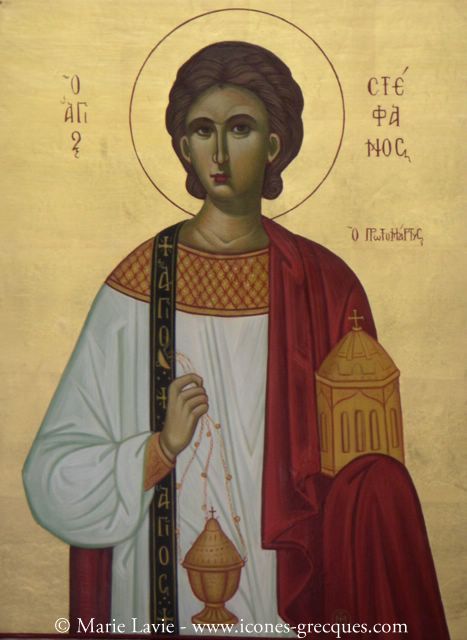
Saint Stephen, Protomartyr -- Sermon at Sunday Mass

The Christmas story is a message of hope and life. Yet the accounts of the birth of Jesus in the Gospels of Matthew and Luke already contain ominous anticipations of the opposition that will ultimately lead to his betrayal, arrest, trial, crucifixion, and death.

In Saint Matthew’s Gospel, the opposition is explicit and deadly. When wise men come from the East seeking him who is born King of the Jews, the then-reigning King of the Jews, Herod the Great, senses a threat to his throne. He seeks to kill the child, forcing the Holy Family to flee into Egypt to escape the slaughter of all the male children two years of age and under in the vicinity of Bethlehem. No sooner has Jesus come into this world than the powers of this world are trying to destroy him.

In Saint Luke’s Gospel, the intimation of future opposition is more subtle. When Mary and Joseph bring the infant Jesus to the Temple forty days after his birth to present him to the Lord, the aged prophet Simeon takes him into his arms, sings a song of praise to God, and then utters a strange prophecy: “Behold, this child is set for the falling and rising of many in Israel, and for a sign that is spoken against.” Some translations say: “a sign of contradiction.”

Simeon is foretelling the effect that Jesus will have on those who encounter him. The people who hear his teachings and witness his miracles will be forced either to accept him as the Messiah and follow him as Lord; or to reject and oppose him. In this way, he will become a sign of contradiction and a source of division. Precisely in the act of forming judgments about him, people will bring themselves under judgment. Those who reject him will fall away from God’s kingdom; while those who accept and follow him will be raised up and exalted.

It’s appropriate that on the day after Christmas – when we’ve just celebrated the birth of Christ into the world – we commemorate the first Christian martyr, Stephen. For by coming into the world, the Christ Child sets in motion the dynamic by which his followers and his enemies choose for or against him; and his enemies seek to put his followers to death just as they put him to death.

Because Stephen preaches the Gospel of Christ boldly, and without compromise, his listeners must heed his message and be converted, or else reject his message and silence the messenger in the only way they know how, by killing him. Stephen thus becomes, like his Lord, a sign of contradiction and a source of division.

Here in this parish dedicated to Saint Stephen, I sometimes wonder if we’ve understood this aspect of our Christian vocation as well as we might. I’m not sure that we’ve really taken on board the profound truth that to be faithful to Christ and his teachings is to incur the hostility and opposition of the world. Stephen clearly understood this, but do we?

Once, when I was in seminary, I was teaching a class in my fieldwork parish on the writings of the second-century bishop Ignatius of Antioch. As he was being taken in chains to Rome to die a martyr’s death in the arena, Ignatius wrote, “The greatness of Christianity consists not in its being loved by the world but in its being hated by the world.”

One of the participants in the class became very upset when he read that, and challenged me to interpret what Ignatius could have meant by such an outrageous and offensive statement. His assumption was clearly that if we Christians are doing what we’re supposed to be doing – feeding the hungry, healing the sick, sheltering the homeless, and so forth – then the world will have no choice but to appreciate our goodness and love us for it.

More and more, I notice a tendency not only among Episcopalians but among members of mainline liberal churches in general to blame Christians of certain other persuasions and styles for Christianity’s bad reputation in the secular culture. We boast to ourselves and anyone else who will listen: “After all, we’re not like those nasty fundamentalists or those reactionary Roman Catholics! If only people could see what well-educated, reasonable, open-minded, sophisticated, and tolerant people we really are … they wouldn’t tar us with the same brush.” And so we’re tempted to try to develop evangelism strategies based on differentiating ourselves from those bigoted and intolerant others who give Christianity a bad name.

Such a strategy is, however, profoundly misguided and fatally flawed because it totally misunderstands the nature of the forces arrayed against us. As Anglicans, and as Anglo-Catholics, we do indeed have significant differences with some of the other strands of contemporary American Christianity. But advertising those differences is never going to impress the partisans of militant secularism because their opposition to the Church and all it stands for goes far deeper than any quibbles we may have with our fellow Christians on today’s hot-button moral and political issues.

Christianity entails a word view that is irreconcilably incompatible with the modern secular world view, and the secularists know it. Modern secularism places humanity at the center, and insists that we are the measure of all things. Christianity places God at the center, and insists that God is the measure of all things. Modern secularism regards the goal of life as human fulfillment and self-actualization. Christianity regards the goal of life as serving God in this world and enjoying him forever in the next. Modern secularism makes enlightened self-interest the criterion of all moral judgment. Christianity makes God’s law the criterion of all moral judgment. Modern secularism holds that we can only know for certain those things that are scientifically proven and empirically verified. Christianity holds that the most important things we can ever know are those that God reveals and that we receive in faith. Modern secularism teaches that the remedy for human problems is a therapeutic process of becoming well-adjusted and learning to accept ourselves as we are. Christianity teaches that the remedy for human problems is repenting of our sins and turning in faith to Jesus Christ as the one whose death and resurrection saves us as we can never save ourselves.

I could go on, and still not do more than scratch the surface of the differences between the two world views. My point is simply that if we’re true to our Christian beliefs and commitments, it should never come as a surprise when the world hates us, ridicules us, and despises us – when colleagues, associates, and even friends and family members make snide remarks and put us down when they learn of even just our church membership and Mass attendance. It’s all part of the package that we signed on to at our baptism. Just ask St. Stephen. But the good news is that as our patron Stephen watches over us and prays for us, along with the whole Communion of Saints. And from him we can derive all the strength and courage we need to withstand anything that the world can throw at us.

Tuesday, December 25, 2012

Solemn Mass of the Nativity -- Sermon

Luke 2:1-20

“And this will be a sign for you: you will find a babe wrapped in swaddling cloths and lying in a manger.”

A striking feature of the Nativity story in Saint Luke’s Gospel is its focus on the shepherds. More than one commentator has remarked that Luke disposes of Our Lord’s birth itself in one verse: “And she gave birth to her first-born son and wrapped him in swaddling cloths, and laid him in a manger, because there was no room for them in the inn.”

And then he immediately switches to the shepherds in the field. Something miraculous happens that first Christmas night, but it’s not the birth of the infant Jesus. We often speak of the “Virgin Birth,” but the real miracle there has happened nine months previously: the Virginal Conception of Jesus by the Holy Spirit in the womb of Mary, which we celebrate on March 25, the Feast of the Annunciation.

No, the miraculous event of the first Christmas does not directly involve Jesus, Mary, and Joseph. The canonical Gospels give us no reason to suppose that anything takes place other than a normal human birth. The miracle involves instead the shepherds, who receive a supernatural announcement of that birth.

Luke sets the scene by describing the shepherds keeping watch over their flocks by night. During the past four weeks, in the Church we’ve done our best to practice the Advent disciplines of watching and waiting, because the Word of God typically comes to those who stay awake and watch, albeit not always in such a dramatic form as to those shepherds.

The annunciation to the shepherds follows a fairly standard biblical pattern. An angel appears to them, and the glory of the Lord – the supernatural light of God’s presence – shines round about them. As in almost all such biblical accounts of appearances of heavenly messengers, the shepherd’s reaction is one of sheer terror. Angels are frightening to behold. And so the first words of such heavenly messengers are almost invariably, “Fear not,” or “Be not afraid.”

The angel proceeds to deliver the announcement: “I bring you good news of a great joy which will come to all the people …” Here, Luke uses the same verb “to bring good news” that will later be translated “preach the Gospel” when he is writing of Jesus and the apostles. The angel’s message thus inaugurates the Gospel proclamation of the good news of God’s salvation.

The angel continues: “For to you is born this day in the City of David a Savior, who is Christ the Lord.” Here the angel’s proclamation takes a form resembling that of a herald announcing, say, the birth of an heir to the throne of an earthly kingdom or empire. But the three titles – Savior, Christ, and Lord – signify unmistakably to the shepherds that this birth is none other than that of Israel’s long-awaited Messiah, the anointed one of God.

Then the angel gives a sign. In the Bible, the purpose of signs accompanying announcements from messengers of God is to provide a means of verification, so that the recipient may know that the message is true, and not a hallucination or deception. For the shepherds, the sign shall be “a babe wrapped in swaddling cloths and lying in a manger.”

The key point to note about this sign is that it is simultaneously unremarkable and yet distinctive. Without having heard the angelic announcement, onlookers and passersby in Bethlehem might not think anything much of the event itself: an infant born to a traveling couple in makeshift lodgings with a feeding trough converted into a makeshift cradle. So long as the child is warm, wrapped up in his swaddling cloths, there’s nothing to worry about.

At the same time, however, the sign is sufficiently distinctive and unusual that when the shepherds see it, they cannot but recognize it as what the angel told them to look for. So, we have an event, and the announcement of that event. The event and the announcement stand in a relationship of reciprocity to each other: the announcement interprets the meaning of the birth; and the circumstances of the birth verify and confirm the contents of the announcement.

And the third element in the story is Luke’s account of the varying reactions of the different characters to what they’ve heard and seen. Here we have the opportunity to reflect and ask ourselves with whom in the story we identify most.

The first reaction is that of the multitude of the heavenly host, who break into a song of praise: “Glory to God in the highest, and on earth peace among men with whom he is pleased.” This song is the first Christmas carol; and every year when we sing the hymns and anthems of the season, we are, in effect, joining in the never-ending angelic chorus praising Christ’s birth.

Then we have the shepherds. Their immediate reaction is obedience to the message: they make haste into Bethlehem to see this thing that the angel has made known to them. And once they find it, they make known the angelic message to everyone there. Luke describes the reaction of those who hear the shepherds’ testimony as one of astonishment. Finally, having completed their mission, the shepherds return to their flocks, praising God for all that they’ve heard and seen.

The final reaction that Luke describes is that of Mary, the child’s mother. She keeps all these things in her heart, pondering them. Some commentators suggest here an implicit contrast with the shepherds, who return to their daily lives and work, and are not heard from again. In this way, perhaps, Luke is holding up Mary, rather than the shepherds, as the truest model of Christian discipleship. Even though she doesn’t yet fully understand the deepest significance of all that has been happening, she holds on to it, stores it all up, and muses on what it all might mean.

As we celebrate Christmas, perhaps it’s tempting to join in the seasonal festivities, to sing the carols, to exchange greetings and give gifts, and then forget all about it until the same time next year, and the year again after that. Perhaps that is what the shepherds did when they returned to their flocks – carried on with the rest of their lives as if nothing had happened, save for occasionally remembering the strange proceedings of a winter’s night and perhaps wondering whatever became of that couple and their babe in the manger ...

But Mary kept all these things and pondered them in her heart. We do well to follow her example. If some aspect of our celebration of Christmas touches you this evening, or in the days to come, even if you don’t understand all at once what it all means – nonetheless, don’t let it go. Hold on to it. Ponder it in your heart. Who knows how it may grow, and where it might lead?

Sunday, December 23, 2012

Advent 4, Year C -- Sermon at Sunday Mass

Hans Memling
Last Judgment Triptych (Detail), 1471
The Four Last Things
Part Four: Hell 


In twenty years of ordained ministry, I must admit that I’ve very seldom preached on hell. But then, I’m an Episcopalian. And few things are as damning to a priest’s reputation as the report that he preaches sermons on damnation. So, the traditional course of Advent sermons on the Four Last Things – Death, Judgment, Heaven, and Hell – is a good discipline for me as well as for you, because it compels us to examine together topics that we might otherwise prefer to avoid.

The most common objection raised by believers and nonbelievers alike to the idea of hell is that it contradicts God’s nature. How could a good, loving, and forgiving God condemn anyone to eternal punishment simply for not believing in him or for not being a Christian? It seems so unfair, so unjust. By the way, during my teenage agnostic years, this was my principal argument against Christianity.

Of course, that objection proceeds from some unfounded assumptions about what Christianity teaches. The Catholic tradition has always affirmed that non-Christians and nonbelievers can be saved. But it also affirms that hell is a very real possibility for any of us.

Part of the reason is that the Bible witnesses clearly to the existence of hell, particularly in the New Testament, and particularly in the teachings of Jesus himself. It’s a popular fallacy that Jesus spoke only comforting words of love and forgiveness, in contrast to, say, the fiery prophets of the Old Testament, or those who came after him like the Apostle Paul. When we read the Gospels, we discover that Jesus preached his share of fire and brimstone sermons too.

Boston College professor Peter Kreeft argues that the doctrine of hell follows logically from two prior doctrines: namely heaven and free will: “If there is a heaven,” he writes, “there can be a not-heaven. And if there is free will, we can act on it and abuse it. Those who deny hell must also deny either heaven (as does Western secularism) or free will (as does Eastern pantheism).”

Here we encounter the paradox that the existence of hell, rather than denying God’s love, instead manifests God’s love. True love never seeks to force itself on the beloved. It always respects the freedom of the beloved to respond in love or not. So it is with God. He loves us, but if we reject his love, he will respect our choice and not force us to love him against our wills. So in his love for us, God gives us the option to reject his love and spend eternity living in that rejection. C.S. Lewis says somewhere that, in the end, there are only two categories of people: those who say to God, “Thy will be done;” and those to whom God says, “Very well, then, thy will be done.”

I once explained this to a friend of mine years ago, who was fascinated with the idea that hell is somewhere people might actually choose to go. If it’s not really a place of punishment, burning in eternal flames and being poked by pitchfork-wielding devils, he mused, then it might not be such a bad place after all.

But that is to miss the point entirely. Hell is nowhere we ever want to be. The images for hell in Scripture are horrible and frightening, but they’re symbolic depictions of a spiritual reality that is even worse. The pain of loss – of losing God who is the source of all human happiness and joy – is infinitely worse than any torture. C.S. Lewis writes: “All your life an unattainable ecstasy has hovered just beyond the grasp of your consciousness. The day is coming when you will wake to find, beyond all hope, that you have attained it—or else that it was within your grasp and you have lost it forever.”

What is hell like? Peter Kreeft offers the fascinating speculation that heaven and hell may represent the same objective reality, namely God’s love, experienced oppositely by opposite souls, just as two people sitting next to each other at the same symphony or rock concert may be having two completely opposite experiences: heavenly ecstasy for the one and a hellish nightmare for the other. Just so, Kreeft writes:

The fires of hell may be made of the very love of God, experienced as torture by those who hate him: the very light of God’s truth, hated and fled from in vain by those who love darkness. Imagine a man in hell—no, a ghost—endlessly chasing his own shadow, and the light of God shines endlessly behind him. If he would only turn and face the light, he would be saved. But he refuses to—forever.

What that quotation makes clear is that hell is not so much a place where God sends us as a state that we choose for ourselves, either explicitly or implicitly, by turning away from God and rejecting his love. There is no hell but that of our own making.

The practical question, then, is how to avoid hell. The theological term is salvation. It means being saved from hell, and for heaven. And the answer is that we cannot save ourselves. Jesus is the Savior. He’s the only one who can rescue us from hell and bring us safely home.

We receive his salvation by believing in him, and by living in him so that we can be renewed and transformed by his life in us. And he gives us the normative means to do this in the corporate life, worship, and sacraments of his Church.

Again, this is not to say that non-Christians and non-believers cannot be saved. Faith in Christ can be implicit as well as explicit. Christ can offer the grace of his salvation to whomever he pleases. And there are many anonymous Christians out there who will discover that even though they did not know Christ in their earthly lives, nonetheless he is the one who sums up and embodies all that they ever regarded as good, beautiful, and true. In the end they, too, will recognize him as the one who saved them.

On the other hand, those of us who call ourselves Christians need to recognize that even for us hell remains a possibility. We cannot take our salvation for granted; and we need continually to renew our faith in Christ and to make use of the Church’s appointed means of grace to increase his life in us.

Here, then, is the deepest significance of our celebrations of the Lord’s Nativity tomorrow evening and Tuesday morning. Christmas celebrates the birth into this world of the one who comes to save us from death and hell. We greet him as our Savior now, so that in the Last Day we shall not be afraid to meet him as our Judge.


Source cited: Peter Kreeft, Fundamentals of the Faith: Essays in Christian Apologetics. San Francisco: Ignatius, 1988. pp. 162-4.

Friday, December 21, 2012

Requiem for the Victims in Newtown -- Homily

(Note: The regularly scheduled 8:30 am Mass this morning was offered as a Week's Mind Requiem for the shooting victims in Newtown, Connecticut. Saint Thomas the Apostle will be commemorated tomorrow at the 9:30 am Mass.)

In a time of national grief, our purpose here this morning is simply to do what the Church does on such occasions: to gather in worship, and to offer our prayers for the souls of those who’ve lost their lives.

The images on TV and the internet these past few days have been heartbreaking: twenty beautiful children between the ages of six and seven senselessly murdered; six educators who died trying heroically to protect those in their care; an entire community left wounded. As Yeats put it, “The blood-dimmed tide is loosed, and everywhere the ceremony of innocence is drowned.”

We cannot forget the shooter’s mother, no less a victim herself whatever mistakes she may have made. And then there is the shooter. To what diabolical evil did he yield himself in his mental disturbance? Unimaginable. He’s not an innocent victim, to be sure, but a victim nonetheless. It’s part of the nature of evil, what the Church calls the mysterium iniquitatis, the mystery of iniquity, to consume and destroy both the innocent and guilty alike, as we saw happen a week ago today.

Some people criticize the traditional prayers of the Requiem Mass as focusing too much on God’s judgment and wrath. And in planning this service I was tempted to omit some of these prayers, because after all the children who died were certainly innocents – like the Holy Innocents of Bethlehem – and they’re safe in the arms of Jesus, who said, “Truly, I say to you, unless you turn and become like children, you will never enter the kingdom of heaven.” They have nothing to fear from God's judgment now that they've suffered the worst that this world can do to them.

But then I thought better, and decided no, leave the traditional prayers intact. There’s plenty of guilt to go around in a world where this can happen, and we all need to be reminded of our common need for God’s forgiveness. “All alike have sinned and fallen short of the glory of God;” and yet this traditional liturgy of prayer for the dead proclaims that all those who cast themselves on God’s mercy in faith and repentance will be saved. The shooter now has God for his judge; and unlike all human judgment “the judgments of the Lord and true and righteous altogether.”

For me, one of the most disturbing aspects of this episode was its almost immediate politicization. The national reaction has magnified the deep ideological cleavages dividing our society. From the liberal-left side of the political spectrum came immediate calls for stricter gun control laws and attacks on the NRA and the gun culture that it represents, which in turn drew counter-attacks from those who felt that they were being scapegoated and demonized, and some of whom argued that it’s time for teachers to start carrying firearms.

Meanwhile, from the conservative-right came suggestions that this massacre was somehow related to the numbers of abortions performed in this country, or perhaps secularization as manifested in the banning of prayer and religious symbols from the public schools; and from the extreme religious right came allegations that this was somehow God’s judgment on American decadence and sexual immorality. No doubt if the shooter had lived, we would be embroiled in yet another national debate about the death penalty.

These various knee-jerk reactions from both the right and the left suggest that as a society we’ve lost the ability to create a space for mourning in the appropriate season. Instead, we short-circuit our grief by trying to assign blame so that we can prescribe remedies to ensure that this won’t happen again. But how this could have happened is a complex problem for which there are no simple solutions or quick fixes. The mutual recrimination and polarization that we’ve experienced in the past week is unseemly and does not honor the memory of the victims. It simply drives us further apart at a time when we need more than ever to come together in sorrow and grief.

Now, I’m not saying that we aren’t entitled to our political opinions, or that we don’t need to continue addressing such issues as gun control and mental health care policy –and I applaud President Obama’s plan to appoint a task force to investigate the issues and report back with concrete policy recommendations. But I am saying that as a society we need to regain the ability, if we ever had it, of putting aside our differences for a period to observe the rituals and practices of collective mourning. Our body politic will be healthier for it.

My final plea is that we allow the deaths of these twenty innocent schoolchildren to raise our awareness of those places in the world where children remain vulnerable to random violent death almost as a matter of course. When massacres occur in American upper middle-class suburban white communities, at least part of the shock is the feeling that this sort of thing isn’t supposed to happen here. That reaction betrays the unspoken assumption that there are places in the world where this sort of thing can be taken for granted and not given much second thought. But massacres of children anywhere in the world – from Chechnya, to Liberia, to Syria – merit our moral outrage just as much as they do a hundred miles from Providence. And perhaps one positive response to this national calamity would be to investigate how we can work to help protect children from violence worldwide.

Be all that as it may, again, our purpose here today is simply to do what the Church does: to gather in worship and prayer to commend the souls of the departed into the care and safekeeping of Almighty God. May they rest in peace. Amen.

Tuesday, December 11, 2012

Tuesday in Advent 2 -- Homily at Mass

Amos 5:18-24
Psalm 50:5-15
Matthew 18:12-14

It is sometimes said that throughout the Bible God comforts the afflicted and afflicts the comfortable. When we begin to get complacent and take our good standing with God for granted, along come some dire warnings of divine judgment and wrath to shake us up and prod us to examine and amend our lives. But lest these warnings drive us to desperation, along come some comforting passages to reassure us of God’s love and will to save.

Today’s readings are a case in point. The Old Testament lesson from the prophet Amos and the verses from Psalm 50 sound urgent notes of warning and condemnation. But then the Gospel reading from Saint Matthew reassures us of God’s will to save by means of the imagery of the shepherd who goes in search of the one lost sheep in the wilderness.

As Anglo-Catholics, however, we need to pay special heed to the warnings in today’s Old Testament reading and psalm. The prophet Amos – one of my favorite prophets, by the way – relates the Lord’s condemnation of the people’s worship and sacrifices. His language is scathing:

I hate, I despise your feasts, and I take no delight in your solemn assemblies. Even though you offer me your burnt offerings and cereal offerings, I will not accept them, and the peace offerings of your fatted beasts I will not look upon. Take away from me the noise of your songs; to the melody of your harps I will not listen. 

Amos prophesied in the eighth century BC in the northern Kingdom of Israel, by the way, so the worship he was condemning was that at the royal shrine at Bethel rather than at the Temple in Jerusalem. But while later generations might have said that no sacrifices outside Jerusalem were legitimate, that is not Amos’s reason for condemning them. Rather, the judgment is that the people are resting content with observing the outward forms of worship without living lives marked by holiness and righteousness.

Much of the Book of Amos is taken up with descriptions and vigorous denunciations of an unjust society in which the rich grow rich at the expense of the poor, and pervert the course of justice by bribing judges and royal officials. Against the background of such corruption and oppression, the worship of God becomes a travesty—even though the people participate in it enthusiastically and joyfully. But they do so to their own damnation. And so, Amos sounds the prophetic cry: “Let justice roll down like waters, and righteousness like an ever-flowing stream.”

The emphasis in Psalm 50 is slightly different. Writing in the name of God putting his case against the people, the psalmist proclaims: “I do not reprove you because of your sacrifices; your burnt offerings are continually before me. I will accept no bull from your house, nor he-goat from your folds. For every beast of the forest is mine; the cattle on a thousand hills … If I were hungry I would not tell you; for the world and all that is in it is mine. Do I eat the flesh of bulls, or drink the blood of goats?”

What is lacking is the inward disposition to match the outward offering. And so the psalmist declares: “Offer to God a sacrifice of thanksgiving, and pay your vows to the Most High; and call upon me in the day of trouble, and I will deliver you and you shall glorify me.”

In other words, the psalmist is saying that the outward forms of worship are without value unless they reflect and reinforce the relationship between God and his people that they are meant to express. Both Amos and the psalmist warn us that we cannot get away with trying to use worship as a means of buying God off. Worship must arise from and in turn form the community’s character as a people set apart for God. It is a means of, but cannot be a substitute for, living into that relationship.

Monday, December 10, 2012

Monday in Advent 2 -- Homily at Mass

Isaiah 35:1-10
Luke 5:17-26

Today’s readings fall into the classical biblical pattern of promise and fulfillment. The Old Testament reading from Isaiah describes the coming of the Lord to redeem his people in many wonderful images, including verses 5 and 6: “Then shall the eyes of the blind be opened, and the ears of the deaf unstopped; then shall the lame man leap like an hart, and the tongue of the dumb sing for joy ...”

The Gospel shows the fulfillment of the specific part of the promise concerning the healing of the lame in the story of the paralyzed man brought on a stretcher to Jesus and lowered down to him from an opening in the roof of the house where he was. The healing of the paralyzed man serves as a twofold sign: first of the fulfillment of the old prophecies concerning the dawning of the messianic age; and second as confirmation of our Lord’s authority to forgive sins in the name of God.

The biblical pattern of promise and fulfillment is actually threefold. Between the two there is usually given a sign that serves to confirm the promise. Thus, for example, at the beginning of Saint Luke's Gospel Zechariah is struck dumb as a sign that the promise given him by the angel Gabriel will be fulfilled in its time, despite his doubt. And likewise Mary is given the sign to confirm the angel’s message to her: “Behold your kinswoman Elizabeth in her old age has also conceived a son; and this is the sixth month with her who was called barren.” In this latter instance, the fulfillment of one promise—namely the conception and gestation of John the Baptist—becomes the sign confirming the imminent fulfillment of another promise—the conception of Jesus himself.

And I think something like this pattern is at work in today’s readings: the fulfillment of one promise becomes in turn the sign of the more wonderful fulfillment of still greater promises. The underlying point is that God keeps his word. And when we see the fulfillment of some promises having already taken place, we are thereby given assurance that God will fulfill all his promises to us.

For this reason, we do well to think of the ministry of Jesus as described in the Gospels as the dawning of the messianic age, the inauguration of the kingdom of God. Theologians often say that we live between the times, in the interim period between our Lord’s first and second comings. And during this in-between time, the kingdom is already-but-not-yet. In the life of the Church, in the Sacraments, and in the many mysterious ways in which God works in our midst, we experience the stirrings of the kingdom, even though we continue to live in a world whose redemption has not yet been made fully manifest.

Yet even now we catch glimpses of the fulfillment of God’s promises. And those become in turn signs to us that everything that he has promised will come to fruition in its own time. C.S. Lewis says somewhere that when we reach our final destination, be it heaven or hell, we will realize that it was the state in which we were living all along. The only difference is that it has now become not only fully manifest and all-encompassing, but also fixed, permanent, and irrevocable. The weekday Mass readings of this Advent season exhort us to be alert for signs of the fulfillment of God’s promises in our midst, here and now, so that we can embrace and hold fast the eschatological and eternal realities to which they point.

Sunday, December 9, 2012

Advent 2, Year C -- Sermon at Sunday Mass


The Four Last Things 
Part Two: Judgment 

You’re judging me! That seems to be one of the worst accusations anyone can make against anyone else today. The thought that others may be judging us makes many people resentful. And the notion that God may judge us makes many people even more nervous and uncomfortable.

This Advent I’m preaching the traditional course of sermons on the four last things: death, judgment, heaven, and hell. So, today we come to judgment. Every Sunday, in the Nicene Creed, we proclaim that Christ “shall come again, with glory, to judge both the quick and the dead.” Yet, in today’s Episcopal Church, the idea of God as judge is not often talked about; we’re far more likely to hear sermons about God’s unconditional love.

Yet, when we look at the word judgment itself, it’s not clear why it should have these negative connotations. According to one definition, judgment involves discerning the positives and negatives—or, in more traditional language, the good or evil—present in a person, situation, or action with a view to reaching a decision on how to respond. By this definition, we judge one another all the time, deciding, for example, who among our acquaintances are trustworthy, reliable, or worth cultivating as friends.

In the Bible, divine judgment comes at the very beginning, in the first chapter of the Book of Genesis. On the third day of creation, God has just separated the dry land from the seas, and verse 10 tells us: “And God saw that it was good.” That refrain punctuates each of the succeeding days as God continues creating plants and vegetation, birds, sea creatures, animals and, finally, human beings. And then at the end of the sixth day: “God saw everything that he had made, and behold, it was very good.”

The original divine judgment on creation is thus entirely positive. And, if we’re honest, we welcome positive judgment from other people. The next time someone says, “You’re judging me,” an interesting response would be, “Yes, because I want to see the good in you.”

Yet we still resist judgment. One reason we don’t want to be judged is that we know from experience the imperfection of most human judges and we don’t want to be judged unfairly. We human beings tend to evaluate and judge one another with a critical eye that is quick to notice faults and flaws, quick to point out mistakes and missteps.

Yet, where human beings are prone to biased and defective judgments, God alone is the perfect judge who sees and knows us exactly as we are. God may judge us, indeed he will judge us, but he will never judge us unfairly.

But there is perhaps another reason why we resist the idea of judgment, and especially divine judgment. Right judgment always brings the truth to light; and in most cases there are still truths about ourselves that we’d rather not have to face: at least not yet. And so, like Adam and Eve in the Garden after eating the forbidden fruit, we hide ourselves and try to evade the judgment of a God who sees everything and knows all.

Last week, we considered death, the first of the four last things. What happens to us after death? The biblical revelation on the subject is couched in highly symbolic imagery and mysterious language that can only hint at rather than fully describe the realities to which it points. But the tradition distinguishes two judgments that we undergo after death: a particular judgment and a general judgment.

In the hour of our death, our soul is separated from our body and is brought into the presence of God. Immediately a judgment takes place based on how we lived our earthly life. If we lived and died in such a way as to completely reject God and all that he represents – if our lives entailed a willful rejection of all truth and goodness—then our soul is banished eternally from God’s presence and that is hell.

If, on the other hand, we lived and died in such a way as to have attained complete holiness and purity, then our soul is admitted directly into heaven. Most people, I suspect, fit into neither category – they are on the way but still have a way to go before they’re ready for heaven; and for them the immediate destination is that state of continued growth and purification that our tradition calls Purgatory.

And so, in the Particular Judgment in the hour of death, the soul, separated from the body, is assigned to Heaven, Hell, or Purgatory. Whatever happens in that hour, however, I suspect that the soul will recognize the judgment rendered as completely fair and just.

The biblical imagery of the General Judgment at the end of time is even more mysterious. At the Second Coming, when Christ returns to judge the living and the dead, there will take place the General Resurrection, when our bodies will be raised from the dead, reconstituted from the elements, and reunited with our souls. Then will follow the Last Judgment, described in chapter 25 of Saint Matthew’s Gospel in the symbolic imagery of the king sitting on his glorious throne separating the righteous from the unrighteous as a shepherd separates the sheep from the goats. To the righteous, he will say, “Come, O blessed of my Father, inherit the kingdom prepared for you from before the foundation of the world …” But to the unrighteous he will say, “Depart from me, ye cursed, into the eternal fire prepared for the devil and his angels …”

How, we may well ask, did such a negative judgment become possible? The answer is that the possibility of such divine condemnation is the necessary concomitant of human freedom and responsibility. Back in the Garden, Adam and Eve ate of the fruit of the tree of the knowledge of good and evil, which God had forbidden them to eat. The forbidden fruit symbolizes the aspiration to make choices based on our own judgment of what is good and evil. By misusing this freedom in the exercise of false judgments, however, we introduced sin into the world. Down through the generations, social evils have multiplied, from crime to poverty to war to destruction of the natural environment. And the only way that the whole creation can be redeemed and restored to its original state as very good in the eyes of God is by a process of divine judgment that begins in the Incarnation, death, and resurrection of Jesus Christ and ends in the return of Christ to judge the living and the dead at the end of time.

The season of Advent calls us to prepare to meet Christ as our judge. If we feel unprepared, the good news is that we still have time. But we don’t have forever. We are accountable to God for all our thoughts, words, and deeds. The choices we make in this life have eternal consequences. And on the remaining two Sundays of Advent, we shall have occasion to look at those consequences in more detail.

Sunday, December 2, 2012

First Sunday of Advent, Year C -- Sermon at Mass

The Four Last Things

Part One: Death


About twenty years ago or so, a priest-monk of the Community of the Resurrection in England came to this country and gave a series of teaching missions in various parishes. His name was Fr. Augustine Hoey, CR, he was well in his eighties, and none of those who heard him speak could ever forget him. I never heard him, but I know several people who did. The sessions took place on successive weekday evenings over the course of a week; and as word spread of his remarkable talks, attendance grew and multiplied from one day to the next.

His presentations were highly dramatic and theatrical, making use of lots of elaborate props. On one evening in particular, the congregation would arrive in a church that had been decorated as for an old-fashioned Victorian funeral, with black crepe draperies, black altar vestments, unbleached wax candles, and somber music quietly played on the organ. At the front, in the crossing, was a bier flanked by six bier lights, but no coffin.

Then came a loud knocking on the back doors, which had been closed; six pall bearers entered carrying a coffin on their shoulders, processed up the center aisle, and laid the coffin on the bier in the crossing. The tension would mount. Finally, the lid of the coffin would open to reveal Fr. Hoey himself lying within, in full mass vestments, his hands clasped and his eyes closed.

After another few minutes in which the tension became almost unbearable, Fr. Hoey opened his eyes, sat up in the coffin, surveyed the congregation, and announced: “Ladies and gentlemen: this evening I would like to speak about that moment to which we all look forward with joyful anticipation: our death!”

Unfortunately, I haven’t been told what he said after that, but what an attention-getter! His techniques were typical of some of the Anglo-Catholic preaching missions of the early twentieth century, and borrowed much from vaudeville and the music hall. But the shock of that particular opening lay in its direct challenge to our death-avoidant culture.

We don’t like to talk about death. In my first year in my previous parish, as a brand new rector, I thought it would be a clever idea to organize a Lenten teaching series on Christian preparation for death. I invited a series of speakers to address such topics as Episcopal funeral customs, options for burial versus cremation, and estate-planning. To the surprise of my neophyte naivety, there was a good deal of grumbling and complaining in the parish, and a bit of pushback as well. One lady summed it up by declaring: “I come to church to feel good; I don’t come to hear things that depress me.”

Yet, one of the duties the Church lays on the clergy is that of instructing the congregation in the Christian understanding of and approach to death. And one of the traditional times for doing so has been Advent. It used to be the custom on the four Sundays of Advent to preach on the “Four Last Things” – Death, Judgment, Heaven, and Hell. And this year it occurred to me for the first time in my priestly ministry to tackle this traditional course of Advent sermons.

The paradox is that while the Church challenges our death-avoidance, she unequivocally affirms the value of life against what has been described as a culture of death that has made ever greater inroads into the contemporary world. From medical ethics to the ethics of war and peace, and crime and punishment, the Church bears consistent witness to life as a gift of God to be received, cherished, and embraced with joyful gratitude. The Gospel imperative is to choose life. Death is never to be deliberately caused or hastened while life remains a viable option.

And yet, when death becomes inevitable, as it ultimately must for all of us, the ideal Christian response is a spirit of resignation and acceptance. The Christian spiritual tradition commends the practice of praying for the grace of a holy death: that is, a death that we’ve had adequate opportunity to prepare for by repenting of our sins, forgiving our enemies, setting our affairs in order, and arranging for the responsible and charitable disposal of our worldly possessions. It was in this spirit that Saint Francis of Assisi was able to sing, “Praise to you, my Lord, through our Sister Bodily Death, from whom no one living can escape.”

Certain modern philosophers rightly point out that the reality of our death is always present to us in the background of our awareness as a kind of “limiting horizon.” In other words, if we could expect to live indefinitely, we’d lose a great deal of our focus and sense of purpose. The knowledge that we have only a finite amount of time to live concentrates our minds and motivates us to make definite choices about what to do with our lives. If we could expect to live indefinitely, it would likely not matter much to us which goals we failed to achieve or which projects we failed to complete because we’d always have more time to get to them later. But the horizon of death limits that time and so impels us to try to respond to our callings and fulfill our vocations in the limited time that God gives us on this earth.

The readings, prayers, and hymns of Advent testify to the reality of the Lord’s coming in glorious majesty with anticipation, longing, hope, joy, and maybe also a little fear and trembling. Just so, for each of us, our death represents our own personal Advent of the Lord. What the Second Coming of Christ will be to the entire cosmos, our death will be to each of us personally: the end of our present world, and the gateway to the world to come.

It follows that all the Season of Advent bids us do together as the Church in anticipation of the Coming of the Lord at the end time – all the traditional practices of watching, waiting, praying, and preparing – the season also bids each one of us do in anticipation of our own personal meeting with the Lord in the hour of our death. And to aid in this preparation, we shall continue next week by considering the second of the Four Last Things, namely judgment.