In Saint Matthew’s Gospel, the opposition is explicit and deadly. When wise men come from the East seeking him who is born King of the Jews, the then-reigning King of the Jews, Herod the Great, senses a threat to his throne. He seeks to kill the child, forcing the Holy Family to flee into Egypt to escape the slaughter of all the male children two years of age and under in the vicinity of Bethlehem. No sooner has Jesus come into this world than the powers of this world are trying to destroy him.
In Saint Luke’s Gospel, the intimation of future opposition is more subtle. When Mary and Joseph bring the infant Jesus to the Temple forty days after his birth to present him to the Lord, the aged prophet Simeon takes him into his arms, sings a song of praise to God, and then utters a strange prophecy: “Behold, this child is set for the falling and rising of many in Israel, and for a sign that is spoken against.” Some translations say: “a sign of contradiction.”
Simeon is foretelling the effect that Jesus will have on those who encounter him. The people who hear his teachings and witness his miracles will be forced either to accept him as the Messiah and follow him as Lord; or to reject and oppose him. In this way, he will become a sign of contradiction and a source of division. Precisely in the act of forming judgments about him, people will bring themselves under judgment. Those who reject him will fall away from God’s kingdom; while those who accept and follow him will be raised up and exalted.
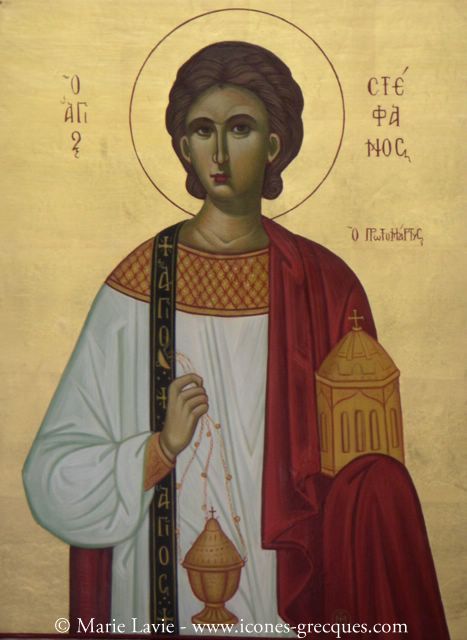
It’s appropriate that on the day after Christmas – when we’ve just celebrated the birth of Christ into the world – we commemorate the first Christian martyr, Stephen. For by coming into the world, the Christ Child sets in motion the dynamic by which his followers and his enemies choose for or against him; and his enemies seek to put his followers to death just as they put him to death.
Because Stephen preaches the Gospel of Christ boldly, and without compromise, his listeners must heed his message and be converted, or else reject his message and silence the messenger in the only way they know how, by killing him. Stephen thus becomes, like his Lord, a sign of contradiction and a source of division.
Here in this parish dedicated to Saint Stephen, I sometimes wonder if we’ve understood this aspect of our Christian vocation as well as we might. I’m not sure that we’ve really taken on board the profound truth that to be faithful to Christ and his teachings is to incur the hostility and opposition of the world. Stephen clearly understood this, but do we?
Once, when I was in seminary, I was teaching a class in my fieldwork parish on the writings of the second-century bishop Ignatius of Antioch. As he was being taken in chains to Rome to die a martyr’s death in the arena, Ignatius wrote, “The greatness of Christianity consists not in its being loved by the world but in its being hated by the world.”
One of the participants in the class became very upset when he read that, and challenged me to interpret what Ignatius could have meant by such an outrageous and offensive statement. His assumption was clearly that if we Christians are doing what we’re supposed to be doing – feeding the hungry, healing the sick, sheltering the homeless, and so forth – then the world will have no choice but to appreciate our goodness and love us for it.
More and more, I notice a tendency not only among Episcopalians but among members of mainline liberal churches in general to blame Christians of certain other persuasions and styles for Christianity’s bad reputation in the secular culture. We boast to ourselves and anyone else who will listen: “After all, we’re not like those nasty fundamentalists or those reactionary Roman Catholics! If only people could see what well-educated, reasonable, open-minded, sophisticated, and tolerant people we really are … they wouldn’t tar us with the same brush.” And so we’re tempted to try to develop evangelism strategies based on differentiating ourselves from those bigoted and intolerant others who give Christianity a bad name.
Such a strategy is, however, profoundly misguided and fatally flawed because it totally misunderstands the nature of the forces arrayed against us. As Anglicans, and as Anglo-Catholics, we do indeed have significant differences with some of the other strands of contemporary American Christianity. But advertising those differences is never going to impress the partisans of militant secularism because their opposition to the Church and all it stands for goes far deeper than any quibbles we may have with our fellow Christians on today’s hot-button moral and political issues.
Christianity entails a word view that is irreconcilably incompatible with the modern secular world view, and the secularists know it. Modern secularism places humanity at the center, and insists that we are the measure of all things. Christianity places God at the center, and insists that God is the measure of all things. Modern secularism regards the goal of life as human fulfillment and self-actualization. Christianity regards the goal of life as serving God in this world and enjoying him forever in the next. Modern secularism makes enlightened self-interest the criterion of all moral judgment. Christianity makes God’s law the criterion of all moral judgment. Modern secularism holds that we can only know for certain those things that are scientifically proven and empirically verified. Christianity holds that the most important things we can ever know are those that God reveals and that we receive in faith. Modern secularism teaches that the remedy for human problems is a therapeutic process of becoming well-adjusted and learning to accept ourselves as we are. Christianity teaches that the remedy for human problems is repenting of our sins and turning in faith to Jesus Christ as the one whose death and resurrection saves us as we can never save ourselves.
I could go on, and still not do more than scratch the surface of the differences between the two world views. My point is simply that if we’re true to our Christian beliefs and commitments, it should never come as a surprise when the world hates us, ridicules us, and despises us – when colleagues, associates, and even friends and family members make snide remarks and put us down when they learn of even just our church membership and Mass attendance. It’s all part of the package that we signed on to at our baptism. Just ask St. Stephen. But the good news is that as our patron Stephen watches over us and prays for us, along with the whole Communion of Saints. And from him we can derive all the strength and courage we need to withstand anything that the world can throw at us.

No comments:
Post a Comment