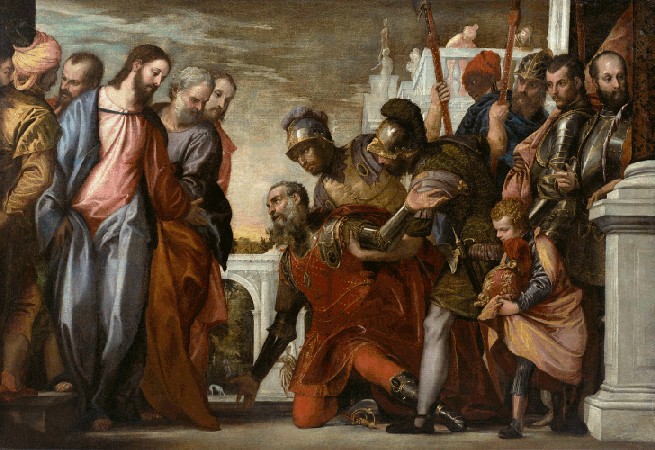
Luke 7:1-10
We hear a lot today about boundaries. The maintenance of appropriate professional and personal boundaries is a hot topic. And both our Old Testament and Gospel readings today touch on what might be called religious boundaries.
In the first reading, King Solomon is praying at the dedication of the newly constructed Temple in Jerusalem. He calls on God to listen to and answer the prayer of even the foreigner who comes to Jerusalem to pray towards this house.
At this stage of Israel’s history, a foreigner is by definition a Gentile. Such a foreigner is forbidden to enter the Temple on pain of death. So here we encounter a firm religious and national boundary. Entry into God’s house is restricted to members of God’s people Israel; everyone else must stay outside.
Yet Solomon acknowledges in his prayer that God himself is not bound by such boundaries. When the foreigner prays towards this house, Solomon implores, “hear thou in heaven thy dwelling place, and do according to all for which the foreigner calls unto thee; in order that all the peoples of the earth may know thy name and fear thee …”
In other words, the boundary restricting a foreigner from access to God’s house may be appropriate and necessary in that time and place; but it doesn’t restrict the foreigner’s access to God himself. God is perfectly well able to hear their prayers as well and reach out beyond the boundary to do all that the foreigner asks.
In the Gospel reading, however, we encounter almost exactly the reverse situation. A Roman centurion in the town of Capernaum has a servant who is ill and at the point of death. The centurion is a foreigner in the land of Israel. And as an observant Jew, Jesus is forbidden by the purity regulations of his religion from entering the house of a Gentile. If he does so, he will become ritually unclean, and will have to undergo a process of ritual purification before being allowed to participate again in the life and worship of the Jewish people.
So, where in the first reading we have a foreigner forbidden from entering God’s house, in the second reading we have God Incarnate forbidden from entering a foreigner’s house. The religious boundaries work in both directions!
Centurions were middle-ranking officers in the Roman army, which was divided into units called legions, cohorts, and centuries. Typically, in the first century, a legion consisted of about 4,800 soldiers, and was divided into ten cohorts each comprising 480 men. A cohort was divided in turn into six centuries, each consisting of 80 men and commanded by a centurion, assisted by junior officers.
So in or near Capernaum, the fishing village on the Sea of Galilee that was home to Saint Peter, there was stationed a century of soldiers commanded by this unnamed centurion. Unlike many Roman officers, however, he loved the Jewish nation, and had even built Capernaum’s synagogue. Incidentally, the basalt foundations and floor of the first-century synagogue at Capernaum can still be seen today, beneath the ruins of the fourth-century synagogue that replaced it.
It’s possible that our centurion may have been what was known in the Roman world as a “God-fearer,” that is, a Gentile who admired the Jewish religion, prayed to its God, and tried to follow its ethical teachings, without going the whole way converting, being circumcised, and becoming a Torah-observant Jew.
Be that as it may, a key responsibility of the centurion’s job was to pay close attention to everything that was going on in his immediate vicinity – so that he would be in a position to respond to the first signs of trouble. He would thus have been fully informed about Jesus. Prophets and teachers with a popular following were precisely the sorts of people the Roman authorities wanted to keep a close eye on. So, no doubt, the centurion would have heard about our Lord’s powers as a healer and miracle-worker as well.
No wonder, then, when his beloved servant is at the point of death, that he sends the local elders of the synagogue to seek Jesus’ assistance. In response to his plea, and with the elders’ good recommendation of this centurion, Jesus agrees and comes with them. But when he hears that our Lord is on the way, rather than let him complete the journey and cross the threshold of his house, the centurion sends friends with the message: “Lord … I am not worthy to have you come under my roof. But say the word, and let my servant be healed.”
In other words, in a display of enormous cultural sensitivity and consideration, the centurion is respecting the religious boundaries that Jesus must observe. His statement, “I am not worthy,” refers not to his moral character but rather to his ritually unclean status as a Gentile. He knows that if Jesus enters his house, it will cause him the great inconvenience of having to undergo ritual purification, and could very well cause others to accuse him of being a Roman collaborator.
But the centurion also knows that while as a human being Jesus is restricted by these religious boundaries, as the agent of God’s power he is not. So the centurion affirms his belief that Jesus can heal his servant simply by speaking a word from a distance – just as he himself obeys orders issued from a distance by his superiors, and just as he commands his subordinates to travel great distances to carry out his orders.
In short, while both the centurion and Jesus himself are restricted by the religious boundaries separating Jews and Gentiles, nonetheless, both the centurion’s faith, and our Lord’s power and authority, are able to cross over and transcend all such boundaries. Jesus marvels that not even in Israel has he encountered such faith. And, even from a distance, the centurion’s servant is healed.
Now the great temptation for the preacher at this point would be to conclude that, well, that was then and this is now, and of course we don’t observe such silly religious boundaries anymore. But that conclusion would be profoundly mistaken. The boundaries have changed, to be sure, but they’re still there.
For example, according to the canon law of the Episcopal Church, only those who’ve been baptized may receive Holy Communion. Only priests may celebrate the Eucharist. Only bishops may ordain. The rubrics of the Prayer Book set multiple boundaries on what may and may not be done in our liturgical services. And these religious boundaries are valid, necessary, and appropriate for ordering our life together in the Church.
Yet the message of our readings this morning also remains valid. We’re bound by these boundaries, but God is not. God hears the prayers of all who call upon him, whether Christian or not, whether religious believer or not. And God retains absolute freedom in deciding how he may choose to respond.

No comments:
Post a Comment