Friday, April 3, 2015

Sermon for Good Friday

Henry Thomas Bodset (d. 1934), Jesus before his Crucifixion

During the Trial of Jesus in the Saint John Passion that we’ve just heard, Pontius Pilate declares not once but three times, “I find no fault in him.” (The Authorized Version (AV) says “fault,” but a better translation might be “guilt” or “crime” (RSV), or even “I find no case against him” (NRSV), or “I find no basis for a charge against him” (NIV).)

In John’s narrative, Pilate initially questions Jesus, asking whether he is King of the Jews. Jesus responds that his kingship is not of this world; otherwise his servants would fight, and that his mission is to bear witness to the truth.

Pilate then goes out to the crowd and declares the first time that he finds no crime in Jesus. He offers to release Jesus according to the custom of releasing a prisoner at the time of Passover. But the crowd insists, “No, not this man, but Barabbas.”

Pilate then has Jesus scourged, and the soldiers place on him the crown of thorns and the purple robe. He brings Jesus out before the crowd and declares, “See I am bringing him out to you, that you may know that I find no crime in him.” That’s the second time he says this. But on seeing Jesus, the crowd cries out, “Crucify him, crucify him!”

Pilate responds, “Take him yourselves and crucify him, for I find no crime in him.” That’s the third time. Pilate wants to find a way to release Jesus, and questions him once more. But when the chief priests implicitly threaten to report Pilate to Caesar, he finally relents and turns Jesus over to be crucified.

In the Jewish law of the time, to declare something three times was to make it irrevocable and binding – like swearing an oath. Some contemporary biblical scholars have argued that John and the other Gospel writers craft their accounts of the trial so as to exonerate the Romans for the death of Jesus and shift the blame to the Jews. But John’s account of Pilate’s actions is fairly damning. Pilate three times declares Jesus innocent, and then hands him over for crucifixion anyway. He thus perverts justice by openly condemning an innocent man to death.

This account of the trial highlights the point that Jesus suffers and dies on the cross as an innocent victim. As a corollary: those who conspire to gather evidence and bring charges against him, and who work to secure his condemnation first by the Sanhedrin and then by Pilate, are not administering justice but rather conspiring to commit a grave injustice. Whatever else the figure of Jesus on the cross represents, then, it depicts first and foremost the unjust suffering of an innocent victim.

The problem of unjust and undeserved suffering remains always with us. For example, when we witness the wholesale slaughter and maiming of civilian men, women, and children in war, our inmost selves cry out to heaven in protest: “Why, O Lord, why?” It’s bad enough that combatants should have to suffer and die in war, and no-one’s suggesting that they deserve it either, but nonetheless something about the unjust suffering of the innocent particularly scandalizes and outrages our consciences.

Down through the centuries, second-rate philosophers and religious teachers have proposed facile solutions to this problem. While we don’t like it at the time, they say, suffering is good for us. It strengthens our character and makes us better people.

But that’s a myth. During the Second World War, the British pacifist Vera Brittain wrote that far from strengthening character and ennobling people, most unjust suffering has precisely the opposite effect. It brutalizes and dehumanizes its victims, creating a legacy of bitterness, resentment, hatred, and thirst for revenge.

The one exception, she wrote – and much more the exception than the rule – is when such suffering is freely accepted by its victim and offered up sacrificially in the service of a higher cause or principle. In that case alone, unjust suffering has the potential to become redemptive and transformative. But very few people have any natural capability for such sacrificial self-offering.

The Gospel that we proclaim today, on Good Friday, is that Jesus Christ, as the Incarnate Son of God, fully human and fully divine, is the one and only innocent victim who ever accepts his unjust suffering and death with such perfect humility and resignation that his offering of himself on the cross constitutes, to quote the Prayer Book, the “one, full, perfect, and sufficient sacrifice, oblation, and satisfaction for the sins of the whole world.”

We don’t need to go into the various theologies describing the mechanisms by which the Atonement is thought to work. The Universal Church has never defined as dogma any of the many competing theories of precisely how and in what way Jesus’ death on the cross accomplishes the forgiveness of sins and the reconciliation of a fallen world to God. It just does, and that’s all we really need to know.

Two consequences follow for us, however, in our calling to live the Christian life. First, in this life at least, following Jesus means walking in the way of the cross. We must never seek suffering for its own sake. But if and when we find ourselves facing some injury, disease, or other calamity that entails pain and loss, we can accept it as a way of being close to Jesus. This acceptance comes to us not naturally but by divine grace, as a gift of the Holy Spirit. So long as we stay close to Jesus, we can bear anything for his sake – and in that case our pain and suffering do have the potential to become redemptive.

Secondly, however, while we may freely accept this path for ourselves, we never have any right to impose it on others. There is something particularly cruel and wicked about telling those in pain to accept their suffering because it will make them better people. And it’s downright blasphemous to inflict pain and suffering on the same pretext, that it’s somehow good for the victims.

No. Down through the centuries the Church’s best wisdom has derived precisely the opposite conclusion from the suffering of Christ on the cross. Our obligation as Christians is to do everything we can to prevent, stop, and relieve the unjust suffering of innocent victims whenever and wherever we encounter it in the world around us. Our mission is one of healing, reconciliation, restoration, and justice.

At this time in our history, in particular, we have an obligation to work to end the systemic injustice that disproportionately victimizes the poor and members of racial and ethnic minorities. The shooting of unarmed black teenagers is but one example. Yet we have the assurance that whenever innocent victims suffer unjustly, Jesus suffers with them. And when we minister to such innocent victims with compassion and love, we minister to Christ himself.

Thursday, April 2, 2015

Sermon for Maundy Thursday

Marc Chagall, The Israelites Eating the Passover Lamb, 1931
The events we commemorate on Maundy Thursday, and indeed throughout the coming three days, all take place within the context of the Jewish celebration of Passover in Jerusalem. This evening’s Old Testament reading from Exodus recounts the institution of the Passover meal, known in contemporary Judaism as the Seder. 

According to three of the four canonical Gospels, the Last Supper was a Passover Meal. In Matthew, Mark, and Luke, Jesus sends his disciples to the upper room to prepare the Passover on the First Day of Unleavened Bread, the day when the Passover lambs are being slaughtered, and that evening after sundown they gather for the meal itself.

The Gospel of John, by contrast, describes the Last Supper as taking place a day earlier, “before the Passover,” with the crucifixion of Jesus happening on the First Day of Passover. John, it seems, wants to emphasize that Jesus’ suffering and death on the cross occur on the same day that the Passover lambs are being slaughtered in the Temple nearby.

Down through the centuries, scholars have debated which of the two accounts is accurate. Either way, the Last Supper takes place when Jesus and his disciples are in Jerusalem to keep the feast. Passover, with all its connotations and associations, is “in the air.” And for all four Gospel writers, the feast of Passover supplies the wider context of meaning illuminating not only the Last Supper but also the unfolding drama of the Lord’s subsequent betrayal, arrest, trial, suffering, and death.

Our reading from Exodus rehearses God’s instructions to the Israelites for keeping the first Passover. Despite a series of nine terrible plagues, Pharaoh has persisted in refusing Moses’ repeated demands to let the people go. About to send the tenth and most terrible plague of all, the death of the firstborn sons throughout the land, God instructs the Israelites that the head of each household must slaughter a lamb and smear some of its blood on the doorposts of the house. The lamb is to be roasted and eaten that night, with nothing left over. Then, when the angel of death goes through the land and sees the blood on the doorposts, he will pass over that house and spare its firstborn.

This last plague finally persuades Pharaoh to relent and let the people go. For the Israelites, then, the Passover lamb becomes a sign of deliverance and salvation. However, the Passover meal is not left as a one-off event. The books of the Old Testament record that the Israelites continued to keep Passover, year by year, as the annual commemoration of their deliverance from bondage in Egypt.

A number of biblical scholars have suggested that this annual celebration of Passover was not merely an occasion of piously recalling events that remained confined to the distant past, but rather a means of dynamically re-appropriating and re-experiencing those events in the present. Subsequent generations of Jews did not live through the Exodus from Egypt, but, in a way that is difficult for the modern western mind to understand, by re-enacting those events liturgically they became one with their ancestors who did, and so were reconstituted as God’s people Israel. This mysterious quality of the Passover commemoration is conveyed in the opening words of the Seder, spoken by the youngest child present: “Why is this night different from all other nights?” The child represents, of course, the future generations who are to be incorporated into the people of Israel by liturgical participation in the long-ago events of the Exodus.

The Greek word for this sort of transformation of time is anamnesis, the making-present of past events, which translates rather lamely into English as “remembrance.” And Saint Paul uses precisely this same word in rendering the words of Jesus at the Last Supper over the bread and the wine: “Do this in remembrance of me.” In Greek: do this for my anamnesis. A better translation might be: Do this to make me present among you; Do this to recall me into your midst.

Earlier in the same letter, Paul explicitly likens Jesus to the Passover lamb in words that we repeat at the Breaking of the Bread at almost every Eucharist: “Christ, our Paschal lamb has been sacrificed. Let us, therefore, celebrate the festival, not with the old leaven, the leaven of malice and evil, but with the unleavened bread of sincerity and truth.” (Paul’s reference there to “unleavened bread” similarly refers to the matzo bread used in the Passover meal.)

At the Last Supper, Jesus transforms powerful religious symbols inherited from the past. Up until now, the Passover lamb has functioned as a sign of God’s deliverance of his people from slavery. But now Jesus himself becomes the new Passover Lamb, the sacrificial victim whose death delivers his people from the power of sin and death for all time and beyond. More than that, Jesus fulfills the symbolism by showing himself to be the true Passover Lamb, the ultimate sacrificial offering towards which the Passover Meal was always pointing.

During the course of the meal, Jesus invests the familiar elements of bread and wine with new meaning: This is my body; this is my blood. In the context of the Last Supper, these mysterious words have a double significance. First, they predict what’s going to happen the next day. Jesus will die on the cross and his blood will be poured out. Obscure as these words are when he speaks them, his disciples will afterwards be able to remember and understand: Yes, what was it that he said at the supper about his body and his blood? His words not only predict but also interpret his coming death. It is not an ignominious and ultimately meaningless defeat, but rather the inauguration of a new covenant in his blood.

Second, his words set the pattern that his disciples are to follow henceforth until the end of time: “As often as you eat this bread and drink this cup,” writes Paul, “you proclaim the Lord’s death until he comes.” From now on, the life of the Church will be defined by this pattern: meeting together weekly and even daily to break the bread and share the cup, and so partake of the Body and Blood of Christ.

On Maundy Thursday, then, we give thanks for our Lord’s gift of himself to us in the Holy Eucharist. We remember with gratitude the Eucharist’s origins in the Passover meal, which Jesus celebrated faithfully throughout his life. We pray for the Jewish people, our “elder brothers and sisters in faith” as Pope John Paul II called them, who will be celebrating the Passover Seder at this time tomorrow evening. And we rejoice that Jesus is our Passover lamb, who feeds us with his own Body and Blood every time we gather to break the bread and share the cup.

Sunday, March 29, 2015

Sermon for Palm Sunday, Year B

Pavel Popov, Judas Betrays Christ with a Kiss (Date Unknown)

Mark 11:1-11
Mark 14:1-15:47

In Episcopal parish churches where they don’t have a choir to sing the Passion Gospel on Palm Sunday, it’s common to have a dramatic reading of it instead. Members of the congregation are assigned different parts, from the narrator, to Peter, to the maid who accuses Peter of being one of Jesus’ disciples, to the centurion at the foot of the cross.

The parish priest almost always takes the part of Jesus. The full congregation takes the part of the crowd, shouting out with particular enthusiasm the lines, “Crucify, crucify him!” (Sometimes one wonders whether they’re referring more to Jesus or the rector.)

Countless sermons and devotional commentaries on this practice point out the contrast between the crowd’s cries of “Hosanna” when Jesus enters Jerusalem, and the same crowd’s cries of “Crucify, crucify him!” within the same week. By reciting these lines, the congregation is reminded that even if we join in singing the praises of Jesus in church, we need to take care that we don’t end up effectively calling for his crucifixion at other times in other contexts.

This year, both the Palm Gospel and the Passion Gospel are taken from Saint Mark. Some biblical scholars reckon Mark’s the first of the canonical Gospels to have been written, while others question that hypothesis. Either way, Mark’s Gospel is clearly the shortest and most succinct of the four.

I want to argue this morning that a careful reading of Saint Mark shows that the real contrast he has in mind is not so much between the cries of “Hosanna” on Palm Sunday and “Crucify him!” on Good Friday, as between the disciples’ enthusiastically following Jesus into Jerusalem at his Triumphal Entry but then deserting him at his arrest a few days later.

Let’s look at both events a bit more closely. On Palm Sunday, Jesus makes his final approach to Jerusalem among the crowds of pilgrims going up to the Holy City to keep Passover. His route by way of the villages of Bethany and Bethphage on the Mount of Olives has deep significance. According to Old Testament prophecy, this is where the Messiah will appear on the Day of the Lord: “On that day,” says the prophet Zechariah, “his feet shall stand upon the Mount of Olives which lies before Jerusalem to the east.”

The elaborate preparations involving the colt evoke another prophecy of Zechariah:

Rejoice greatly, O daughter of Zion!
Shout aloud, O daughter of Jerusalem!
Lo, your king comes to you;
triumphant and victorious is he,
humble and riding on an ass,
on a colt the foal of an ass.

Jesus riding into Jerusalem on a young donkey is thus what the biblical scholars call an enacted sign: a bit of street theater designed to make a theological and political point. He’s visually proclaiming himself the true king of Israel, the Messiah or Anointed One of God, arriving to take possession of his capital city.

The point is not lost on those accompanying him. Spreading their garments and leafy branches in his path, they pay him the homage due royalty and acclaim him the one who comes in the name of the Lord to restore the kingdom of his father David.

Those who engage in this acclamation are not, however, the multitudes at large. Rather, they’re those who’ve traveled with Jesus from Galilee, along the Jordan valley, through Jericho, and up to Jerusalem. The Twelve Apostles are the inner circle of Jesus’ disciples, but the disciples are really a much larger group. They’ve followed him, listened to his teachings, and witnessed his miracles – most recently the healing of blind Bartimaeus on the road out of Jericho. These disciples traveling with Jesus and the Apostles are the ones who acclaim him as Messiah as they enter Jerusalem.

Within the week, however, their hopes for the establishment of the messianic kingdom are dashed. After eating the Passover meal with the Twelve, Jesus goes out to a place called Gethsemene with Peter, James, and John, and spends much of the night in prayer. Identified by his betrayer Judas with a kiss, he is seized by an armed mob sent by the chief priests and scribes and elders. Then, as Mark notes with characteristic brevity, his disciples all forsake him and flee.

There follows that strange incident, found only in Mark’s Gospel, of the young man who follows him wearing only a linen garment. The mob seizes him but he leaves the linen cloth and runs away naked. Biblical commentators down through the centuries have speculated on his identity. Some have wondered if he’s Mark himself. Most likely, however, Mark’s point in relating the incident has to do with the shame of nakedness in that culture. Rather than allowing himself to be seized so that he can continue to follow Jesus in the Way of the Cross, the young man chooses instead the shame of running away naked. In this way, Mark highlights the shame of all those who abandon Jesus and flee in the moment of crisis.

Peter subsequently experiences the shame of forsaking Jesus when he denies him three times in the high priest’s courtyard when accused of being one of his disciples. Remembering the Lord’s prediction, “Before the cock crows twice, you shall deny me three times,” Peter breaks down and weeps bitterly.

In the end, Jesus faces his trials, his scourging, his mocking, his carrying of the cross, and his death by crucifixion alone, abandoned and forsaken by the same disciples who followed him into Jerusalem singing hosannas just a few days before. The sole exceptions in Mark’s account are the women who came up with him to Jerusalem. As Jesus dies on the cross, they stand watching from afar.

New Testament scholars suggest that Mark may have been writing specifically to encourage Christians in his own day to remain loyal and faithful to Jesus under the threat of persecution and martyrdom. Unlike the disciples who fled, the Christians of Mark’s generation had received the Holy Spirit, first poured out upon the Church at Pentecost, and subsequently conveyed in the Church’s Sacraments. One of the Spirit’s gifts is fortitude, the ability to stand fast and confess Jesus as Lord even at the cost of one’s own life. The martyrs of the early Church exhibited such fortitude in spades.

This gift of remaining faithful unto death was most recently displayed by the twenty-one Coptic Christians beheaded by the Islamic State on a beach in Libya; to a man they died saying prayers, with the name of Jesus on their lips. They did not forsake Jesus, and Jesus will not forsake them.

Mark’s challenge to us, then, is not to forsake Jesus as his disciples did on the night of his arrest. We’re called to remain faithful in simple ways: most of all by keeping on coming to Mass and participating in the life of the Church – both when it feels good and when it seems difficult, inconvenient, and the last thing we feel like doing. For if we continue faithful to Jesus, in season and out of season, we have the assurance he will continue faithful to us.

Wednesday, March 25, 2015

Sermon for the Fifth Sunday in Lent, Year B

April 22, 2015

Jeremiah 31:31-34

If you’ve been paying attention to the readings and the sermons this Lent, you’ll have noticed that the theme of Covenant has pervaded the past five Sundays. We’ve seen that biblical covenants are mutual agreements between God and his people, usually commemorated by some sort of sign or marker.

On the First Sunday in Lent, the Old Testament reading introduced God’s Covenant with Noah and all his descendants, that is, the entire human race, in which God promised never again to destroy the earth with water. The sign of that covenant was the rainbow.

On the Second Sunday in Lent, we considered God’s Covenant with Abraham and his descendants, whom God promised to make as numerous as the stars in the sky, and to whom he promised the land of Canaan. The sign of that covenant was circumcision.

On the Third Sunday in Lent, we looked at God’s Covenant with Moses and the Israelites, given on Mount Sinai. The sign of that covenant was the two stone tablets bearing the Ten Commandments.

Then last week, on the Fourth Sunday in Lent, the focus changed a bit. The Old Testament reading from Numbers introduced the problem of the people’s disobedience and rebellion in the wilderness. Although they’d promised to obey God’s laws and walk in his ways, they nonetheless grumbled and complained against Moses, so that God sent fiery serpents, which bit them so that many died.

Then, when Moses interceded with God for the people, the remedy was a bronze serpent mounted on a pole; upon which those bitten by the fiery serpents could then look and live. We noted also that, beginning with Chapter 3 of John’s Gospel, the Christian tradition has understood the bronze serpent as an anticipation or type of the cross of Christ, upon which sinners may look and be saved.

The wider point is that there’s a big difference between promising obedience and actually being obedient. Throughout, the Old Testament records that again and again the people of Israel broke their promises to God, and relapsed into idolatry and wickedness.

From the Christian viewpoint, the Old Testament has a certain quality of incompleteness. It clearly reveals God’s holiness, goodness, and mercy; and it tells the stories of many very good and even heroic individuals. But the overall picture it paints of the human response to God is one of infidelity and rebellion. The Old Testament masterfully points out the problem of the human condition, namely sin, but it doesn’t quite give the solution. Last week’s Old Testament reading pointed towards the solution, in the form of the cross, by which God forgives our sins. But even then, forgiveness by itself isn’t quite enough. Something more is needed.

One way of describing the problem is that deep down within ourselves we often experience a conflict between what we know to be right in our minds and what we desire with our hearts and choose with our wills. Faced with this conflict, we can go in one of two directions.

First, we can simply rebel. In today’s world, this rebellion most often expresses itself in the attempt to rewrite God’s laws and redefine wrong as right and right as wrong. Now it’s true that a good deal of re-thinking of traditional morality is taking place in today’s Church. That process is, however, a matter for corporate discernment rather than private judgment. Over time, the Church may or may not reach a new consensus on what counts as right and wrong on any given issue. In the meantime, however, we’re called to remain obedient to the laws, commandments, and precepts that we’ve received. But the sad fact is that our unruly wills and disordered affections all too easily lead us astray.

Second, we can make a strenuous effort to obey God’s laws even though deep down what we really want is precisely what the law forbids. Without the inner renewal of our hearts, this effort leads to legalism: a rigid insistence on keeping the letter of the law that breeds nasty intolerance and hypocrisy.

So, we find ourselves caught on the horns of a dilemma: between rebellion on one hand, and legalism and hypocrisy on the other. We have the assurance that Christ’s sacrifice on the cross obtains the forgiveness of our sins, but still, something more is needed: namely, a thoroughgoing renewal of our inner selves so that what we know in our minds to be right also becomes what we desire most in our hearts.

None of the covenants of the Old Testament were able to accomplish this inner renewal – at least not completely or permanently. Yet in today’s reading from the prophet Jeremiah, God announces a new Covenant: “I will put my law within them, and write it upon their hearts; and I will be their God, and they shall be my people.”

As Christians, we believe that this new Covenant is none other than that mediated by Jesus Christ. In his Incarnation he lived the perfect human life, overcoming all opposition between law and desire, letter and spirit, outward constraint and inward motivation. By his death upon the cross, he obtained the forgiveness of our sins. By his Resurrection, he overcame the power of sin and death. And by the sending of the Holy Spirit, he incorporates us into his risen life so that the New Covenant prophesied by Jeremiah becomes a living reality in our midst.

The promise of the New Covenant is that by putting our faith in Jesus Christ, and inviting the Holy Spirit to take charge of our lives, we open the door for God to begin working on us and changing us from the inside. Little by little he will reform us and renew us, writing his law not only in our minds but in our hearts and wills as well.

The well-known preacher Fleming Rutledge writes this:

“When God’s law is written on our hearts by the Holy Spirit, we discover that God’s will and our will are one and the same. Not only will we not want to be … angry with our brother … we won’t nurse anger, and we won’t even notice that we don’t do it. That’s freedom! Our wills have blended into God’s will.

“Impossible you say. Precisely. It’s as impossible as unlocking the door from the inside with no key. It has to be done by divine intervention. Something has to work on us from beyond ourselves. That is exactly what God announced through Jeremiah in his new covenant. ‘With men it is impossible but not with God,’ said Jesus, ‘for all things are possible with God.’”

Beginning next Sunday, we shall commemorate the mysteries of our Lord’s suffering, death, and resurrection: the saving actions by which God establishes his New Covenant with us and with all creation. Rather than just piously remembering these events as having happened in the distant past, we do well to seek to enter into them and experience their power in the present. We pray that God will make his new Covenant a living reality in our lives, and that he shall write his law in our hearts.

Friday, March 20, 2015

Sermon for the Fourth Sunday in Lent, Year B

Michelangelo, The Brazen Serpent, Sistine Chapel Ceiling, 1508-1512
Sunday 15 March 2015


Numbers 21:4-9
John 3:14-21


One of the recurring images of the Lenten Season is that of the Israelites’ forty years in the wilderness after the Exodus from Egypt. Both the Old and New Testaments repeatedly cite this period as a time of testing – during which the Israelites were often tried and found wanting. Instead of trusting the God who’d sent Moses to lead them, they frequently grumbled and complained, finding fault with Moses and accusing him of having led them out into the desert to die of thirst and starvation.

Three weeks ago on the First Sunday of Lent, the Gospel presented Jesus as effectively reversing Israel’s disobedience by successfully resisting the devil’s temptations during his forty days in the wilderness. And so, Christian Lenten devotion down through the centuries has urged us to avoid the negative example of Israel’s rebellion and to embrace instead the positive example of our Lord’s faithfulness and steadfastness.

Today’s Old Testament reading from the Book of Numbers continues this theme of Israel’s disobedience in the wilderness. This episode occurs near the end of the forty years of wandering, when the Israelites are about to make their final approach to the Promised land from the lands to the east of the River Jordan. Their route takes them out of the Sinai Peninsula by way of the northeastern tip of the Red Sea, the Gulf of Aqaba. For much of their forty years in the Sinai they have camped near oases where food and water have been at least available even if not plentiful. But now, again traversing an arid desert landscape, they begin to grumble and complain once more.

In the past, these incidents have come to fall into a standard pattern. First, the people find fault with Moses and accuse him of having led them into the desert to die. Second, in desperation and fear for his life, Moses prays to the Lord. And third, in response to Moses’ intercession, God provides a miraculous deliverance in some such form as manna from heaven, or water from the rock, and the people cease complaining.

This time, however, events take a slightly different turn. In response to the people’s grumbling and complaining, God sends a plague of fiery serpents, which bite the people so that many of them die. But the Israelites have actually learned something during their forty years in the wilderness, for now they recognize without being told that they’ve sinned and that the snakes are their punishment. And again, they’ve learned that the right course of action in such circumstances is to entreat Moses to pray to God for them.

The Lord’s response this time is interesting. He answers the prayer not by taking away the snakes, but by providing a remedy for the snakebite. The theological point is that even though sins can always be forgiven, the consequences of sin cannot always be undone. So, God directs Moses to make a bronze image of a snake and set it on a pole, so that anyone who’s bitten may look on the image and live.

Anthropologists have a field day with this story, pointing out how primitive religions often use images of dangerous animals to protect against those animals, and also how in many cultures snakes are symbols of medicine and healing. But in the Bible the serpent has a deeper significance still. Remember that in the second chapter of the Book of Genesis, it is the serpent who tempts Adam and Eve to disobey God in the Garden of Eden.

We see certain parallels between the two stories. In the wilderness, the Israelites are disobedient to God and so suffer death by fiery serpents, just as in the beginning Adam and Eve are tempted by the serpent to disobey God and so become subject to sin and death. In a sense, then, the grumbling of the Israelites in the wilderness symbolizes all human sin in all times and places, while the fiery serpents symbolize the poisonous consequences of that sin.

Why, then, should healing come by means of the visual image of a bronze serpent on a pole? The Greek Orthodox theologian Andreas Andreopoulos suggests that in order to be healed, the Israelites must face up to the reality of their sin and its consequences. The bronze serpent visually symbolizes their transgression, so they can look upon it, acknowledge their sin, and come to repentance. Only in this way can they find healing, forgiveness, and salvation.

This background helps explain the significance of our Lord’s words to Nicodemus in today’s Gospel reading from Saint John: “As Moses lifted up the serpent in the wilderness, so must the Son of Man be lifted up, that whoever believes in him may have eternal life.”

The healing of the snake-bitten Israelites by means of a bronze serpent on a pole foreshadows the healing of our fallen humanity by means of the cross of Christ. There is no more powerful symbol of the horror of human sin than the cross. When the Son of God came into the world, this is what we did to him. Yet, paradoxically, for this very reason the cross becomes the remedy for sin. Looking at the cross, we come face to face with the consequences of our rebellion against God. And in this way God gives us the opportunity to repent and return to him.

As we continue our journey through Lent towards Holy Week and Good Friday, we pause today to acknowledge that we’re often more like the disobedient Israelites in the wilderness than we care to admit. We have sinned; and the consequences of our sin are always with us, like nasty little vipers nipping at our ankles. Yet just as God gave the Israelites a remedy for snakebite in the form of a bronze snake on a pole, so he gives us a remedy for our sin in form of a cross. And when we look upon him who was lifted upon that cross for our sakes, we receive the assurance of eternal life.

Wednesday, March 11, 2015

Sermon for the Third Sunday in Lent, Year B

March 8, 2015
The Ten Commandments

During Lent in Year B of the three-year lectionary cycle, the Old Testament readings at Sunday Mass focus attention on the theme of Covenant. To review what I said two weeks ago: in the ancient Near East, a covenant was a well-known form of agreement or treaty between two parties usually but not always of unequal power and status: a superior and an inferior, such as a powerful king and a vassal.

In a typical covenant, the superior party promised some benefit, such as military protection and good government, to the inferior party, in return for the inferior party’s pledge of obedience, loyalty, and tribute. Very often, also, the parties to such a covenant erected some sort of monument to stand as a perpetual sign and reminder of the agreement they’d made.

A basic principle of biblical theology is that in revealing himself to his people in a particular time at a particular place, God accommodates himself to their dominant images, symbols, and categories of thought, to make himself understandable in the context of their society and culture. So, it’s not surprising that the Old Testament depicts the relationship between God and his people as unfolding through a series of covenants. In each covenant, God makes a promise, usually makes some demand in return, and usually gives some sign to stand as a reminder of the covenant.

Two weeks ago, the Old Testament reading reminded us of God’s covenant with Noah, in which God promised never again to destroy the earth by water. The sign of that covenant was the rainbow.

Last week, the reading reminded us of God’s covenant with Abraham, in which God promised to make Abraham the ancestor of a great nation in whom all the nations of the earth would be blessed. The sign of that covenant was circumcision.

Today, we come to the third of the great covenants of the Old Testament, God’s Covenant with Moses on Mount Sinai. In this covenant God promises the twelve tribes of Israel that they will enter and take possession of the Promised Land, and that he will be their God and they will be his People, if they keep his laws and commandments. The sign of this covenant is the two stone Tables of the Law that Moses brings down from the mountain. And inscribed on these two Tables are the Ten Commandments.

Jews and Christians alike revere the Ten Commandments as the definitive summary of God’s moral law. Even though the Church early on set aside many of the ritual and ceremonial precepts of the Torah as no longer binding upon Christians, we’ve nonetheless always recognized the Ten Commandments as a digest of moral principles that remain valid for all people in all times and places. G.K. Chesterton once said that you can’t break the Ten Commandments; you can only break yourself against them.

The Ten Commandments are best understood in the context of the story of how they’re given. Moses leads the Hebrews out of slavery in Egypt with great signs and wonders. At the Red Sea, they’re miraculously delivered from death at the hands of the Egyptians when God parts the waters to let them cross over on dry land. They enter the wilderness and come to the foot of Mount Sinai. The mountain is covered by clouds of thick darkness and flashes of fire. Alone, Moses ascends the mountain, to receive God’s law.

The first commandment refers explicitly to this preceding sequence of events: “I am the Lord your God, who brought you out of the land of Egypt, out of the house of bondage. You shall have no other gods but me.” Here God is saying, in effect, “Now that I’ve done all this for you; here’s what I expect of you in return.”

The purpose of the Covenant is to call the people into relationship with the Lord who has delivered them from slavery. Henceforth, their motive in obeying the Commandments will be to express their gratitude and loyalty to the God who has chosen them as a people for His own possession.

The Christian Church has traditionally interpreted the Ten Commandments in light of our Lord’s Summary of the Law in Matthew 22:37-40: “You shall love the Lord your God with all your heart, and with all your soul, and with all your mind. This is the first and great commandment. And a second is like it: You shall love your neighbor as yourself. On these two commandments depend all the Law and the Prophets.”

The classical Christian tradition sees the first four commandments as teaching what it means to love God with all our heart, soul, and mind: You shall have no other Gods before me, you shall not make any idol, you shall not take the Lord’s name in vain, remember to keep holy the Sabbath Day. The remaining six commandments teach what it means to love our neighbors as ourselves: Honor your father and your mother, you shall not murder, you shall not commit adultery, you shall not steal, you shall not bear false witness, you shall not covet.

The Ten Commandments are worthy of memorization, study, and reflection. We Anglicans have traditionally used them as an outline for examining our consciences and repenting of our sins before we come to Holy Communion, which is why they’re printed in the Prayer Book at the very beginning of the Eucharistic Liturgy.

But it’s crucial to remember that we cannot save ourselves by keeping these laws. Notice that God gives the Commandments to the Israelites after He’s saved them from the Egyptians, not before. Similarly, for us, salvation comes to us first, apart from works of the law. If we try to fulfill God’s commandments by our own efforts, we quickly discover how far short we fall of the mark, and how much we need God’s forgiveness and grace.

Instead, God offers us eternal salvation through the death and resurrection of Jesus Christ; and we receive that salvation in faith. Then, and only then, do the Commandments come into play as a means of teaching us a way of life appropriate to our identity as a redeemed people, a way of life by which we express our gratitude and loyalty to God for all that he’s already done for us.

During this Season of Lent, then, the Church calls us to renew our commitment to keeping God’s Law. But we do so never as a means of earning God’s favor – as if that were possible – but always as an expression of love for God, who in Christ Jesus has loved us first.

Wednesday, February 25, 2015

Sermon for First Sunday in Lent, Year B

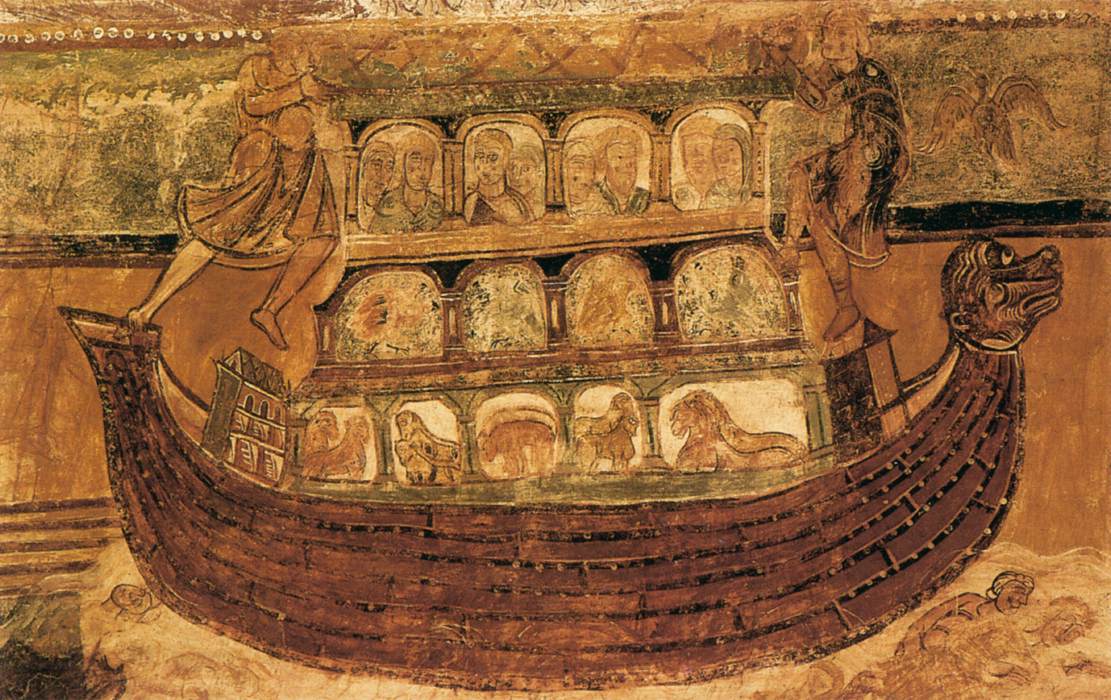
Noah's Ark, English circa. 1100


Sunday 22 February 2015

This year, the Old Testament readings for four of the five Sundays of Lent have the common theme of covenants between God and his people. In church circles, we tend to toss around the word “covenant” quite freely. We talk about the Old Covenant, the New Covenant, the Marriage Covenant, and the Baptismal Covenant. But I’m not sure that we’re always clear on what “covenant” actually means. So, it may be helpful to look at the biblical meaning of the word.

In the ancient world, a covenant was an agreement or treaty between two parties. Today, we’re more familiar with the idea of a contract. In a contract, two parties sign an agreement attested by witnesses and enforceable by law. If either party breaks the contract, the injured party has recourse to the courts to have the terms of the contract enforced by a judge.

In the ancient world, however, a covenant was an agreement made between two parties in the absence of any judge or court to enforce its terms. Both parties would make solemn promises concerning their future behavior. Two kings, for example, might make a covenant to live at peace with each other, to respect each other’s trade routes, and to come to each other’s aid if attacked. More often, though, a covenant was not between equals, but rather between unequals, such as a lord and a vassal. In this case, the superior party typically promised to protect and care for the inferior party, and in return the inferior party typically promised loyalty and obedience to the superior party.

To ratify the covenant, the parties would participate in a solemn ceremony that might include an animal sacrifice or a ritual meal, invoking blessings on themselves if they kept the covenant, and curses if they broke it. Finally, they might erect some sort of public monument or sign – perhaps an engraved obelisk, plaque, or stone marker – to stand as a perpetual reminder of the covenant they had made.

Throughout the Bible, God reveals himself and discloses his purposes by means of ideas and concepts that people already know from the world of their everyday experience. In other words, God accommodates himself to the limits of our human understanding by speaking our language. And since covenant agreements were so familiar in the ancient world, it’s not surprising that God made use of them to initiate and establish relationships with his people. In the Old Testament, God makes at least four covenants: with Noah, with Abraham, with Moses, and with David. In each case, the covenant spells out a promise on God’s part, and sometimes also stipulates corresponding obligations on the people’s part.

This background is crucial for understanding the story of Noah. The Book of Genesis tells us that after God creates the world, the wickedness of the human race multiplies, from the original disobedience of Adam and Eve in the Garden; through the murder of Abel by Cain; to the blasphemous attempt to build a tower that reaches to heaven, the Tower of Babel. God regrets having created human beings, and so resolves to put an end to their wickedness by means of a great flood that will inundate the whole earth.

Amidst the whole wicked human race, God sees one righteous man, Noah; so God tells Noah to build a ship, the Ark, and to take into the Ark both his family and a male and female specimen of every animal upon the earth. So, Noah and his three sons and their wives – eight persons in all – enter the Ark. Then God opens the floodgates of the Great Deep, and it rains for forty days and forty nights. All living creatures on the earth are destroyed, except Noah, his family, and all the animals on the Ark. At length, the waters recede, the dry land re-appears; and Noah, his family, and all the animals go forth from the Ark to re-inhabit and repopulate a new creation.

God then makes a covenant with Noah promising never again to destroy the earth by water. This covenant is truly universal in scope; God makes it not with any particular race or nation but with all generations that shall come after Noah: and not only with all the people of the earth, but with every living creature as well. And the sign of this covenant is the rainbow that God puts in the clouds as a perpetual reminder of his promise.

The story of Noah makes the point, on one hand, that a holy and righteous God cannot abide human sin and wickedness. When people do evil, they bring God’s judgment upon themselves. But, on the other hand, God’s judgment always contains within itself a deeper purpose of redemption and salvation. So, in the Flood story, we see God executing judgment on a sinful and disobedient world and yet, at the same time, through Noah and the Ark, making possible that same world’s re-creation and renewal. 

In other words, God’s final purpose is never to annihilate and destroy but always to redeem and save, to start over and make new. Our God is above all a God of second chances and fresh starts.

We need to remember this truth at those times of crisis in our lives – times for example of illness, death, bereavement, conflict, or separation – when it seems that the flood is raging around us and our world is coming to an end. Even in the moments of greatest darkness, God is still present and at work to realize his purposes of redemption and salvation in ways that we can’t yet see and don’t yet understand.

This biblical pattern – of judgment carrying within itself the seeds of redemption – finds its ultimate expression and fulfillment on the cross. To all outward appearances, the death by crucifixion of Jesus represents unmitigated disaster and total defeat, and yet it bears within itself the seeds of cosmic victory and eternal life.

We begin to share in that life through Holy Baptism, which in today’s Epistle reading Saint Peter likens to the Flood. The analogy is that just as the Deluge drowned a sinful world while the Ark saved Noah and brought the members of his household to a creation made new, so the waters of Baptism drown out our old sinful natures and bring us to the new creation begun in Jesus Christ. The only reason we keep on sinning is that we’ve not yet fully lived into the reality of what God has already done for us in Baptism.

Even though our sins have merited God’s judgment, then, our Baptism holds out God’s promise and pledge of salvation. So, perhaps the best way to begin our Lenten pilgrimage is simply by renewing our trust in God’s promises. For the story of Noah reminds us that God’s desire above all else is to redeem and save his creation, which he loves.

Sunday, February 15, 2015

Sermon for the Last Sunday after the Epiphany, Year B


Isaac Williams, 1802-1865
II Kings 2:1-12
Mark 9:2-9

In 1837, Isaac Williams, a priest of the Church of England and one of the leaders of the Oxford Movement, published Tract Number Eighty of Tracts for the Times. The Tract was titled, “On Reserve in Communicating Religious Knowledge.” It caused quite a storm of controversy at the time, and established what became known as “the principle of reserve” as a key tenet of Anglo-Catholic teaching.

Briefly, the principle of reserve suggests that some mysteries of the Christian faith are so sublime and holy that they are best not talked about too openly, too publicly, or too casually, in settings where they’re apt to be not only rejected but also blasphemously ridiculed and reviled. Instead, such teachings are best left unmentioned except in hushed tones of reverence and respect.

Over and against the Evangelicals of the era, who had taken to preaching Christ’s Death, Resurrection, and Second Coming on street corners and in open-air marketplaces – often before hostile crowds who responded with catcalls and even projectiles – Williams advocated a restrained and graduated approach. Preachers, teachers, and catechists should progressively reveal the deepest and most sublime truths of the faith to potential converts only as they were ready to receive them.

Williams buttressed his argument with numerous illustrations from Scripture. It’s always seemed to me that today’s Gospel contains an archetypal example of the principle of reserve where it records that after the Transfiguration, as they were coming down the mountain, Jesus charged the disciples Peter, James, and John to tell no-one what they had seen, until the Son of Man should have risen from the dead.

Today’s readings are shot through with mystery. The Old Testament story of the assumption of the prophet Elijah, from the Second Book of the Kings, sets the stage for the Gospel. Since Elijah did not die but was taken up into heaven, he remains alive with God and thus appears on the holy mountain with Moses and Jesus in the light of divine glory.

The death of Moses, as well, is an event shrouded in mystery. The Book of Deuteronomy records that at the end of the Hebrews’ forty years of wandering in the Wilderness, Moses ascended Mount Nebo, in full view of the Promised Land, and there died. The Lord himself buried Moses, the narrative continues, and no one knows the place of his burial. By New Testament times, however, the tradition had grown up that Moses had not died but had been taken up into heaven – a view propounded in such apocryphal works as the Assumption of Moses.

Moreover, the tradition had also developed that the return of either Elijah or Moses or both would signal the arrival of the Messianic age. So the prophets of Israel had foretold. The Book of Malachi included the prophecy, “Behold, I will send you the prophet Elijah before the great and terrible day of the Lord comes.” And before he died, Moses himself had told the Israelites, “The Lord your God will raise up a prophet like me from among you, from among your brethren – him you shall heed.”

So, when Peter, James, and John witness the spectacle of Jesus transfigured with the brightness of divine glory, and Moses and Elijah with him, the message is clear. Jesus is the Messiah, the Christ, the Anointed One of God. He is the One destined to bring about the reign of God on earth. So the voice from heaven confirms: “This is my beloved Son; listen to him.”

Most likely, as Peter, James, and John are coming down off the mountain they want nothing more than to proclaim what they have seen and heard: to the rest of the Twelve, to all the disciples, and to the multitudes far and wide. But then, to their surprise, Jesus enjoins silence. “He charged them to tell no one what they had seen, until the Son of Man should have risen from the dead.”

Why this divine gag order? The most likely reason is that while Peter, James, and John have seen a vision of overwhelming power and significance, they are not yet properly equipped to interpret the vision’s meaning.

The Transfiguration comes seven days after Peter has confessed Jesus to be the Messiah. Yet when Jesus immediately thereafter began to teach that he must suffer many things, and be rejected by the elders and the chief priests and the scribes, Peter began to rebuke him, drawing in turn the Lord’s rebuke, “Get behind me Satan, for you are not on the side of God but of men.”

Again, shortly after the Transfiguration, Mark records that Jesus was traveling through Galilee teaching his disciples that “the Son of Man must be delivered into the hands of men, and they will kill him; and when he is killed, after three days he will rise.” But, says Mark, “they did not understand the saying, and they were afraid to ask him”

A bit later, as they are on the road going up to Jerusalem, Jesus predicts his death and resurrection a third time, and in more detail than before: “Behold, we are going up to Jerusalem, and the Son of Man will be delivered to the chief priests and scribes, and they will condemn him to death, and deliver him to the Gentiles; and they will mock him, and scourge him, and spit upon him, and kill him; and after three days he will rise.” But the disciples still don’t get it; and the depth of their incomprehension is evident in the request of James and John to sit one at his right and one at his left in his glory.

James and John, remember, were both present at the Transfiguration. For the moment, all they can see is the promise of divine glory of which they have received an anticipatory glimpse. Despite the Lord’s repeated warnings and admonitions, they still don’t grasp that before they can share in the glory of God’s Kingdom, they must first follow Jesus in the Way of the Cross. That is why the Lord charged them as they were coming down the mountain to say nothing of what they had seen until the Son of Man should have risen from the dead. Apart from the cross, the story of who Jesus is cannot be fully told. In this case, the principle of reserve means refraining of speaking of things not only that the hearers are not yet ready to hear, but also that the teachers are not yet ready to teach.

The assumption of Elijah in today’s Old Testament reading anticipates the ultimate ascension and glorification of Jesus, towards which the Transfiguration in today’s Gospel likewise points forward. For the disciples, as for us, the Transfiguration is a glimpse of a promised future but not yet the possession of that future. So, after today’s celebration, on Wednesday we begin the observance of Lent, by which the Church annually reminds us that before we can enter into the glory of Christ’s Kingdom, we must first climb with him another mountain, that of Golgotha.

Thursday, January 22, 2015

Sermon for the 2nd Sunday after the Epiphany, Year B

January 18, 2015 (at the 8 o'clock Mass)

I Samuel 3:1-20
John 1:43-51


Cambridge, England: Gonville and Caius College: chapel apse mosaic
(prophet Samuel being tutored by Eli)
(1870, made by firm of Antonio Salviati)

The Gospel readings for this season after the Epiphany emphasize the manifestation or showing forth of Christ. At Christmas we celebrate the Son of God coming down from heaven and sharing in our human life. But, momentous as that was, it was not enough to suffice for our salvation. His divine identity also had to be revealed and made known to us. Otherwise, we would never have known who he was or what he had come to offer us.

Revelation is a process that takes place in two stages. First, God must speak. But, second, we must hear his voice and recognize who it is that’s speaking. Today’s readings tell the stories of two people who come to recognize the Lord speaking to them: Samuel in the Old Testament; and Nathanael in the Gospel.

In the Old Testament reading, the boy Samuel is serving in the temple at Shiloh. Religion in that period seems to have reached a low ebb and become dry and formalistic: “the Word of the Lord was rare in those days; there was no frequent vision.” So, when Samuel hears a voice calling him, it doesn’t occur to him that it might be the Lord, and he thinks that it’s his master Eli instead.

Similarly, in the Gospel reading, when Philip goes to tell his friend Nathanael that they’ve found the Messiah – and it’s Jesus of Nazareth – Nathanael’s reaction is one of incredulity and disbelief: “Can anything good come out of Nazareth?” In both cases, the serious danger is that although the Lord is speaking, the message will be missed: by Samuel on account of his mistaking the voice for something else; and by Nathanael on account of his prejudice that no-one from Nazareth could possibly be the Messiah.

Notice, however, that in both cases someone else helps bring the person to the point of recognition. Samuel goes three times to Eli, saying, “Here I am, for you called me.” When Eli finally catches on as to what’s really happening, he instructs the boy: “The next time he calls, you shall say, ‘Speak Lord, for thy servant hears.’” Without Eli’s help, Samuel might simply shut the voice out and go through life never realizing his vocation to be a great prophet.

Likewise, Nathanael most likely would never come to know Jesus without the help of his friend Philip. For it’s Philip who first bothers to tell him, “We’ve found the Messiah,” and then, when Nathanael expresses disbelief that anything good could come out of Nazareth, it’s Philip who says simply, “Come, and see.” (That, by the way, is excellent evangelistic strategy. Philip doesn’t try to argue or persuade. He simply invites. Come and see.)

In both cases, the actual life-changing encounter with the divine is direct, one-on-one. Samuel must hear for himself what the Lord will say; Eli can’t do that for him. And Nathanael must meet Jesus for himself and come to his own realization that this is the Son of God, the King of Israel. Nonetheless, neither Samuel nor Nathanael comes to that point alone or unaided. Both Eli and Philip play pivotal roles in making the encounter possible. Reflecting on our own lives, we may be able to recall the role that such individuals have played in helping us come to faith and recognize the Lord’s voice calling us.

When I was a graduate student in Washington DC, my friend Susan played such a role for me. One Saturday evening, she and I were out having a drink in one of the bars on Connecticut Avenue; and I asked her if she would like to join a group of my friends for a game of volleyball on Sunday morning. She replied, “No, I can’t. I’m going to church.” So, I started asking her about the church she attended, and she invited me to come with her.

At that point, I was an agnostic who didn’t believe anything much, and I hadn’t darkened the door of a church in years. But for some reason I found myself saying yes; and the next morning I was attending the Sunday liturgy at Saint Margaret’s Episcopal Church, also on Connecticut Avenue. And that was the beginning of my conversion to Christianity. In a sense, then, Susan was Philip to my Nathanael. She issued the initial invitation, Come and see, and our Lord did the rest.

A couple of years later, I found my brain invaded by crazy thoughts about becoming a priest. Initially, I thought that this was the most ridiculous idea that had ever occurred to me. But the more I tried to push these thoughts out of my mind, the more they came back and reasserted themselves with a vengeance.

Finally, I went to my parish priest in the hope that he would disabuse me of any thoughts of ordination and tell me to do something else with my life since obviously I was so totally unsuited to the priesthood. Instead, he just smiled and said, “I’ve been wondering when you would come to talk about this.” In a sense, then, he was Eli to my Samuel. In so many words, he told me not to ignore the call I was hearing but rather to pay attention and listen.

The point is that the Christian life is not a solo endeavor. Relationships in the Body of Christ are crucially important. We all need others to be Eli and Philip to us, strengthening our faith and helping us discern all the different ways in which God is speaking to us. Then, having received this gift, we in turn need to make ourselves available to be Eli and Philip to others. And we need to keep on building a parish community that nurtures and fosters these relationships of spiritual friendship: a community in which we all help each other to know the Lord and to hear his voice.

Sermon for the Confession of Saint Peter

Sunday 18 January 2015 (at the 10 o'clock Solemn High Mass)

Matthew 16:13-19


In its present form, the feast of the Confession of Saint Peter is a fairly recent addition to the Church calendar. Up until 1960, the Roman Church kept January 18th as the Feast of Saint Peter’s Chair at Rome. In the apse at the back of St. Peter’s Basilica stands the magnificent Bernini bronze sculpture encasing the chair traditionally identified as the one on which Saint Peter sat to preside at worship as the first Bishop of Rome.

The bishop’s chair is, of course, an item of great symbolic significance. In Judaism, rabbis would sit in a chair to teach. The Gospels describe Jesus sitting down to teach – most notably as he delivers the Sermon on the Mount. And so the apostles and bishops of the earliest church likewise would preside at worship from a seat from which they would teach and which came to symbolize both the content of their teaching and their teaching authority.

In the early centuries of Church history, the great see cities of the Christian world were careful to preserve the chairs on which their founding bishops had sat. According to Eusebius, writing in the fourth century, Jerusalem preserved the chair of Saint James, and Alexandria preserved the chair of Saint Mark. In the late second century, Tertullian wrote: “Visit the apostolic churches in which the very chairs of the apostles preside in their places. If you are near Italy, there is Rome.” 

One of the Latin words for chair, cathedra, is the root of the English word cathedral, the church where the bishop has his chair. So, the Feast of St. Peter’s Chair celebrated Saint Peter’s teaching authority as the first Bishop of Rome – authority which was believed to be derived from our Lord’s words in today’s Gospel: “You are Peter, and on this rock I will build my church.”

In the old Roman calendar, January 18th was identified as the date when Saint Peter first presided over an assembly of the faithful after his arrival in Rome. A second feast of Saint Peter’s Chair at Antioch was kept on February 22nd. According to Gregory the Great, after leaving Jerusalem, Peter went first to Antioch where he stayed for seven years; and then he went to Rome, where he lived twenty-five years before his martyrdom during the persecution of the Emperor Nero.

Records indicate that during the pontificate of Pope Damasus in the fourth century, a wooden chair, identified as that of Saint Peter, was kept in the baptistery in old Saint Peter’s Basilica. Following baptisms, the pope would sit on the chair, and the newly baptized would be brought to him to receive an anointing with oil, known as the consignatio, or Sacrament of Confirmation.

During the Middle Ages, the Chair of Saint Peter would be brought from the baptistery to the High Altar on February 22nd, which was believed to be the anniversary of the date on which Peter had confessed Jesus to be the Christ and was in turn identified by Jesus as the rock on which he would build his Church. At their enthronements, also, new Popes would be seated on this chair, brought from the baptistery to the high altar for the occasion.

In the seventeenth century, to preserve this precious relic, Pope Alexander VII had it encased in the Bernini sculpture in which it sits today. In 1867, however, it was exposed for veneration by the faithful, and photographed. The photographs show a very medieval-looking chair that has been added to and embellished over the centuries with panels of acacia wood and inlaid ivories. Nonetheless the original frame of oak, much worm-eaten, is also clearly visible; and there is no reason to dismiss the possibility that this is the frame of the chair on which Saint Peter sat as he began his ministry as the Bishop of Rome.

In 1960, the Roman Catholic Church abolished the January 18th Feast of St. Peter’s Chair, keeping it instead on February 22nd. In the 1970s, however, a number of churches of the Anglican Communion, including our own Episcopal Church, added a Feast of the Confession of Saint Peter to their calendars on January 18th to mark the beginning of the Week of Prayer for Christian Unity.

So we’ve come full circle. In its current form, the feast of the Confession of Saint Peter is a fairly new addition to the Church Calendar. Nonetheless, a rich history stands behind it. Its trajectory begins with Peter confessing Jesus to be the Messiah, the Christ, at Caesarea Philippi. It continues through Peter’s subsequent ministry as bishop first at Antioch and then at Rome. The Chair of Saint Peter symbolizes both his teaching and his teaching authority, grounded in the faith that expressed itself in his original Confession of Jesus as the Christ.

I encourage us all to observe the Week of Prayer for Christian Unity between now and next Sunday. Pray not only for the healing of the divisions of the sixteenth-century Reformation, but also for reunion between the historic Churches of the Christian East and West. It seems to me that here in Rhode Island we are significantly lacking in ecumenical interaction and cooperation – including joint worship service – and I wish we could do more.

Beginning the Week of Prayer for Christian Unity with the feast of the Confession of Saint Peter reminds us that Christian unity cannot be predicated on good feelings and warm relationships alone, nor even on cooperation in matters of shared pastoral concern and social witness. Genuine Christian unity must also rest upon the rock of the faith and teaching of the apostles, of whom Peter was the acknowledged leader and spokesman. In our search for Christian unity, then, we can do no better than to seek to re-appropriate and re-immerse ourselves in this shared heritage of apostolic faith and teaching symbolized by the Chair of Saint Peter at Rome.


Thursday, January 8, 2015

Sermon for the Epiphany


THE EPIPHANY OF OUR LORD JESUS CHRIST
Tuesday 6 January 2015
At Saint John's Church, Newport, RI

Epiphany follows logically after Christmas. At Christmas, we celebrate the Incarnation. God the Son came down from heaven and was born in Bethlehem so that he could redeem us by sharing in our human condition, living and dying as one of us, to free us from sin and death and lead us to eternal life.

Yet we would never have known what Christ had done for us, we would never have been able to accept his offer of new life, unless somehow his Incarnation had been revealed to us. Without some clear public manifestations or signs of who he was, Jesus would have lived and died like any other First Century Jewish rabbi, without anyone recognizing his true identity as the Son of God.

So, it was necessary not only for the Son of God to take human flesh and come among us, but also for his divine identity to be revealed and made manifest to those among whom he came. The word Epiphany simply means “showing forth” or “manifestation.” And the Feast of the Epiphany begins a season in the Church Year when we celebrate the signs, illuminations, and manifestations that point to Christ and tell us who he is.

Thus, in the Gospel according to Saint Luke, Christ is not merely born in Bethlehem, but his birth is immediately announced by angels to shepherds in the fields. There’s not only a birth but also an announcement of who’s been born: a Savior, who is Christ the Lord.

Similarly, Saint Matthew’s Gospel describes the Wise Men from the East who see his star and come bearing gifts for the newborn King. The point of the star, by the way, is to show that even the world of nature, the very cosmos itself, heralds the Messiah’s birth. And the Wise Men from the East signify that the recipients of this Good News are not only the children of Israel, but all the nations. It’s not enough for the Christ simply to arrive: his arrival must be made known to the whole world.

In the coming weeks, we shall be looking at other signs by which Christ’s identity as the Son of God is made manifest to those around him: the Holy Spirit descending in the form of a dove at his baptism in the Jordan River; his many miracles of healing; his Transfiguration with dazzling light on the holy mountain. All these signs point behind the outward appearance of the man, Jesus of Nazareth, to the inward reality of the Incarnate Son of God.

Christianity is a religion of signs and symbols. We practice a sacramental faith, in which inward and spiritual realities are made known by outward and visible signs: water in baptism, bread and wine in the Eucharist, oil in anointing, rings in marriage, the sign of the cross in absolution, the laying-on-of-hands in confirmation and ordination. These sacramental signs are, if you will, epiphanies showing forth inward and spiritual graces. And like the star that guided the wise men in their pilgrimage, their purpose is always to lead us to Christ.

Epiphany, then, is a feast with a profoundly evangelistic message. It’s not enough for Christ simply to be present as a carefully guarded secret in the most private recesses of our inner lives. Rather, he must be made manifest in us. Those around us must be able to see in us the signs of his life. The wise men from the East were led to Christ by the sign of a star in the heavens; we are called to be signs by which the world may be led to Christ.

The wise men offered gifts of gold, frankincense, and myrrh. According to the early Church Fathers, these gifts manifest or show forth three aspects of who Christ is: gold as the sign of his kingship; frankincense, which is burned in worship, as the sign of his divinity; and myrrh, the oil used to anoint the dead, as the sign of his cross and passion.

But another possible interpretation of the three gifts concerns what we can offer Christ as we seek to serve him and let him make himself manifest in our lives.

Gold symbolizes our earthly treasure. As Christians, we’re called to serve Christ by giving generously to fund the mission and ministry of his Church.

Frankincense symbolizes our worship and prayer. We serve Christ by our faithful attendance at Mass on Sundays and Holy Days, and by our participation in the Church’s daily round of prayer and devotion.

And what of myrrh? In the Bible, the oil of anointing is often used as a metaphor for good deeds and morally upright behavior. And that really completes the picture. In addition to our offerings of earthly treasure, and our worship and prayer, we make Christ manifest to the world by lives of moral integrity and by deeds of compassion and loving kindness towards those less fortunate than ourselves.

So, the Feast of the Epiphany draws our attention once again to the various signs by which Christ is made manifest to us: a star in the heavens; Sages from the East bearing gifts; a ewer of water poured out into a baptismal font; bread and wine changed into his Body and Blood. But if Christ is to be made manifest in our society today, it can only be through us. Our calling as the People of God is open ourselves up to the leading of the Holy Spirit so that Christ may make us his Epiphany to an unbelieving world.


Sunday, January 4, 2015

Sermon for the Second Sunday after Christmas

Jesus among the Doctors
Duccio di Buoninsegna (c. 1255 -- c. 1318)
Luke 2:41-52

Saint Luke’s account of the finding of the child Jesus in the Temple is the only episode we have in the canonical Gospels from what are sometimes described as Our Lord’s “hidden years.” Apart from this one incident, the New Testament skips from the infancy of Jesus to his baptism at the River Jordan, conventionally reckoned to have occurred when he was about thirty years old.

Some of the non-canonical apocryphal Gospels do feature fantastic stories of Our Lord’s childhood, such as the boy Jesus fashioning twelve clay birds and then causing them to come to life and fly away, or striking his playmates dead with a wave of his hand when they tease him. By comparison, Luke’s account of Mary and Joseph losing Jesus and then finding him three days later in the Temple is simple and prosaic by comparison -- and yet so much more profound.

Although this story is not devoid of symbolic elements, nonetheless in its basic outline it’s entirely plausible as the description of an incident that could really have happened. Jews living in Judea were expected to go up to Jerusalem three times a year for the great festivals of Pesach (Passover), Shavuot (the Feast of Weeks), and Sukkot (the Feast of Booths). For those living in places further away but still within reasonable traveling distance, such as Galilee, the requirement was reduced to once a year, at Passover.

In the way he tells the story, Luke is emphasizing that Jesus was brought up in the traditions of Judaism in an observant household. Luke is careful to make this point all along in his infancy narrative, noting both that Jesus was circumcised on the eighth day after his birth, and that after forty days Joseph and Mary brought him up to the Temple to present him to the Lord, as required by the Torah.

Even the detail of Jesus getting left behind by mistake is credible in the context of the times. Pilgrimages to Jerusalem often involved populations of entire villages traveling together, so Mary and Joseph could easily have assumed that he was elsewhere in the party. In his commentary on this passage, the Venerable Bede speculates that since even in the same caravan men and women customarily traveled separately, Mary and Joseph could each have assumed that Jesus was traveling with the other. 

Yet something new is also happening here. Up until now in the infancy narratives, Jesus has remained silent. As an infant he could say nothing, so others did all the talking for him. Between them, the angel Gabriel, Mary's cousin Elizabeth, the angels and shepherds in the fields, and Simeon and Anna in the Temple, have made some extravagant claims on his behalf: he is “the Son of the Most High …” “a Savior, who is Christ the Lord,” “a light for revelation to the Gentiles, and for glory to thy people Israel.”

But now, Jesus speaks, and his first recorded words in Scripture are: “How is it that you sought me? Did you not know that I must be in my Father’s house?” Here he claims for himself the filial relationship with his Father in heaven that up to now others have ascribed to him. He is the Son of God. The Jerusalem Temple is his Father’s House.

(Notice that the Church offers children the opportunity to do something similar at about the age of twelve or older. If we were baptized as infants, our parents and godparents made the baptismal vows on our behalf. That was fine, but sooner or later there comes a point when we must own those promises for ourselves, and claim the relationship with God into which baptism has initiated us. So, in the Sacrament of Confirmation we reaffirm our baptismal vows and receive the strengthening of the Holy Spirit through the bishop’s laying-on-of-hands.)

In telling the story, also, Luke conveys something of the tension that is beginning to emerge in Our Lord’s relationship with his earthly family. His remaining behind in the Temple causes Mary and Joseph no small amount of distress, as Mary herself voices in the words, “Son, why have you treated us so? Behold, your father and I have been looking for you anxiously.” As a son, he has clearly defined duties to his parents. Luke duly notes that after this incident Jesus returned to Nazareth and was obedient to them. At the same time, however, his growing awareness of his filial relationship with his Father in heaven has introduced the claims of a higher loyalty: “Did you not know that I must be in my Father’s house?”

Here the boy Jesus gives an anticipatory hint of the conflicts that his disciples will experience between earthly loyalties and obedience to God’s will. Later in the Gospels, Jesus repeatedly warns his disciples that they must be willing to give up everything that stands in the way of following him – and that sometimes faithful discipleship will entail conflict with members of their own families and even the sundering of family relationships.

Early Christian commentators on this passage liked to point out two more details of the story from the viewpoint of Mary and Joseph. First, they found Jesus in the Temple after three days of searching. Whether or not Luke intended it in telling the story, the three days struck the early Church fathers as an overwhelmingly obvious symbolic anticipation of our Lord’s Resurrection from the dead on the third day after his crucifixion and death. The losing-and-finding of Jesus in the Temple thus exemplifies the basic pattern of death and resurrection that shapes all Christian experience.

Second, the place where they found him was none other than “his Father’s House.” When we feel that we’ve lost sight of Jesus, and don’t know where to find him, that detail gives us a clue as to where to look: namely in the Church, the assembly of the faithful gathered for worship.

Listen to the words of the third-century Christian writer Origen of Alexandria:

“He is not found as soon as sought for, for Jesus was not among his kinsfolk and relations … nor in the company of the multitude … Learn where those who seek him find him, not everywhere, but in the Temple. And then seek Jesus in the Temple of God. Seek him in the Church, and seek him among the masters who are in the Temple. For if you will so seek him, you shall find him. They found him not among his kinsfolk, for human relations could not comprehend the Son of God; nor among his acquaintances, for he passes far beyond all human knowledge and understanding. Where then do they find him? In the Temple! If at any time you seek the Son of God, seek him first in the Temple, thither go up and you shall find Christ, the Word, and the Wisdom of God” (quoted in Thomas Aquinas, Catena Aurea).


Sunday, December 28, 2014

Saint Stephen, Deacon and Protomartyr (Transferred)

Rembrandt, Stoning of Saint Stephen, 1625

Have you ever heard of “The Witness Days?” The term was unfamiliar to me until a few days ago. It refers to the multiple commemorations of martyrs surrounding the seasons of Advent and Christmas: Saint Andrew on November 30, Saint Thomas on December 21, Saint Stephen on December 26, the Holy Innocents on December 28, and Saint Thomas Becket on December 29.

The Greek word martyr means “witness,” and in the Church’s tradition it has come to signify those holy men and women who bore witness to Christ unto death. This church is dedicated to the Protomartyr, or first martyr, Stephen. Although Saint Stephen’s Day is the day after Christmas, the Prayer Book permits us to celebrate it on the Sunday following because it is our patronal feast.

Every year, many commentators remark on the seeming incongruity between the celebration of the Lord’s Nativity and the commemoration of Stephen’s grisly martyrdom, execution by stoning, the very next day. So much of the devotional imagery and language surrounding Christmas focuses on the angelic hymn extolling peace on earth. Yet the stoning of Stephen on December 26 and, even more, the slaughter of the Holy Innocents on December 28, seem to belie that promise.

So, this morning, it seems appropriate to reflect on this apparent discontinuity. The juxtaposition of Christmas Day, and Saint Stephen’s Day stands to teach us much about the nature of the Christian faith.

The first point to note is that the coming of the Christ child into the world provokes deadly opposition. He comes as the Prince of Peace, the bearer of God’s Kingdom. But that prospect presents itself as a threat to the ruling powers of this world. The birth narratives in both Matthew and Luke’s Gospels both emphasize this point in very different ways.

In Matthew, on learning from the wise men of the recent birth of one born to be King of the Jews, King Herod the Great immediately orders the slaughter of all the male children aged three years and under in the vicinity of Bethlehem. Jesus, Mary, and Joseph escape in the nick of time and take refuge in Egypt.

In Luke, by contrast, the note of opposition is sounded in the form of a warning by the old man Simeon, when Joseph and Mary take Jesus up to the Temple in Jerusalem to present him to the Lord forty days after his birth. After hailing the child as the long-awaited Messiah, “a light for revelation to the Gentiles, and for glory to thy people Israel,” Simeon foretells, “Behold, this child is set for the falling and rising of many in Israel, and for a sign that is spoken against … that thoughts out of many hearts may be revealed.”

Simeon is saying that the coming of Christ into the world precipitates a crisis in the classical sense of the word. The word “crisis” comes from the Greek verb “to judge” or “to decide” and it signifies a time when a difficult or important decision must be made, often for or against something or someone. Related to the words “critic” and “critical,” it suggests a time requiring the exercise of critical judgment. The coming of Christ into the world confronts people with the existential question of how they will respond to him – by accepting or rejecting him – and in so exercising their human judgment they invoke divine judgment upon themselves in the process.

Those who decide for Christ in this moment of crisis must expect to suffer opposition and persecution just as Christ himself suffered opposition and persecution. Our Lord says as much on multiple occasions. For example, in Matthew 10:34 he declares: “Do not think that I have come to bring peace on earth; I have not come to bring peace, but a sword.”

These words remain as true today as in the early centuries of Church history. Throughout the world, more Christians are suffering persecution and martyrdom than ever before. In the twentieth century more Christians suffered martyrdom than in all the previous centuries combined; and the twenty-first century is shaping up to be as bad or worse.

Commentators often remark on the similarities between the trial and stoning of Stephen in the Acts of the Apostles and the trial and crucifixion of Our Lord in the Gospel passion narratives. Stephen is tried before the Sanhedrin, just as Jesus was. False witnesses testify against him, just as they testified against Jesus. At the critical moment in the trial, Stephen looks into heaven and declares, “Behold, I see the heavens opened and the Son of Man standing at the right hand of God,” just as, at his trial, Jesus had declared, “from now on the Son of man shall be seated at the right hand of the power of God.” Stephen is cast out of the city to be stoned, just as Jesus was taken outside the city walls to be crucified. Finally, Stephen’s dying prayers, “Lord Jesus, receive my spirit,” and “Lord, do not hold this sin against them,” directly echo our Lord’s words from the cross: “Father, forgive them, for they know not what they do,” and “Father, into your hands I commit my spirit!”

So, just as Christ came into the world ultimately to suffer death on the cross, so those of us who call ourselves Christians may well find ourselves called to suffer opposition and persecution for our witness to Christ. Insofar as we bear such adversities patiently and with love, we become more and more conformed to Christ, more and more united with him in his sufferings, just as Stephen was, and hence all the more effective in our witness.

Notice how boldly Stephen testifies before the Sanhedrin. He doesn’t mince words. It’s disappointing how contemporary church members often seem embarrassed to be Christians and feel compelled to make excuses for their faith. “Yes, I’m a Christian, but not like those dreadful fundamentalists …“ “Yes, the Church has committed its share of crimes with its inquisitions and crusades, but my church isn’t like that …” Enough already! That kind of talk just buys into and internalizes the hateful propaganda the world has always used to persecute and oppress us, from the days of King Herod until now. Better to take a leaf from Saint Stephen’s notebook and bear witness to Christ without excuse, and without apology.

And it is precisely Christ’s Incarnation – his birth at Bethlehem and his subsequent life, death, and resurrection – that enables us to bear such witness to him faithfully. Here is the deepest linkage of all between Christmas Day and St. Stephen’s Day. In today’s Old Testament reading, Jeremiah prophesies bravely against the inhabitants of Jerusalem at great risk to himself. But in our reading from the Acts of the Apostles, Stephen has gained something that Jeremiah lacked: namely the knowledge that Jesus will be with him in bearing whatever suffering he may have to endure. Thus dying with Jesus, Stephen gains the assurance of rising with Jesus in glory.

Thursday, December 25, 2014

CHRISTMAS 2014 -- At the Midnight Mass

John Duns Scotus, 1266-1308
Christmas is the feast that we Anglicans celebrate best. The glories of the Anglican musical and liturgical tradition come into their own with the choir of King’s College, Cambridge, singing the festival of nine lessons and carols, showcasing choral gems from David Willcock’s arrangement of Cecil Frances Alexander’s “Once in Royal David’s City” to Harold Darke’s setting of Christina Rossetti’s “In the Bleak Midwinter.”

Attempting to explain why it is that Anglicans celebrate Christmas so splendidly, some commentators point to the central place of the Incarnation in Anglican theology and spirituality. I find this explanation entirely persuasive. The Word became flesh and dwelt among us. At Christmas we take particular delight in recounting the story of his taking flesh in all its vivid and earthy detail: the inn, the stable, the manger, the shepherds, the angels, and the animals.

And yet – from time to time I hear church members make slightly supercilious and denigrating remarks about the celebration of Christmas. It’s all well and good to commemorate the birth of Jesus, they say, but the theological significance of Christmas pales in comparison with that of Holy Week and Easter. Our Lord’s death on the cross and resurrection are what really matter to Christian faith.

To evaluate such claims, we need to look a bit more closely at the classical Christian doctrine of the Incarnation. At Bethlehem, God the Son, the eternal Second Person of the Holy Trinity, came down from heaven to be born at a particular place in a particular time, to share in our human nature, and to participate in our human condition. But why?

The standard and indeed correct answer is that he came to save us from sin and death. In the biblical account, Adam and Eve disobeyed God and the whole human race inherited the guilt of their sin. We need not read the story of Adam and Eve literally to understand it as a definitive interpretation of the human condition. We are fallen creatures, held captive by sin, unable by our own efforts to redeem ourselves or to live as God intended when he created us. So in the Incarnation Christ came among us to redeem us by dying on the cross.

One possible implication of this account, however, is that Christ’s conception and birth of the Virgin Mary have significance only as preliminaries to his atonement. To suffer and die for us, he had first to be born as a human being. A further implication is that if Adam and Eve had not sinned, the Incarnation would not have taken place.

In the medieval West, this line of thinking even led some to regard the fall of Adam and Eve as a good thing for having occasioned the great blessing of Christ’s coming into the world. In the hymn known as the Exsultet, sung by the deacon at the blessing of the Paschal Candle during the Easter Vigil, we encounter the famous lines: “O happy fault, O necessary sin of Adam, which gained for us so great a Redeemer!”

The fifteenth-century English carol “Adam lay ybounden,” expresses the same basic idea. If Adam had not sinned by taking the apple in the Garden of Eden, then our Lady (the blessed Virgin Mary) would never have become Queen of Heaven. So the carol concludes: “Blessed be the time / That apple taken was / Therefore we moun singen / Deo gratias!”

This view became widespread in the Christian Church, at least in the West. But from the beginning a number of theologians of impeccable orthodoxy took the opposite view: that even if Adam and Eve had never fallen, the Incarnation would likely have taken place anyway. Saint Irenaeus made this suggestion in the second century, and Saint Maximus the Confessor developed it in the seventh. Both theologians proposed that, even before the Fall, God created the world with the precise intention of becoming incarnate in it as a human being.

Medieval scholastic theologians debated the question with enthusiasm, as they were wont to do. In the thirteenth century, Saint Thomas Aquinas took the negative position, pointing out that Scripture consistently describes the Incarnation as a remedy for human sin – as, for example, in I Timothy 1:15, “Christ Jesus came into the world to save sinners.” Yet after concluding that the Incarnation would probably not have taken place if humanity had not sinned, Thomas immediately adds that God’s power is not limited, so that God could have become incarnate under any circumstances he chose.

Taking the opposite position, the thirteenth-century Franciscan theologian John Duns Scotus argued vigorously that it was unfitting for God’s greatest deed ever of becoming incarnate to have been contingent upon Adam’s sin, such that if Adam had not sinned, the Incarnation would have remained undone. (In subsequent years, as in so many other theological controversies, the Dominicans tended to follow Aquinas, while the Franciscans tended to follow Scotus.)

But why would God have become incarnate as a human being apart from the purpose of redeeming fallen humanity? All the writers I’ve mentioned propose in different ways that by becoming incarnate and participating in our human nature, God communicates his infinite life, wisdom, and love to us finite human beings. He shares in our human life so that we may share in his divine life, and so fulfill the purpose for which he created us: to live in union with him for eternity.

We should exercise due caution about making any sweeping claims on this question. The suggestion that God would have become incarnate even in the absence of human sin is a contrary-to-fact hypothetical speculation. We can never know the answer for sure because, as it happened, humanity did fall, and Christ did come into came into the world to save us from our sins. What we can say, perhaps, is that if we had not sinned, then Christ would not have had to suffer and die on the cross. The Incarnation of the Son of God may well have taken place anyway but would likely have taken a very different course.

So, we’re left with a speculation, but an edifying speculation all the same. At Christmas, we give thanks to God for sending his Son into the world to save us from sin and death. At the same time, the possibility that he would have come anyway, even apart from the Fall, confirms our characteristically Anglican intuition that Christmas cannot be reduced to a mere prerequisite to Holy Week and Easter. This festival celebrates a mystery that to some extent stands independently and in its own right.

To put it bluntly, even apart from Holy Week and Good Friday, there might well still be Christmas. Even if he had not had to suffer and die on the cross, the Son of God might still have been born as one of us, to teach us, enlighten us, and bring us to the fullness of eternal life and joy in God’s presence. This evening’s celebration proclaims that promise and that hope, in which we do well to rejoice with all the enthusiasm we can muster.