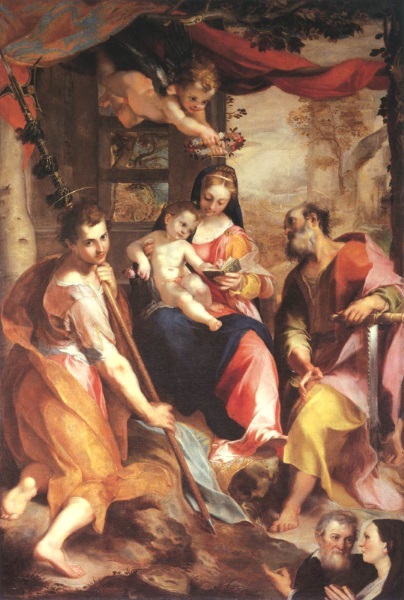
Today, then, we are celebrating the Feast of Saint Simon and Saint Jude. It’s been observed that nobody wants to be in last place. And yet Simon and Jude seem to come in last in more ways than one. In all four of New Testament lists of the twelve apostles, their names always take the tenth and eleventh place—right before Judas Iscariot, the traitor.
Their feast day is the last commemoration of apostles in the church year. After Simon and Jude on October 28th, we have All Saints on November 1st, and then a new church year starts on Advent Sunday at the beginning of December. Herbert O’Driscoll comments that it seems as though Simon and Jude were put into the Church Kalendar almost as an afterthought.
While the New Testament contains an Epistle attributed to Saint Jude, it is the very last of all the Epistles, coming just before the Revelation to John, the very last book in the Bible. And Saint Jude is known in popular devotion as the saint of last resort, the patron of lost causes – the saint to whom we turn when all else has failed. Not so long ago, in Catholic colleges and universities, students would ask the prayers of Saint Jude on the day of final exams—as a last resort when all other options had been exhausted, in aid of the lost cause of getting a good grade.
So, in all these ways, Simon and Jude stand last among the twelve apostles. Moreover, we know so very little about either of them.
The various New Testament lists of the Twelve describe Simon as Simon the Cananean or Simon the Zealot. This title has led to speculation that Simon was part of the revolutionary Jewish independence movement known for its violent tactics of assassination and insurrection. But it’s equally possible that the title simply means that Simon was known for his zeal and enthusiasm for the Jewish Law and customs. Beyond that, the New Testament says nothing about him.
We know a little more about Jude. Some of the lists give his name as Thaddeus, and identify him either as the brother or the son of James the Son of Alphaeus, also known as James the Less. The Gospel of John records a question that Jude asked Jesus at the Last Supper, about why he revealed himself only to the disciples. Beyond that, however, the New Testament is silent about Jude. And the Letter attributed to Jude toward the end of the New Testament is almost certainly the work of a later author writing in Jude’s name.
Interestingly enough, the lists of the so-called brothers of Jesus in the Gospels of Matthew and Mark include the names Simon and Jude; so some commentators have identified the apostles Simon and Jude as relatives of Jesus. For the Greek word adelphos can mean “cousin” or “kinsman” as well as “brother.” But this identification seems unlikely, since the Gospels give several indications that the actual family of Jesus was less than fully supportive of his ministry during his earthly life.
A post-biblical tradition relates that after the Lord’s Resurrection, Simon and Jude traveled to Persia, where they preached the Gospel and suffered martyrdom together. According to one tradition, Simon was sawed in half with a large saw; and Jude was beaten to death with a club. What are claimed to be their relics ended up interred together in Saint Peter’s Basilica in Rome. Either their martyrdom on the same day or the translation of their relics would account for their sharing the same feast day in the Kalendar. But it’s impossible to be certain.
Thomas Hardy gave the protagonist of one of his novels the title “Jude the Obscure.” I don’t know whether Hardy had the biblical Saint Jude in mind as the inspiration for the name of his character. Nonetheless, the description certainly fits both Simon and Jude very well. They are both obscure apostles.
And yet—despite their obscurity, Simon and Jude were still numbered among the Twelve. And perhaps that’s all we really need to know about them. For it was the Twelve who bore witness to the Lord’s death and resurrection, handing on the deposit of faith that was committed to writing in the New Testament and handed down from generation to generation in the Church. Just next month, the thirteenth bishop of Rhode Island will be consecrated; and that ceremony, with its laying-on-of-hands by multiple bishops, signifies that the bishops are the successors of the Apostles in our own time, charged to guard the Church’s faith and unity. My guess is that in heaven Simon and Jude don’t mind in the least that no one remembers their earthly words and deeds, because their apostolic ministry was never meant to be about themselves. It was about proclaiming the Gospel and bearing witness to Christ. What would please them is seeing us in our day continuing faithfully in the same teaching that they in their day handed on to their successors.
Simon and Jude may be last among the apostles, but as our Lord says, that the first shall be last and the last shall be first. And so today we give Simon and Jude first place as we commemorate them on their feast day. If it weren’t for Simon, Jude, and all the other apostles, we wouldn’t have a Christian faith to believe in or a Christian Church to belong to. It falls to us, then, to guard and cherish the apostolic heritage that we’ve received from them; and to pass it on with all care to those who come after us.

No comments:
Post a Comment