From this identification we can deduce certain details of Luke’s life. At the beginning of his Gospel, Luke writes that he was not among the eyewitnesses to the events he describes, but that he has written down what he has received from the eyewitnesses. Then, at a certain point in Acts – chapter 16, verse 10 to be precise, when on his Second Missionary Journey Paul is in Troas in Asia Minor and has a vision of a man of Macedonia saying “Come over to Macedonia and help us” – Luke starts using the word “we,” indicating that he was personally present with Paul from that time on. This has led some scholars to speculate that Luke resided in Troas. The three sections in Acts that use the first person plural pronoun “we” include Paul’s final arrival in Rome; which confirms the text from Second Timothy just mentioned.
The literary style of both Luke and Acts indicates that Luke was well educated. There is some speculation that Luke was a Gentile since in Colossians Paul seems to distinguish him from other colleagues whom he describes as “of the circumcision.” But this phrase could also be used to distinguish Jewish Christians who strictly observed the Law from those who did not.
Luke writes in the tradition of ancient historiography. He addresses his works to a certain Theophilus, explaining that his aim is to provide an ordered account of the events that have taken place among us. He is an accomplished storyteller. He is not attempting to write an objective historical record, but to proclaim the Good News disclosed in the narrative of Jesus Christ and the early Church. He is careful to locate the story at identifiable points in world history: “In the days of Herod, king of Judea, there was a priest named Zechariah …” (Luke 15); and again: “In those days a decree went out from Caesar Augustus that all the world should be enrolled. This was the first enrollment, when Quirinius was governor of Syria …” (Luke 2:1-2). Likewise, Luke’s emphasizes the geographic progression of the preaching of the Gospel, beginning from Jerusalem, to all the nations (Luke 24:47). Luke’s Gospel is marked by the developed infancy narratives of both Jesus and John the Baptist – including the Annunciation and Visitation – from which we derive much of our knowledge of Mary, the mother of the Lord; and also by his emphasis on social justice and concern for the poor. For example, where Matthew has Jesus say, “Blessed are the poor in spirit,” Luke has him say simply, “Blessed are you poor.”
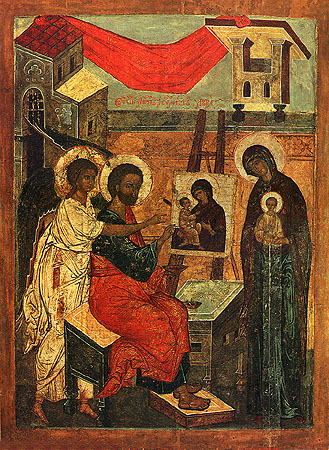
According to an ancient Eastern tradition, Luke was also the first Christian iconographer, painting the first icon of the Virgin Mary. In the legend dating from at least the sixth century, in the days after Christ’s Resurrection and Ascension, when Mary lived in the home of Saint John, Luke visited her and painted her portrait on the top of a table that Jesus had built in the workshop of Joseph in Nazareth. He listened to her stories of Jesus and later incorporated them into his Gospel. In Eastern Orthodox tradition, icons of the Hodegetria type are modeled on the prototype originally painted by Luke. Among a number of icons claiming to be painted by Luke is that known as the Salus Populi Romani in the Basilica of Santa Maria Maggiore in Rome.
According to tradition, Luke was martyred at the age of 84 in Boethia in Greece. His tomb was said to have been located in Thebes; his relics were transferred to Constantinople in 357. Stolen by the Crusaders and taken to Italy, the relics of Saint Luke are today divided into three principal parts: his body at the Abbey of Saint Justina in Padua; his head at St. Vitus Cathedral in Prague; and since 1922 one of his ribs at the traditional tomb of Saint Luke in Thebes, Greece.
Luke is the patron saint of painters, physicians, notaries, and butchers. His symbol as one of the Four Evangelists is the ox.

No comments:
Post a Comment