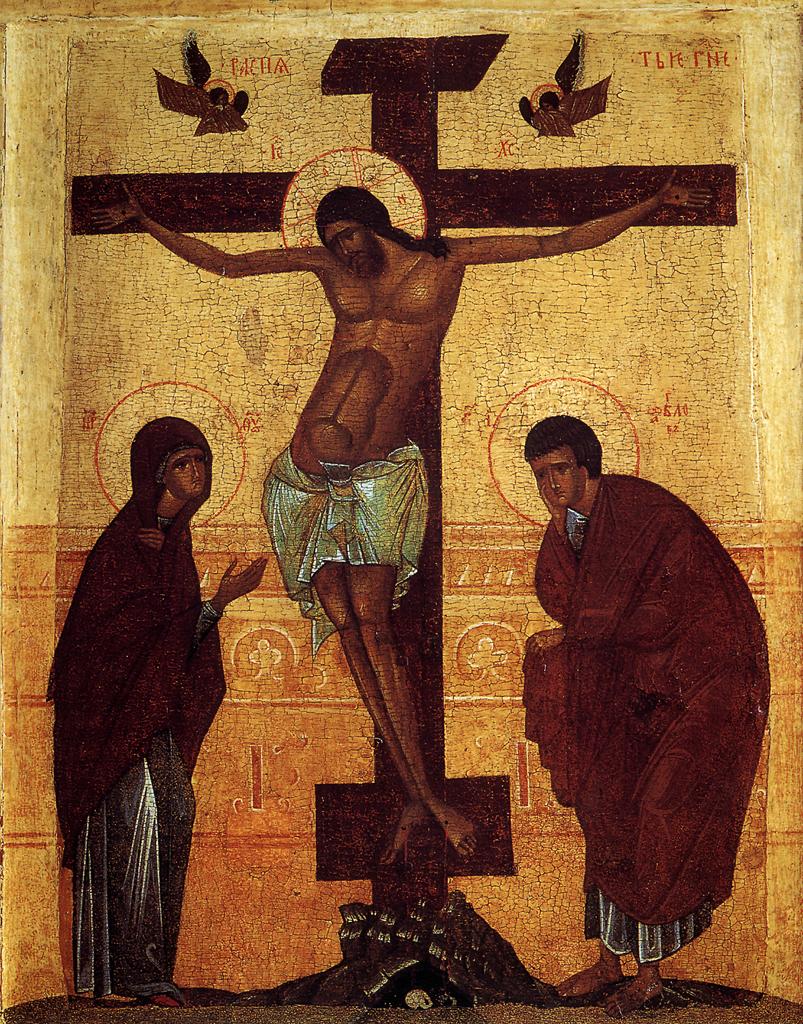
This year, the theme of our Sunday evening Lenten series was forgiveness and reconciliation. During the course of the series, we watched three movies and read one book. The book was Free of Charge, by Miroslav Volf, a professor at Yale Divinity School who was born in Croatia. And one of the movies was the French language film The Widow of Saint Pierre. So, by way of a Good Friday sermon, I want to offer some reflections on both the movie and the book.
The film is set on the island of Saint Pierre, a French territorial possession located just off the coast of Newfoundland. The year is 1850, during the short-lived Second French Republic. The movie begins with a senseless drunken murder committed one night by a drunken fisherman, Neel Auguste.
After his arrest, Neel is sentenced to death. Since there is no guillotine on the island, however, the island authorities must send to France for one before the execution can be carried out. And it will take months and months for a guillotine to be shipped to Saint-Pierre.
In the meantime, Neel is delivered into the custody of the local army captain. Skeptical that the guillotine will ever arrive, his wife takes an interest in rehabilitating the convict. She soon has Neel doing odd jobs all over the island – fixing roofs and such – so that he becomes popular, well-loved, and apparently forgiven. It also turns out that Neel has several children by one of the women on the island, and the captain’s wife arranges for the local priest to solemnize their marriage.
Meanwhile, the island authorities grow increasingly nervous, knowing that Neel’s new-found popularity could cause them problems when the guillotine finally arrives. But the law must be upheld. They try alternatively bullying and cajoling the Captain to restrain his wife’s activities on behalf of Neel. But the Captain, deeply devoted to his wife, refuses to rein her in and insists that the prisoner is his responsibility, not theirs.
In one revealing scene, the captain’s wife explains to Neel the philosophy of what she’s doing. He was drunk when he committed the murder, but since he no longer drinks, he’s changed. People can change, so they ought to be given second chances. Yet the expression on Neel’s face betrays skepticism of such a simplistic and facile explanation.
When a guillotine finally arrives from Martinique, it becomes clear that even though the islanders have forgiven him, Neel has not forgiven himself. Deep down, he believes that he must pay the penalty of his crime. He refuses to take advantage of an opportunity to escape to Newfoundland; and when the islanders initially refuse to unload the ship’s cargo, Neel himself enlists for the work because the money he earns will go to support his wife and children once he’s dead.
Meanwhile, on account of his defiance of the island authorities, the Captain is sent back to France where he’s court-martialed and executed by firing squad for mutiny. And on Saint-Pierre, Neel is finally executed as well.
It’s a disturbing movie, devoid of any explicitly religious message. But if I read it correctly, the deaths of both Neel Auguste and the Captain have a dimension of redemptive self-sacrifice. Rather than escape, Neel Auguste chooses to accept the death penalty to expiate the guilt of his crime, and in the process he’s able to bequeath a small inheritance to his survivors. Similarly, the Captain loves his wife so much that he accepts death willingly to pay the price of her transgression and testing the limits of what was acceptable to the island’s authorities and their sense of the demands of outraged justice.
As I watched the movie and reflected on it afterwards, I couldn’t help wishing that someone had told Neel Auguste that he didn’t have to die to expiate the guilt of his crimes, because Christ had already done that for him on the cross. He was already forgiven by God on account of the death of Christ. His faith in that assurance might not have altered the outcome of the story – the wheels of temporal justice would likely have turned inexorably anyway. But then he could at least have faced his death in the confidence that his sins were forgiven, his guilt taken away.
At some level, Neel understood what the Captain’s wife did not: that true forgiveness is always costly. In the book Free of Charge, Miroslav Volf makes it clear that to forgive is not to excuse or overlook wrongdoing. If I forgive you for some injury you’ve caused me, I am simultaneously condemning what you’ve done as wrong, and also saying that I’m not going to hold it against you. And that kind of forgiveness is costly, because it requires me to bear the injury, to absorb the offense, and to let go of the natural desire for compensation or retribution.
Yet Volf is also clear that as Christians we’re called to forgive others their trespasses because God has forgiven ours. When someone injures or offends us, we cannot withhold our forgiveness once we learn to see that person as a sinner for whom Christ died, someone who stands forgiven by God in Christ. And just as forgiveness is costly to us, so it’s costly to God, for it entails the sacrifice of the cross.
Volf does a good job of making clear that Christ’s death on the cross is not the unjust punishment of an innocent victim to make satisfaction for human sin. Rather, because Jesus Christ is the Incarnate Second Person of the Holy Trinity, by dying on the cross God himself bears the burden of our sins and absorbs our offenses. Volf writes: “the one who was offended bears the burden of the offense” (p. 145).
And yet, because Christ is not only truly God but also truly human, his death pays the price of human sin. In his First Letter to the Corinthians, Saint Paul writes: “One has died for all; therefore all have died.” Volf expands on this idea: “Now we see that we were also in Christ. What happened to him happened to us. When he was condemned, we were condemned. When he died, we died” (p. 147). The upshot is that our sinful natures have been crucified with Christ; we’re separated from the guilt of our sins; and we’re set free from the power of sin itself.
Such is the power of the cross in the life of the Christian. It’s the sign of the forgiveness of our sins in virtue of Christ’s sacrifice on our behalf. So, unlike Neel Auguste in The Widow of Saint-Pierre, we don’t need to die to expiate the guilt of our sins, because we’ve already died in Christ. And insofar as we accept God’s forgiveness, we can rest assured that Christ has taken away our guilt. We’re set free to live in the power of Christ’s resurrection, to live in Christ and to have the risen Christ live in us as the source of our life. But that is to get ahead of the story, which we’ll pick up again tomorrow evening and on Sunday morning.

No comments:
Post a Comment