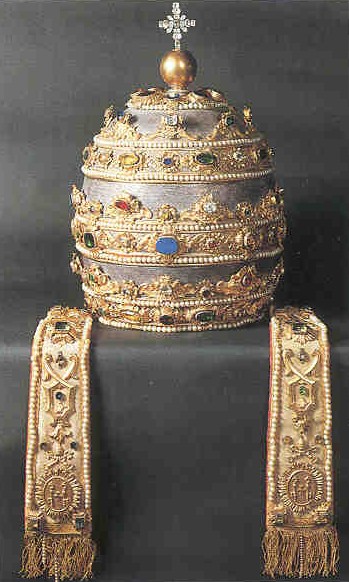
When Pope Francis is inaugurated on Tuesday, one item almost certain to be missing from the ceremony is the papal tiara, the beehive-shaped Triple Crown. From the twelfth century until well into the twentieth, the papal inauguration was actually a coronation. But the last Pope to be crowned with the tiara was Paul VI in 1963. Later in the same year, at the end of the second session of the Second Vatican Council, Pope Paul descended from the papal throne, and laid his tiara on the High Altar in a dramatic gesture of renunciation of temporal power and glory. It was later announced that the tiara would be sold and the proceeds given to the poor. As it happened, Roman Catholics in the United States bought the tiara, which is now on display in the National Shrine of the Immaculate Conception in Washington D.C.
At one level, Pope Paul’s gesture calls attention to a perennial issue in the life of the Church: the tradeoff between earthly riches, and the Gospel mandate to give to the poor. In one place in the Gospels, our Lord tells the rich young man, "If you would be perfect, go, sell what you possess and give to the poor, and you will have treasure in heaven; and come, follow me." But then in today’s Gospel, after Mary of Bethany anoints our Lord's feet with costly ointment, Judas issues the challenge, “Why was this ointment not sold for three hundred denarii and given to the poor?” and Jesus rebukes him, ‘Let her alone … The poor you have always with you, but you do not always have me.”
Judas’s objection is not unreasonable. Mary’s gesture is certainly costly. A denarius is a day’s wage, so a jar of ointment valued at 300 denarii is worth the best part of a year’s wages. Moreover, Mary’s actions are as extravagant as the ointment is expensive. Anointing his feet and wiping them with her hair borders on scandalous impropriety in a culture where men and women are supposed to keep their distance and certainly not touch one another. What’s going on?
Mary’s action becomes intelligible in light of the preceding events in the narrative of John’s Gospel. Remember, this Mary is the sister of Martha and Lazarus. And today’s episode follows on directly our Lord’s raising Lazarus from the dead.
To recapitulate the main points of that story, Jesus and the disciples withdrew across the Jordan because a mob in Jerusalem was on the verge of stoning him, and the Jewish authorities tried to arrest him. When Jesus received word that his friend Lazarus was ill, he waited three days and then announced his intention to go to him. Since Bethany was only two miles from Jerusalem, however, the disciples reminded Jesus of the danger; and ultimately Thomas said, “Let us also go, that we may die with him.”
So, it was enormously risky for Jesus and the disciples to return to Judea. Then, after the raising of Lazarus, the dangers multiplied. For in John’s Gospel it was this miracle that precipitated the decision of the Council, the Sanhedrin, to do away with Jesus. The chief priests and the elders asked: “What are we to do? For this man performs many signs. If we let him go on thus, everyone will believe in him and the Romans will come and destroy both our holy place and our nation.” And the High Priest Caiaphas responded, “It is expedient for you that one man should die for the people, and that the whole nation should not perish.”
When today’s Gospel begins, then, Jesus is already a man marked for death. The authorities are trying to track him down and catch him away from the crowds so they can arrest him and hand him over to the Romans for execution. Against this background, Mary’s anointing his feet has deep significance. If she’d poured the oil on his head, the symbolism would have been that of a coronation—anointing a king about to enter into his reign. But anointing the feet is characteristically something done to the dead in the Jewish rites of burial.
Our Lord’s words in today’s Gospel bear this symbolism out. But we have a slight translation problem. Our Revised Standard Version renders his words as “Let her alone, let her keep it for the day of my burial.” But another possible translation is something like, “Let her alone, for she was keeping it for the day of my burial.”
Barbara Brown Taylor points out that Mary’s action is itself prophetic, an enacted sign pointing to our Lord’s crucifixion. For it’s precisely the costliness of Mary’s offering, the selfless extravagance of her love, that anticipates the great cost that Jesus will bear on the cross out of God’s extravagant love for his creation.
One further detail: when Jesus was about to raise Lazarus from the dead and ordered the stone sealing the tomb to be removed, Mary’s sister Martha objected, “Lord, by this time there will be an odor, for he has been dead four days.” By contrast to the stench of death, however, when Mary anointed Jesus’ feet, “the whole house was filled with the fragrance of the ointment.” In the same way, our Lord’s approaching death on the cross will be a sacrifice of sweet fragrance that brings life, health, and salvation to the whole world.
None of what I’ve said really answers the question with which I began, of the trade-off between the Church’s stewardship of earthly riches and its fidelity to the Gospel mandate to give generously to the poor. I have a hunch that at times we are indeed called as the Church to do as our Lord bade the rich young man do: sell what we have, give to the poor, and have treasure in heaven. And there are times when we’re called to expend the equivalent of costly ointment of pure nard in our worship of the one Lord.
We spend a significant amount of money on our music and liturgy here at S. Stephen’s, not because we’re refined people who deserve quality entertainment, but because we believe that the worship of God demands our very best, just as Mary of Bethany gave her very best to honor her Lord. There’s a time to don the papal tiara, and a time to lay it aside. And who knows, the time may come when it will become appropriate for a future Pope to put it on again.
However we negotiate these choices, today’s Gospel suggests we’re called to do nothing by half measures. The Christian life is a life of radical generosity born of love. And we’re called to give it our all. Mary of Bethany enacts this radical generosity born of love in her anointing of our Lord’s feet, just as Jesus will soon offer himself for the whole world in his sacrifice of himself on the cross. And it’s precisely this same costly, extravagant, all-outpouring love that we’re called to make manifest in the Church today, as we follow Christ, and serve the world in his name.

No comments:
Post a Comment